Christian IV of Palatinate-Birkenfeld-Zweibrücken
Christian IV of Palatinate-Birkenfeld-Zweibrücken (16 September 1722 - 5 November 1775) was Duke of Palatinate-Zweibrücken from a cadet line of the Wittelsbachs, who ruled from 1735 to 1775. In the memory of his contemporaries he appears as the "good duke" and a patron, but his time is also associated with a close orientation towards France and with court…
Christian IV of Palatinate-Birkenfeld-Zweibrücken was born in Bischwiller in Alsace as the son of Christian III of Palatinate-Zweibrücken and Caroline of Nassau-Saarbrücken. He took the ducal throne already in 1735, when he was twelve years old, and for this reason his mother initially ruled for him as regent. Only after he was declared of age did he personally take over the rule (1740). This start is typical for small German principalities: the stability of the state often depended on the ability of a regency to maintain the running of the offices and finances until the young ruler grew up.
The upbringing of Christian IV reflected the demands of the day placed on princely elites. Part of his studies he completed in the Netherlands and subsequently he stayed at the French court, which strengthened his lifelong orientation towards France. In the milieu of the Holy Roman Empire Francophilia was not just fashion but also a political tool: small states often built their protection and prestige through ties to more powerful patrons. Christian IV belonged among rulers who sought a cultivated, representative court, and in regional memory he remained in contrast to his later, more absolutist-acting successor.
History
A notable chapter of his life is the change of confession. Under pressure from the French milieu he converted in 1758 from Lutheranism to Roman Catholicism, which had not only a personal but also a diplomatic significance. In 18th-century German lands religion was still linked to the legitimation of rule, to relations with neighbours and to where support was expected in times of crisis. Christian IV at the same time took on responsibility for the upbringing of his nephews, among others Charles II August and Maximilian Joseph, of whom the latter later became King of Bavaria. This too shows how dynastic ties of small principalities could reach into the future "great" history.
The duke's private life was unusual in that he contracted a morganatic marriage with the French dancer Marianne Camasse, later Countess of Forbach. Their children therefore had no claim to succession in the duchy, which had a direct impact on dynastic continuation and opened the way for the accession of his nephews. Christian IV died in 1775 at Pettersheim Castle; contemporary reports speak of a hunting accident, although memoirs also mention the possibility that it was rather an illness.
The duke on coins and his relation to numismatics
Christian IV of Palatinate-Birkenfeld-Zweibrücken appears in numismatics as the issuer of coins of the Duchy of Zweibrücken at a time when a number of territorial strikes operated in the German area within wider monetary agreements. On silver coins of his era the ruler's portrait and the territorial heraldry are typically used, performing two roles: they confirmed the legitimacy of the ruler and at the same time allowed the coin to be quickly recognised in circulation, where strikes from many states mingled. Auction descriptions commonly mention, for example, his thalers and conventional thalers, which belong among the sought-after types for collectors of German territorial numismatics.
For this ruler it is moreover important that the coins are a good "imprint" of 18th-century court representation: portrait, titulature and arms show how a small state wished to present itself among its larger neighbours. Combined with the duke's cultural reputation and Francophile orientation, strikes from his time thus represent not only metal and denomination, but also a visual expression of the Wittelsbach dynasty in one of its cadet branches.
In our auction and shop
- Code: RX-Z-019
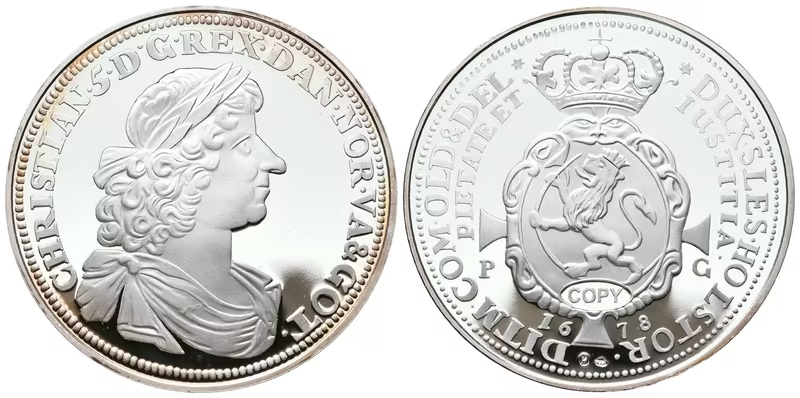
Dánsko, Speciedaler 1678 - Portrét Kristiána V., korunovaný erb s lvem - Holstein, Ditmarschen, Oldenburg, Delmenhorst, replika
Dánské království - Kristián V. (1670-1699) Speciedaler 1678 - Portrét Kristiána V., korunovaný erb s lvem - Holstein, Ditmarschen, Oldenburg, Delmenhorst Ag (.999), 40 mm (20 g), v kapsli. Stav mince odpovídá fotografii.
Skladem 1 ks - Code: RX-Z-022
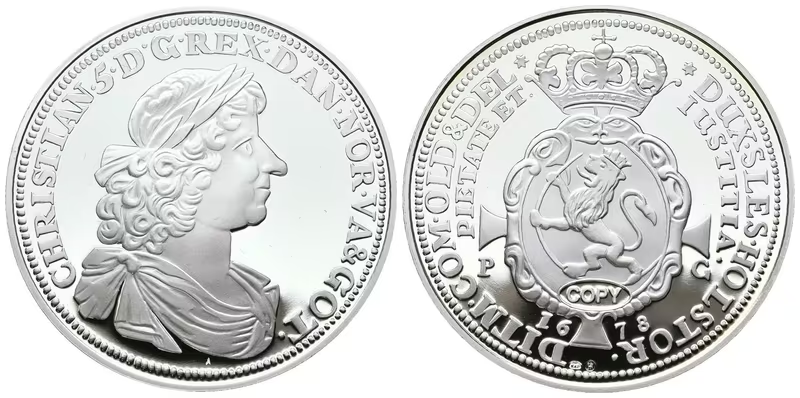
Dánsko, 1 Speciedaler 1678 - Portrét Kristiána V. / Korunovaný dánský erb se lvem, replika
Dánské království - Kristián V. (1670-1699) 1 Speciedaler 1678 - Portrét Kristiána V. / Korunovaný dánský erb se lvem Ag (.999), 40 mm (20 g), v kapsli. Stav mince odpovídá fotografii.
Skladem 1 ks - Code: RX-Z-012
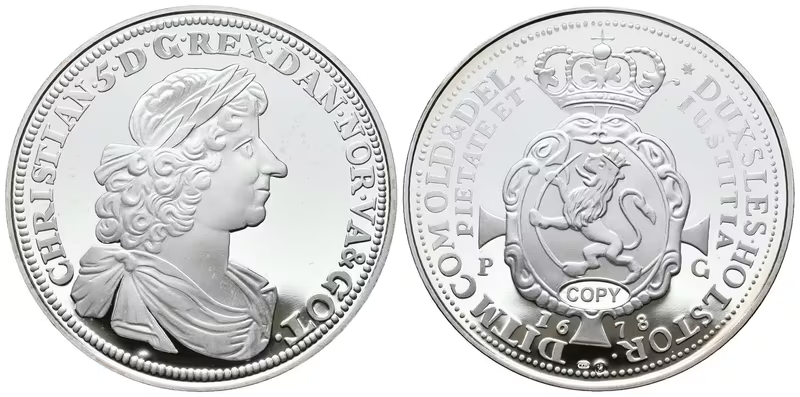
Dánsko, Speciedaler 1678 - Portrét panovníka / Korunovaný dánský lev, replika
Dánské království - Kristián V. (1670-1699) Speciedaler 1678 - Portrét panovníka / Korunovaný dánský lev Ag (.999), 40 mm (20 g), v kapsli. Stav mince odpovídá fotografii.
Skladem 1 ks - Code: RX-Z-013
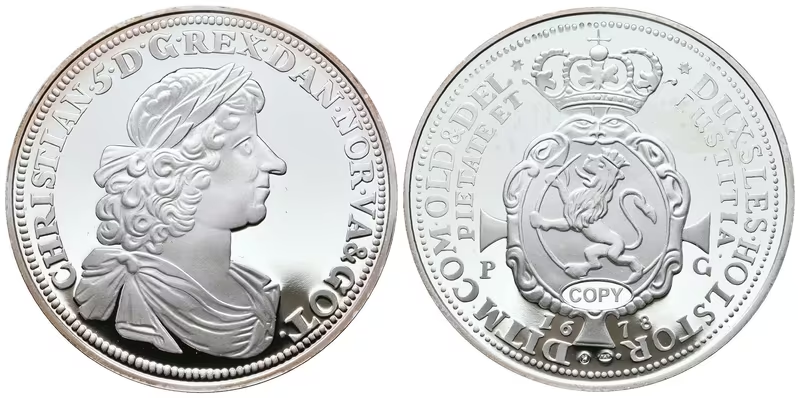
Dánsko, Speciedaler 1673 - Portrét Christiana V., dánský státní znak, replika
Dánské království - Kristián V. (1670-1699) Speciedaler 1673 - Portrét Christiana V., dánský státní znak Ag (.999), 40 mm (20 g), v kapsli. Stav mince odpovídá fotografii.
Skladem 1 ks