Claudius II
Claudius II Gothicus (214–270 AD) was a Roman emperor in the period of the third-century crisis, who during his short reign defeated the Goths in the decisive battle at Naissus and temporarily stabilised the disintegrating empire. His antoniniani with the inscription DIVO CLAVDIO rank among the most common ancient coins on account of the massive posthumou…
Marcus Aurelius Claudius came from Illyria, probably from Dalmatia or Pannonia. We know little of his early life; he began his career as a common soldier under the reign of Gallienus. Thanks to military abilities he advanced quickly and became commander of the cavalry, the elite corps of the reformed army. According to some accounts he participated in the conspiracy against Gallienus in 268, although he denied it. After Gallienus was assassinated during the siege of Mediolanum, Claudius was proclaimed emperor by the army. The Senate confirmed his election with relief, because Claudius promised to respect senatorial privileges, unlike his predecessor.
Claudius inherited the empire in a critical state — the Gallic Empire controlled the west, Palmyra ruled the east, barbarian tribes ravaged the borders. His priority was defence against the Goths, who with a vast coalition of Heruli and Peuki invaded the Balkans. In 269 he clashed with a barbarian army numbering reportedly 320,000 warriors (the number is certainly exaggerated) at Naissus (present-day Niš). In this greatest battle of the third century Claudius crushed the barbarian coalition. According to reports, 50,000 of the enemy fell, the rest were scattered. The victory earned him the cognomen Gothicus Maximus and temporarily halted the barbarian invasions.
History
After the victory at Naissus, Claudius continued to clear the Balkans of remnants of Gothic bands. He also planned campaigns against Palmyra and the reunification of the empire. In 270, however, a plague epidemic broke out (probably smallpox or typhus) in his camp at Sirmium. Claudius became infected and died after a brief illness. Before his death he reportedly designated Aurelian as his successor, thereby ensuring the continuation of the restoration of the empire. The Senate deified him as Divus Claudius, one of the last officially deified emperors.
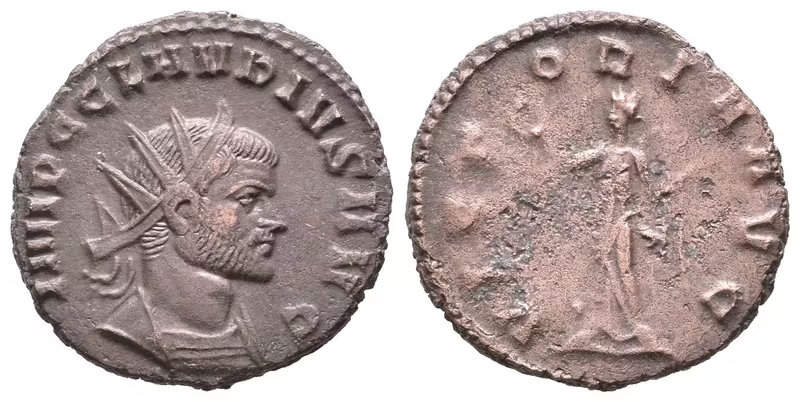
Claudius struck coins in all the main mints of the empire — Rome, Mediolanum, Siscia, Cyzicus. His antoniniani (double denarii) contained only 2–3 per cent silver, which reflected the economic crisis. On the obverse is the emperor's portrait with a radiate crown and the inscription IMP CLAVDIVS AVG. The reverses celebrate his military successes — Victoria with a wreath, Mars as avenger, Virtus (bravery). After the victory at Naissus, coins were struck with the inscription VICTORIA GOTHIC celebrating the defeat of the Goths.
The coinage of Claudius II
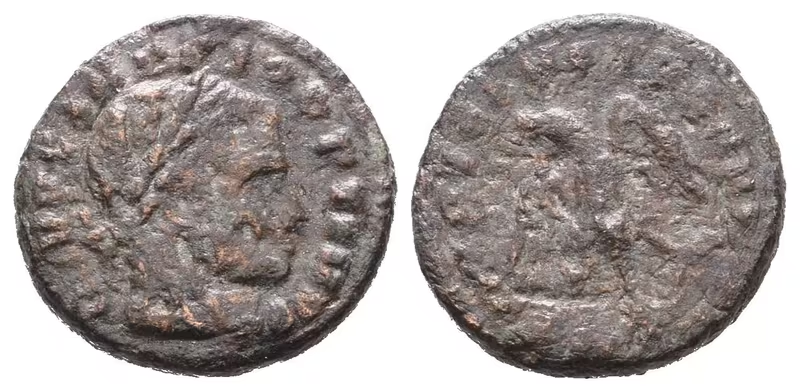
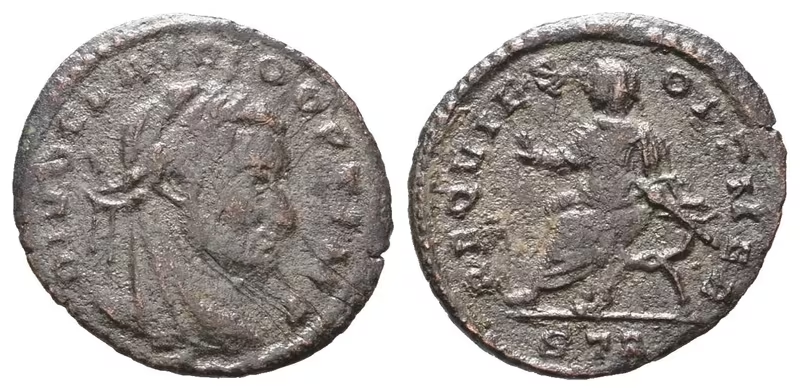
Most widespread are the posthumous consecration coins DIVO CLAVDIO struck by Aurelian. These antoniniani with an eagle or an altar on the reverse were produced in millions of pieces. Aurelian thereby legitimised his reign as the continuation of Claudius's. The quality of these coins is often poor — rough striking, low silver content. There are over 30 variants of these posthumous strikes. Paradoxically they are today more common than coins struck during Claudius's lifetime. Claudius also struck rare gold aurei and bronze sesterces, which are very rare. His coinage documents the military character of his reign and the economic crisis of the period of military anarchy.
In our auction and shop
- Code: BE104-0112New
Claudius II. Gothicus, antoninián, Řím, RIC 112
Claudius II. Gothicus (268 - 270) mincovna Řím, posmrtná pamětní ražba za Konstantina I. Velikého (317 - 318), DIVO CLAVDIO OPTIMO, orel s hlavou doleva, RIC 112
Skladem 1 ks - Code: BE104-0207
Claudius II. Gothicus, antoninián, Trevír, RIC 207
Claudius II. Gothicus (268 - 270) mincovna Trier, posmrtná pamětní ražba za Konstantina I. Velikého (318), DIVO CLAVDIO OPTIMO, císař na trůně, RIC 207
Skladem 1 ks - Code: BE104-0104
Claudius II. Gothicus, Aantoninian, RIC 104
Claudius II. Gothicus (268 - 270) raženo 268-269 ve městě Římě, Rev. VICTORIA AVG, kráčející Viktorie s věncem a palmovým listem, RIC 104
Skladem 1 ks