Darmstadt
Darmstadt is a city in the German federal state of Hesse, lying on the edge of the Odenwald mountains south of Frankfurt am Main. It is famed as the former residential city of the Hessian landgraves and grand dukes, and also as one of the main centres of German Jugendstil, linked with the artists' colony at Mathildenhöhe.
Darmstadt is documented in written sources from the Middle Ages, and its significance for a long time was tied to its position on the edge of the fertile region of the Upper Rhine Plain and within reach of important country roads. From an originally small settlement it gradually grew into a town with an administrative function and with growing craft and commercial activity. The key turning point came in the late Middle Ages and early modern period, when Darmstadt began to be more markedly associated with the House of Hesse. In the 16th century it became the seat of the Hesse-Darmstadt line, which gave the town the character of a residential centre: court institutions, administrative offices and building projects arose here, intended to underscore the prestige of the ruler and the representation of the state.
In the 17th and 18th centuries Darmstadt further strengthened its role as the administrative and cultural centre of a smaller but ambitious German state. The court supported learning, music and art, and the town gradually developed in urban planning as well. Early modern Europe was meanwhile a period of frequent wars and crises that also affected the Hessian lands, so urban growth was not even. Nevertheless, Darmstadt retained the stability of a residential city in which state administration, military infrastructure and the court economy were concentrated, creating job opportunities and demand for crafts.
A fundamental transformation came at the turn of the 18th and 19th centuries in connection with the Napoleonic era and the reorganisation of the German lands. Hesse-Darmstadt was elevated to a grand duchy, by which Darmstadt became the metropolis of the Grand Duchy of Hesse. This change strengthened the administrative importance of the city and brought new institutions, representative buildings and the modernisation of public space. In the 19th century the city was also affected by industrial development: infrastructure and transport links expanded and new businesses arose. Darmstadt thus gradually changed from a purely court centre into a modern city with a broader economic base.
History
A very prominent chapter, still recalled today, is the period around 1900, when Darmstadt became one of the focal points of German Jugendstil. The artists' colony at Mathildenhöhe brought together architecture, design, applied arts and the idea of a modern way of life. Thanks to this, the city entered cultural history as a place where new forms of living, artistic expression and public space were experimented with. This layer of identity is characteristic of Darmstadt to this day: it is not just "another German city" but a centre that at a certain time became a laboratory of modern aesthetics.
In the 20th century the city went through dramatic upheavals, including war damage and post-war reconstruction. After the Second World War Darmstadt developed once more as a regional centre and at the same time strengthened its role in science and education. Gradually it asserted itself as a city of universities, research and technology, building on the long tradition of institutional infrastructure that it had acquired as the residential and administrative metropolis of Hesse.
Darmstadt as a residential city was long connected with the state administration and financial economy of the Hessian state. In practice this meant that here precisely were concentrated the institutions that decided on taxes, expenditures and the organisation of economic life. In the German lands, where many states and monetary customs existed alongside one another, such centres were also significant for the circulation of coins: the town market, offices and army needed sufficient currency and reliable rules for payments. Hence the history of money and coinage of Hesse is also indirectly linked with Darmstadt, although specific mintages and mint marks are associated rather with the particular mints of the given state.
Significance of the city and connections with coins
Today Darmstadt is known as a cultural and technological centre with striking architecture and the legacy of Jugendstil. For the visitor it is attractive precisely because of this contrast: on the one hand the tradition of a residential city, on the other modern scientific institutions and a lively university environment. In the European context Darmstadt thus represents a type of city whose significance rests not on a single "famous event" but on the long continuity of administration, culture and modernising ambitions.
In our auction and shop
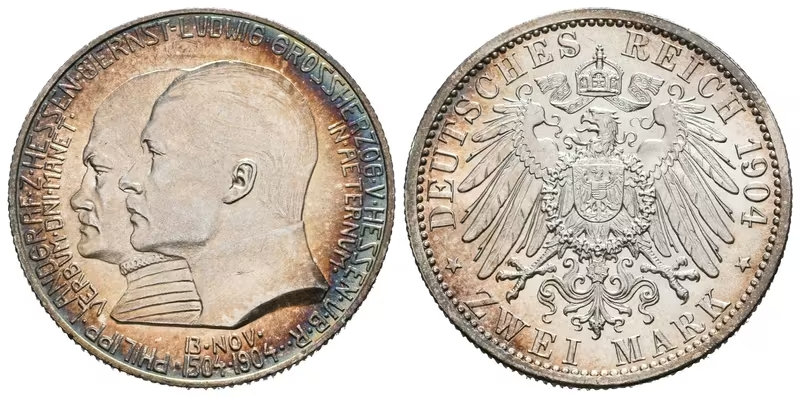
- Code: NBHES-BZ1904
Hesensko, 2 Marka 1904 - Pamětní
Hesse-Darmstadt, Ludwig III. (1848 - 1877) 2 Mark 1904 A - K 400. výročí narození Philippa I. Velkodušného , KM.372, J.74 (Vyrařeno 100 000 ks), luxusní zachovalost, ražební lesk, patina, drobné rysky_R!
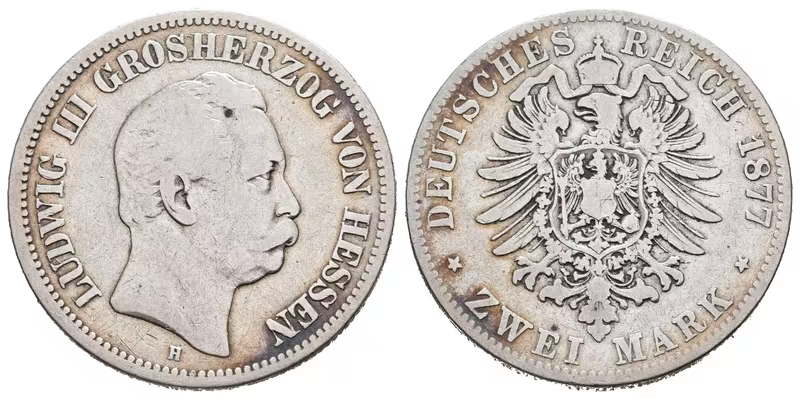
Skladem 1 ks - Code: NBHES-BZ1877
Hesensko, 2 Marka 1877
Hesse-Darmstadt, Ludwig III. (1848 - 1877) 2 Mark 1877 H, Darmstadt, KM.355, J.66, oběhová zachovalost (Vyraženo 338 000 ks)
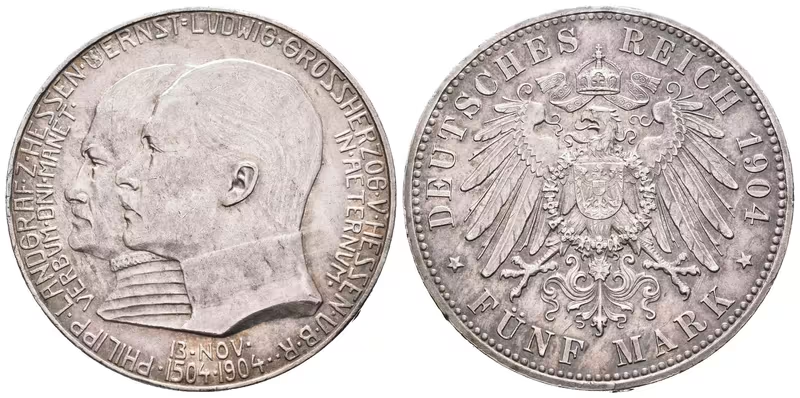
Skladem 1 ks - Code: NBHES-CX1904.1
Hesensko, 5 Marka 1904 - Pamětní
Hesse-Darmstadt, Ernst Ludwig (1892 - 1918) 5 Mark 1904 A, Berlín - K 400. výročí narození Philippa I. Velkodušného, KM.373, J.75 (Vyraženo 40 000 ks), krásná zachovalost, lesk, patina, rysky a drobné hranky
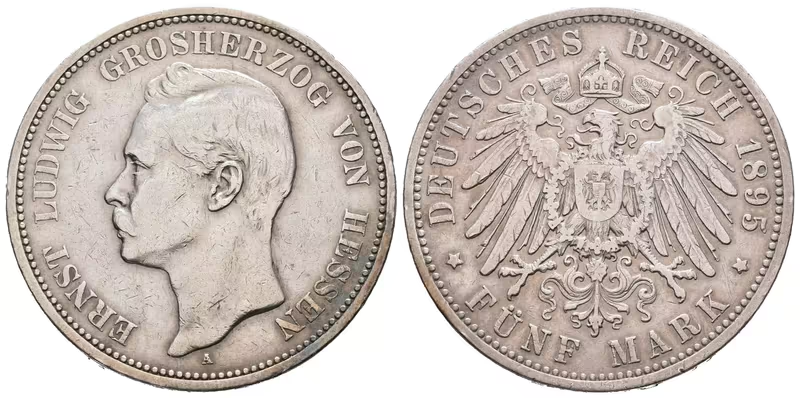
Skladem 1 ks - Code: NBHES-CX1895
Hesensko, 5 Marka 1895
Hesse-Darmstadt, Ernst Ludwig (1892 - 1918) 5 Mark 1895 A, Berlín, J. 73, KM.369, patina, rysky a drobné hranky, oběh (vyraženo 39 000 ks)_R!
Skladem 1 ks