Denier
The denier (from the Latin denarius) is a silver coin which the Frankish king Pepin the Short introduced around 755 as the basis of a new monetary system and which his son Charlemagne reformed in 793–794 into the form of an empire-wide standard. The denier became, during the 8th to 13th centuries, the main silver coin in circulation in western and central…
The reform of Pepin the Short took place at a time when early medieval Europe was dealing with a chronic shortage of gold coins, and when the gold reserves of the Mediterranean were being drawn off, among other things, by demand for silk along the Silk Road. Pepin opted for a silver standard, which better matched the European deposit possibilities north of the Alps, and he established that from one Carolingian pound (about 408 g) of silver, 240 denarii were to be struck at a theoretical weight of approximately 1.7 g and a purity of roughly 94%. The coin bore on the reverse the ruler's monogram and, after the reform of 794, also the name of the mint — at one point about sixty are recorded in the Carolingian empire.
The reform of Pepin the Short
Charlemagne, by the reform of 794 (sometimes dated 793 in the sources), unified the minting across the empire: the ruler's monogram CARLVS REX FR, a uniform weight of approximately 1.70 g, a purity of about 95 to 96% silver and control over minting as an exclusive royal prerogative. From this reform the whole monetary logic of medieval Europe follows: only the denier was actually struck as a physical coin, while the solidus and the pound remained for centuries mere accounting units. Higher silver denominations — grossus, gros tournois, the Prague groschen, the English groat — only began to be struck from the 13th century onwards, when developing trade could not do without more convenient denominations.
The Carolingian reform of 794 and the LSD system
The Carolingian model of the denier spread far beyond the borders of France. The Anglo-Saxon king Offa of Mercia around 790 took over the Carolingian model and began to strike the English penny, which holds to Pepin's standard both in weight and in the accounting system. In Italy the denier developed into the denaro — the basis of the later Italian lira. In Germany the denier went through linguistic adaptation into the form pfennig (heller) and in some regions into the form groschen after the 13th-century reform. In Spain from the same root arose the dinero, in Portugal the dinheiro, in Poland the denar, in Bohemia the denár (the young Boleslavs, Břetislav I), in the Balkans the dinar, in the Levant the Crusader denier after the Fourth Crusade, and in Cyprus the denier of the Cypriot kingdom. The common etymology and structure show how strongly the Carolingian reform defined European monetary practice up to the early modern period.
Spread across Europe
The denier underwent gradual debasement over the long medieval period. Key milestones: in the 12th century French minting practice was reducing purity to about 80%, in the 13th century below 50%, and in the 15th century the French denier tournois contained only around 25% silver. This debasement was linked to the growing fiscal needs of the rulers, to the depletion of silver deposits and to competition from newer, higher-quality coins such as the gros tournois (1266) and the Venetian groat. In most countries of Europe the denier ceased to function as a real coin sometime between the 14th and 16th centuries, but in some places the name survived as an accounting unit much longer — in England the penny–shilling–pound system functioned until 1971.
Gradual debasement
For numismatics the denier is a watershed coin for three reasons. First, it defined the European silver standard, which replaced the late-antique gold coinage of the Roman and Byzantine empires and adapted monetary affairs to the availability of precious metals north of the Alps. Second, it created an accounting structure that linked England, France, the Empire, Italy and the Central European monarchies into one compatible system. And third, it gave its name to a whole range of modern currencies: the English penny, the French denier, the Italian denaro, the German pfennig, the Serbian dinar and others are direct descendants of the Carolingian reform. Collectors' originals of Carolingian denarii of Charlemagne, Louis the Pious and Charles the Bald are among the most sought-after early medieval European mintages and form a border field between archaeological numismatics and the collector market value.
Numismatic legacy
In our auction and shop
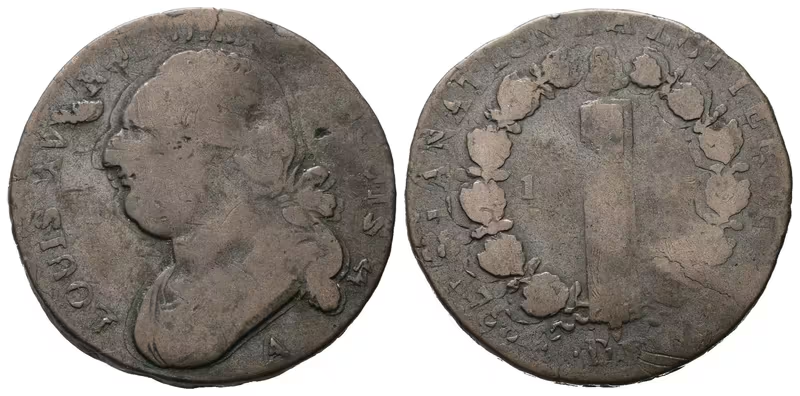
- Code: SFRA91-BC1792
Francie, 12 Denier 1792
Francie, Ludvík XVI. (1774 - 1792), konstituční monarchie 12 Deniers 1792 BB, KM.601
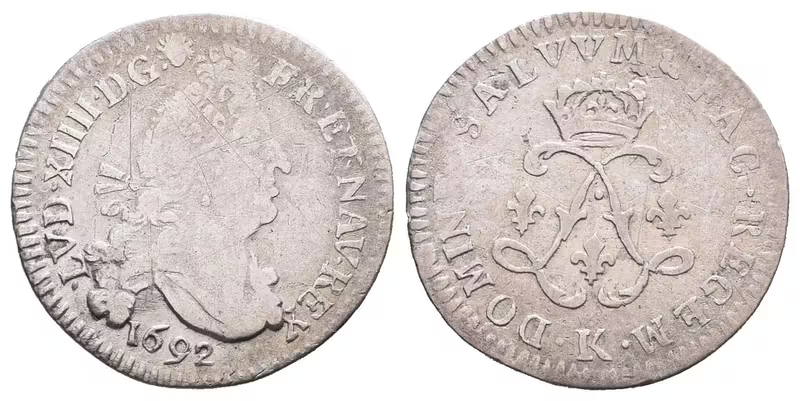
Skladem 1 ks - Code: SFRA89-K1692K
Francie, 4 Sol 1692 K
Francie, Ludvík XIV. (1643 - 1715) Quadruple sol aux deux L a 2 Deniers (4 Sols 2 Deniers) 1692 K, Bordeaux, KM.281, Ciani.1959, Dup.1519, pěkná zachovalost a patina, rysky
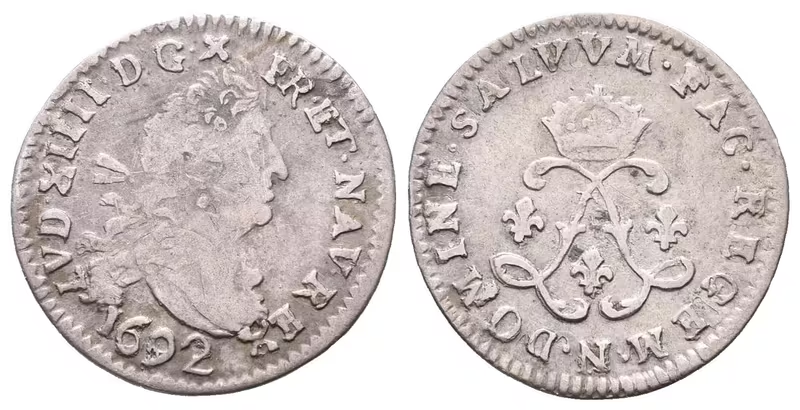
Skladem 1 ks - Code: SFRA89-K1692N
Francie, 4 Sol 1692 N
Francie, Ludvík XIV. (1643 - 1715) Quadruple sol aux deux L a 2 Deniers (4 Sols 2 Deniers) 1692 N, Montpellier, KM.281, Ciani.1959, Dup.1519, pěkná zachovalost a patina, zbytky lesku, drobné rysky
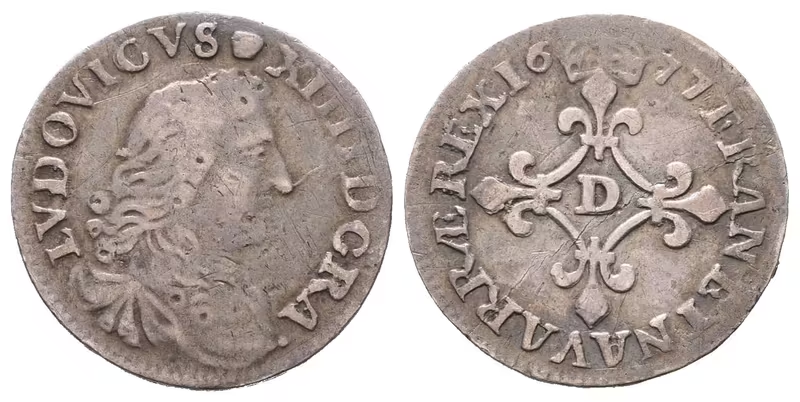
Skladem 1 ks - Code: SFRA89-K1677D
Francie, 4 Sol 1677 D
Francie, Ludvík XIV. (1643 - 1715) Quadruple sol dit "des Traitants" (4 Sols 2 Deniers) 1677 D, Lyon, Ciani.1957, Dup.1504, patina, rysky