The Silk Road
The Silk Road is the traditional name for an extensive network of trade and cultural routes which, from the second century BC to the middle of the fifteenth century, connected China with the Mediterranean via Central Asia, Iran and the Levant. The term in its present sense was introduced by the German geographer and traveller Ferdinand von Richthofen in 1…
The beginning of regular trade between the Chinese Han Empire and the empires to the west is historically associated with the mission of the Chinese diplomat Zhang Qian, dispatched in the 130s BC by Emperor Wu to forge an alliance against the nomadic Xiongnu. After Zhang Qian's return the imperial court learned of the existence of the Ferghana horses, of the Parthian and Greco-Bactrian states, and the way was opened for state-supported trade. The network then went through periods of expansion and decline depending on the political stability of key sections; it reached its peak under the Chinese Tang dynasty (618–907) and later under the unified Mongol Empire in the thirteenth century, when the so-called Pax Mongolica guaranteed the safety of caravans along a great part of the entire route.
Origin and historical framework
The main land branch connected the Chinese capital of Chang'an (modern Xi'an) via the Tarim Basin, the Pamirs, Sogdiana, Khorasan, Persia, Mesopotamia and Anatolia with the coast of the Mediterranean Sea; various sources give a length of approximately 6,400 to 8,000 kilometres, depending on whether only the core or also its side branches are counted. The southern branch led across the Hindu Kush passes into India, the northern branch followed the steppe belt north of the Tian Shan. The pivotal role fell to traders and intermediaries—Sogdians, Persians, Jews from the Khazar empire, later Arabs and the Italian republics of Genoa and Venice—who in caravanserais and oasis cities such as Samarkand, Bukhara, Kashgar, Merv or Palmyra took over the goods and sold them on. The road thus never served a single empire; its longevity depended on the balance among the Iranian, Chinese, Central Asian and European hegemons.
The route and the empires it connected
From China there travelled westwards above all silk, tea, porcelain, paper and later gunpowder; to the east went horses, camels, glass, precious stones, spices, ivory, wool and, not least, gold and silver. It was precisely the precious metals that played a critical role in the balance of the road, since Roman and later Byzantine demand for silk created a constant outflow of coinage silver and gold to the east; Roman authors such as Pliny the Elder complained of this outflow, and in his Historia naturalis he estimated the annual outflow of capital from the Roman Empire to the east at fifty million sesterces. In China, by contrast, Roman and Parthian coins accumulated, and subsequently Sasanian drachmas, which served not only as a means of payment but also as a prestigious store of value.
Commodities, coins and monetary exchange
The decline of the Silk Road was gradually determined by geopolitical changes. The fall of the Mongol Empire in the fourteenth century restored the fragmentation of key sections; the Black Death interrupted the caravan trade in the 1340s; after 1368 the Chinese Ming dynasty chose a more isolationist policy, and in 1453 the conquest of Constantinople by the Ottoman Turks closed off the last secure access to the Mediterranean. European maritime expansion, initiated by the Portuguese voyage of Vasco da Gama to India in 1498 and the Spanish voyage of Christopher Columbus to America in 1492, opened cheaper maritime trading routes, and the classical land Silk Road ceased to be economically competitive. Since 1988 UNESCO has run the Silk Roads programme as a shared world cultural heritage, and from 2014 part of the north-western Chinese and Central Asian section has been entered on the World Cultural Heritage List.
Decline and the maritime alternative
For numismatics the Silk Road represents one of the best-documented examples of cross-border circulation of coins in antiquity and in the Middle Ages. Along the route archaeologists find Roman silver denarii and aurei, Byzantine gold solidi including coins of Justin II in Sui-period Chinese tombs in Shanxi province, Sasanian drachmas in caravan hoards in Central Asia, Chinese coins of the Kaiyuan Tongbao type, and Kushan coins in gold issues from present-day Afghanistan. Bronze coins of Constantius II (337–361) have been found at Karghalik in Xinjiang; Sasanian silver functioned alongside silk as an internationally accepted means of payment, and in some Chinese oases a mixed circulation of Persian and local issues can be demonstrated as late as the eighth century. The road thus plays in the history of money the role of the first truly intercontinental exchange: the journey of a coin from Rome to a tomb in Shanxi is documented evidence that the concept of cross-border trade and long-distance circulation of precious metals has been functioning for at least two thousand years.
Numismatic significance
In our auction and shop
- Code: ZSCINA-1996
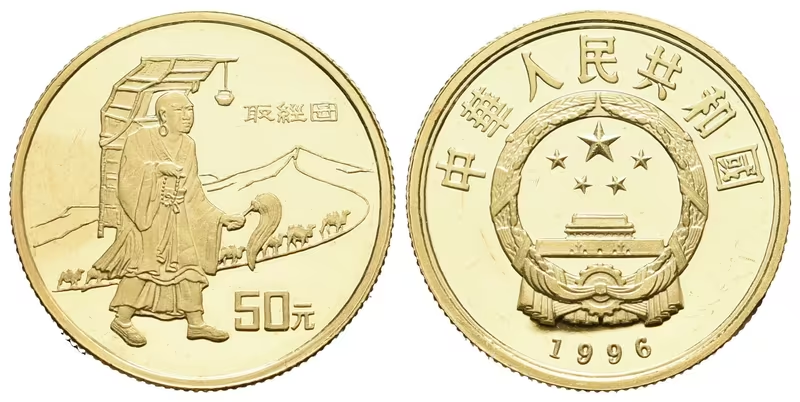
Čína, 50 Yuan 1996 - Hedvábná stezka
Čína (China) 50 Yuan 1996 - Hedvábná stezka, poutník Xuan Zang Au 0,916, 23 mm (11,32 g), 10,37 g fein, Friedb. 167, KM. 975, Proof 50 Yuan 10.37 g fine, 1996. Silk Road - Pilgrim Xuan Zang. Friedb. 167, KM. 975