Long coin (dlouhá mince)
The long coin (dlouhá mince) is the historical designation for debased coin strikes produced in Bohemia and Moravia during the operation of the mint consortium led by Hans de Witte between 1621 and 1623. The term expressed the protracted process of determining the real value of these low-quality means of payment with drastically reduced precious-metal con…
The concept of the long coin arose in the dramatic period at the beginning of the Thirty Years' War, when the Habsburg monarchy was desperately seeking financial resources to wage the conflict. After the defeat of the Bohemian Estates at the Battle of White Mountain in 1620, a consortium of entrepreneurs led by the Dutch financier Hans de Witte obtained the monopoly on the striking of coins in the Bohemian lands. Members of the consortium included influential figures such as Albrecht of Wallenstein, Pavel Michna of Vacínov and Karel of Liechtenstein.
The system functioned on the principle of leasing the minting regalia - the consortium paid the sovereign fixed sums and generated profit by reducing the silver content of the coins while maintaining the nominal value. While the high-quality prewar coins had contained 70-80% silver, the new strikes often had only 20-30% pure metal. The rest consisted of copper and other cheap admixtures, which led to the coins quickly tarnishing and corroding.
The designation "long" was linked to the complicated calculation of the real purchasing power of these means of payment. Merchants had to convert rates in complex ways, because the nominal value did not correspond to the actual content of precious metal. Transactions stretched out into long negotiations over the rate at which to accept debased coins. Extensive rate tables were produced and changed daily according to current confidence in the currency.
History
In parallel, the term Kipper coinage became established, derived from the German kippen, wippen - to tip, to wobble. The metaphor captured the instability of the monetary system, when the value of money fluctuated dramatically. The German designation Kipper und Wipper became a synonym for the speculators and forgers who profited from the monetary chaos. These individuals bought up high-quality old coins, melted them down and struck new ones with minimal silver content.
The situation culminated in the monetary catastrophe of 1623. Inflation reached astronomical levels - the prices of basic foodstuffs rose tenfold. Emperor Ferdinand II was forced to proclaim on 13 December 1623 the kalada - in effect a state bankruptcy linked with a radical monetary reform. All Kipper coins were declared invalid or drastically devalued. The consortium was dissolved and de Witte committed suicide.
The kalada was followed by the restoration of coinage of good standard - strikes with guaranteed content of high-quality silver. The new coins were to restore confidence in the currency, but the process of stabilisation took several years. The economic damage caused by the long coin lasted for decades and contributed to the economic devastation of the Bohemian lands during the Thirty Years' War.
Economic consequences and mechanisms
The system of the long coin represented a refined form of state-organised inflation. The sovereign obtained immediate revenue from leasing the minting rights, while the economic damage was borne by his subjects. The consortium profited from the difference between the nominal value and the actual costs of producing the debased coins.
According to Gresham's Law, bad money drove good money out of circulation - high-quality old coins were hoarded or exported abroad. Only debased strikes remained in domestic circulation. This led to the collapse of the monetary economy and a return to barter in many regions.
The phenomenon of the long coin documents the social stratification of the crisis. The nobility and wealthy townsmen managed to preserve the value of their property in real estate and precious metals. The middle classes, dependent on monetary income, were decimated. The poorest classes paradoxically suffered the least - they operated mostly in a barter economy.
In our auction and shop
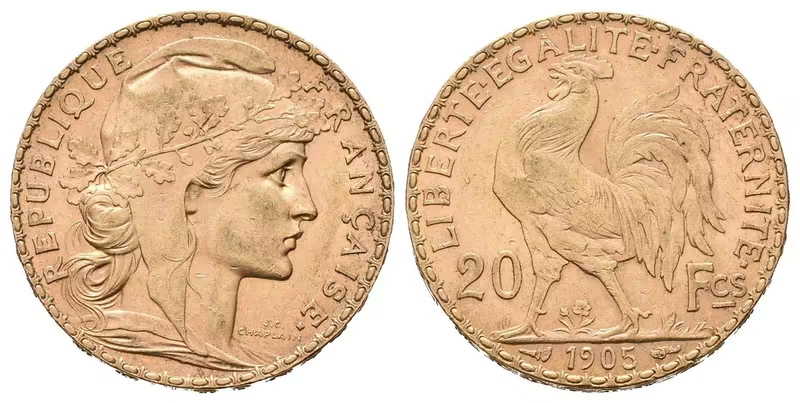
- Code: ZSFRA-91F1905
Francie, 20 Frank 1905
Francie, III. republika (1871 - 1940) 20 Frank 1907 Au 0,900, 21 mm (6,4516 g), KM. 847 Francouzský 20 franc Marianne Coq byla měna vydávaná za Třetí republiky v letech 1899 až 1914 , v ryzosti 900/1000 Au (21,6 kt), váze 6,45 g a průměru 21 mm . Celková…
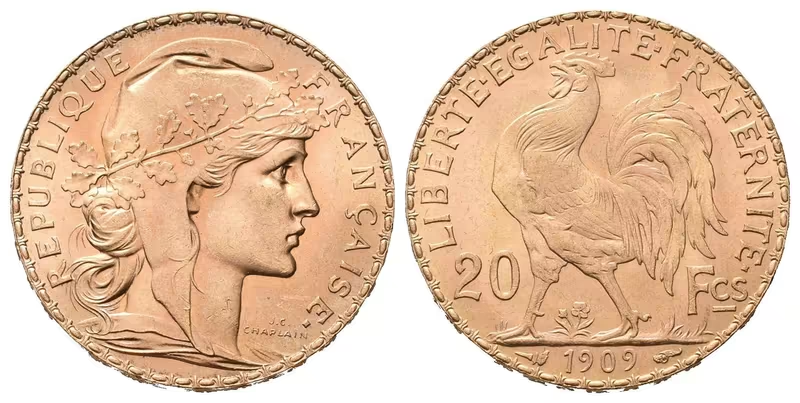
- Code: ZSFRA-91F1909
Francie, 20 Frank 1909
Francie, III. republika (1871 - 1940) 20 Frank 1909 Au 0,900, 21 mm (6,4516 g), KM. 847 Francouzský 20 franc Marianne Coq byla měna vydávaná za Třetí republiky v letech 1899 až 1914 , v ryzosti 900/1000 Au (21,6 kt), váze 6,45 g a průměru 21 mm . Celková…
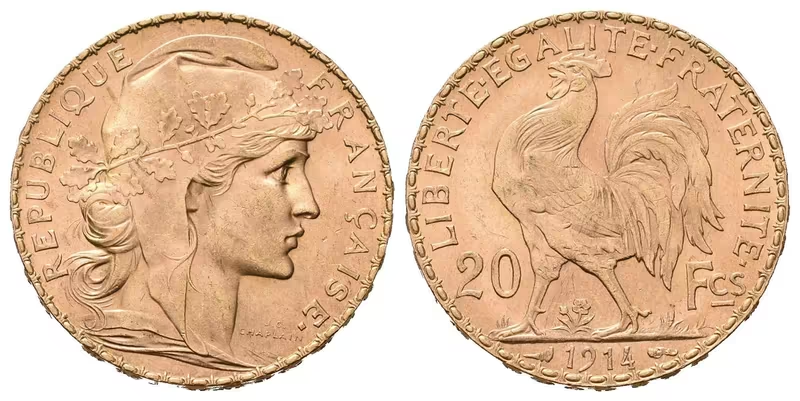
- Code: ZSFRA-91F1914
Francie, 20 Frank 1914
Francie, III. republika (1871 - 1940) 20 Frank 1914 Au 0,900, 21 mm (6,4516 g), KM. 847 Francouzský 20 franc Marianne Coq byla měna vydávaná za Třetí republiky v letech 1899 až 1914 , v ryzosti 900/1000 Au (21,6 kt), váze 6,45 g a průměru 21 mm . Celková…
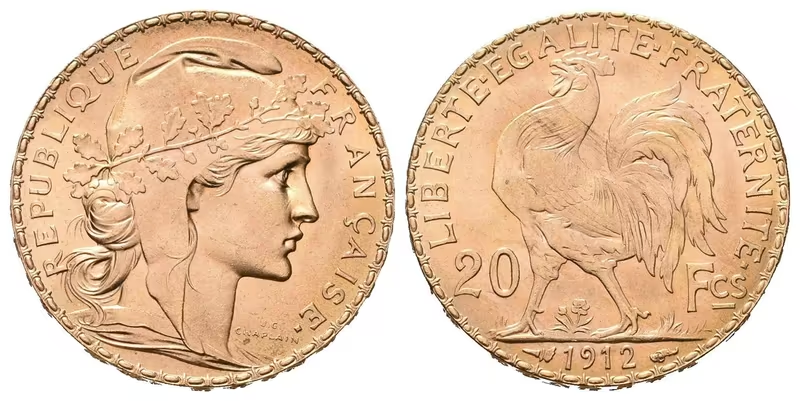
- Code: ZSFRA-91F1915
Francie, 20 Frank 1912
Francie, III. republika (1871 - 1940) 20 Frank 1912 Au 0,900, 21 mm (6,4516 g), KM. 847 Francouzský 20 franc Marianne Coq byla měna vydávaná za Třetí republiky v letech 1899 až 1914 , v ryzosti 900/1000 Au (21,6 kt), váze 6,45 g a průměru 21 mm . Celková…