Elba
Elba is an Italian island in the Tyrrhenian Sea lying between Corsica and the Italian coast. It entered history as the place of Napoleon Bonaparte's first exile, where from 1814 to 1815 he ruled as a sovereign before his return to France.
The island of Elba was inhabited as early as the Bronze Age and from antiquity was renowned for the mining of iron ore. The Etruscans and Greeks operated smelters here, and the products of Elban iron were exported throughout the Mediterranean. The Romans called the island Ilva and continued the mining tradition, which lasted for centuries. During the Middle Ages Elba changed hands among various overlords — Pisa, Genoa, the Spanish Habsburgs and the Tuscan grand dukes.
In 1802 Elba passed to France as part of the Napoleonic territorial changes in Italy. The island served as a naval base and a control point on the routes between France and her Italian possessions. Napoleon himself probably never visited Elba during his rise to power, although he passed it several times by sea on his journeys to Corsica.
The turning point came in the spring of 1814, when coalition armies occupied Paris and forced Napoleon to abdicate. The Treaty of Fontainebleau of 11 April 1814 granted the defeated emperor the title of sovereign of the island of Elba, with the right to maintain a small army and draw an annual stipend of two million francs from the French government. Napoleon accepted these terms and landed at the port of Portoferraio on 4 May 1814.
Napoleon's rule on Elba lasted only nine months but was marked by characteristic energy and reforming zeal. The former emperor reorganised the island's administration, improved the roads, introduced a new tax system and supported iron mining and agriculture. He built up a small fleet and an army of about a thousand men, including loyal veterans of the Imperial Guard, who followed him into exile.
History
Despite the seemingly idyllic life of a sovereign prince, Napoleon suffered on Elba. The promised stipend from France never arrived, since the restored Bourbon government refused to pay its predecessor. Reports from France brought news of discontent with the new regime of Louis XVIII, of economic difficulties and of rifts among the victorious allies at the Congress of Vienna. Napoleon also obtained information about plans to move him to a more remote island in the Atlantic.
In February 1815 Napoleon resolved on a bold step. On 26 February he left Elba with about a thousand men in a small flotilla and headed for the French coast. He landed in the Gulf of Juan near Cannes on 1 March and began a triumphal march on Paris. Troops sent against him went over to his side, Louis XVIII fled, and on 20 March Napoleon re-entered the Tuileries. The famous Hundred Days had begun, ending with the defeat at Waterloo.
After Napoleon's final fall Elba returned under the administration of the Grand Duchy of Tuscany and later became part of unified Italy. The Napoleonic episode, however, has permanently marked the island's identity, which to this day benefits from tourism connected with the memory of its famous exile.
Elba preserves a range of monuments to Napoleon's stay. The Villa dei Mulini in Portoferraio served as the chief imperial residence, with a view over the harbour and the sea. The simple building with a terraced garden contrasted with the grandeur of the palaces over which Napoleon had ruled as French Emperor. The interiors with their original furniture and personal effects are today open to the public.
Napoleonic monuments
The summer residence Villa San Martino, in a valley behind Portoferraio, provided Napoleon with an escape from the summer heat. After the emperor's departure the villa was extended by the Russian prince Anatole Demidoff, who added a Neoclassical gallery with Napoleonic collections. The two villas, together with the Napoleon Museum, form the island's chief tourist attractions.
The town of Portoferraio has preserved the character of a fortified port with 16th-century bastions. The Church of the Misericordia houses Napoleon's death mask and other relics. Annual celebrations on the island commemorate the emperor's arrival and departure, attracting enthusiasts of Napoleonic history from all over the world.
In our auction and shop
- Code: RX-FRAN068
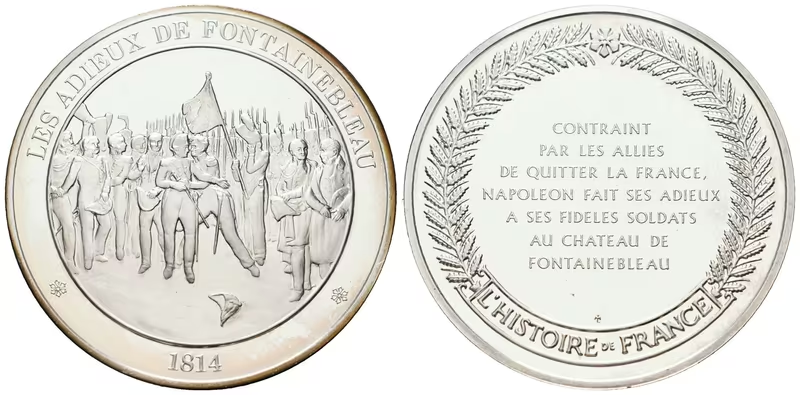
Francie - AR Medaile b.l. - Les adieux de Fontainebleau
Les adieux de Fontainebleau - 1814 Ag 0,800, 44 mm (cca. 37 g) Na minci se nachází Francouzský punc ryzosti. V originální kapsli. Medaile je ze série 'Historie Francie v medailích' - Na některých mincích jsou viditelné stopy patiny aj. - Viz. obrázek.…