Euro Cent
The euro cent is the one-hundredth subdivision of the euro, the common currency of nineteen European Union member states, which has been in use since the introduction of cash euros on 1 January 2002. In numismatics, euro cent coins represent a unique phenomenon of a single currency with national variants, with rare year-issues and mint errors from small s…
The concept of the euro cent originated during preparations for a single European currency in the 1990s as part of the decimal system of the euro. The name was chosen by analogy with the American cent and was intended to be intelligible across all linguistic groups of the European Union. The Maastricht Treaty of 1992 established the basic parameters of the future currency, including the division of the euro into one hundred cents. The first prototype euro cent coins were created in 1996 by the European Monetary Institute, predecessor of the European Central Bank, which set the unified design of the obverse and the technical specifications.
The introduction of the euro cent into circulation on 1 January 2002 represented the largest currency exchange in history, when twelve countries of the eurozone simultaneously replaced their national currencies. More than 50 billion euro cent coins were struck in advance and distributed to banks and businesses. The euro cent replaced German pfennigs, French centimes, Italian centesimi, Austrian groschen and other small national denominations. The logistical operation of currency exchange required years of preparation and coordination among national central banks, mints and security services.
History
The first enlargement of the eurozone brought new national variants of the euro cent — Greece joined in 2001 before the cash introduction, Slovenia in 2007, Cyprus and Malta in 2008, Slovakia in 2009. Each new member state brought its own reverse design of the euro cent coins with national symbols. The Baltic states joined between 2011 and 2015, with the most recent member being Croatia from 2023. Some countries have changed the design of their national sides — for example Belgium in 2014 or Spain in 2015 following the accession of King Philip VI.
Inflation and rising production costs have led to discussions about the future of the smallest denominations. Finland and the Netherlands no longer use one-cent and two-cent coins in cash transactions, with prices being rounded to five cents. The European Central Bank regularly assesses the cost-effectiveness of producing small coins, where the production costs of one-cent and two-cent coins often exceed their face value. Nevertheless, these denominations remain legal tender and are sought after by collectors.
Coinage System and Technical Parameters
Euro cent coins exist in eight denominations — 1, 2, 5, 10, 20 and 50 cents plus 1 and 2 euros. The smallest denominations 1, 2 and 5 cents are struck from copper-plated steel; the silvery 10, 20 and 50 cent coins are made of Nordic gold (an alloy of copper, aluminium, zinc and tin). The one-cent coin has a diameter of 16.25 mm and weighs 2.3 grams; the largest fifty-cent coin has a diameter of 24.25 mm and weighs 7.8 grams.
The common obverse of all euro cent coins depicts a map of Europe and the face value, designed by the Belgian artist Luc Luycx. The national reverses are unique to each country — from the Finnish heraldic lion through the Irish harp to the Maltese cross. Vatican, San Marino and Monégasque euro cents with the portraits of popes and princes are among the rarest owing to limited mintages. Apart from the standard issues, countries also release commemorative two-euro coins with limited motifs.
In our auction and shop
- Code: MCZ075-SADA
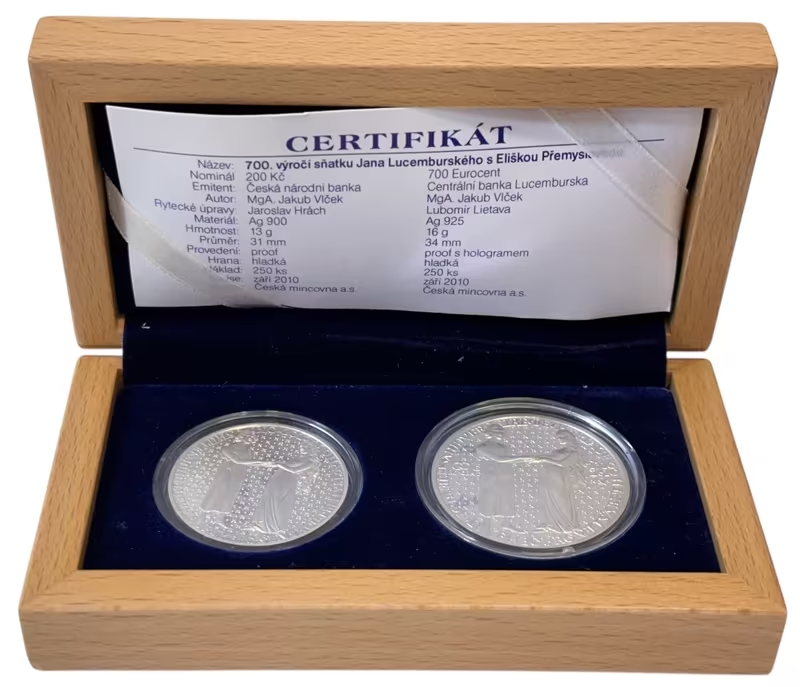
Sada mincí k 700. výročí sňatku Jana Lucemburského s Eliškou Přemyslovnou, PROOF
Česká republika (1993 - ) Sada mincí k 700. výročí sňatku Jana Lucemburského s Eliškou Přemyslovnou Česká republika, 200 Koruna 2010, autor Jakub Vlček, Ag 0,900, 31 mm (13 g), Aurea C175 Lucembursko, 700 Eurocent 2010, autor Jakub Vlček, Ag 0,925, 34 mm…