Ferdinand II of Tyrol
Ferdinand II of Tyrol (1529–1595) was an Austrian archduke and Count of Tyrol, the second son of Emperor Ferdinand I, who became famous as a patron of the arts, founder of Ambras Castle and through his morganatic marriage to Philippine Welser, which shocked the Habsburg court. Ferdinand II is significant in numismatics for the Tyrolean thalers with his po…
Ferdinand was born on 14 June 1529 in Linz as the second son of Emperor Ferdinand I and Anna Jagiellonica. From childhood he was destined for rule in Tyrol and Further Austria according to the Habsburg system of dividing inheritance among descendants. He received a careful humanist education at the imperial court in Vienna, where he learned several languages and developed a love for art and the sciences.
The administration of Tyrol began in 1547, when the eighteen-year-old Ferdinand took over the rule of one of the wealthiest Habsburg provinces thanks to the silver mines at Schwaz and Hall. Tyrol provided a significant part of the income of the Habsburg Monarchy, and Ferdinand had to manage carefully the mining, trade and finances. He proved himself a capable administrator who modernised the Tyrolean administration.
The scandalous marriage to Philippine Welser in 1557 shocked the Habsburg court and provoked a family crisis. Philippine came from the wealthy Augsburg merchant family of the Welsers but was not of noble origin, which made the marriage morganatic according to Habsburg standards. Ferdinand married her secretly out of love, despite the opposition of his father, Emperor Ferdinand I.
The conflict with the imperial court over the marriage lasted several years until Maximilian II approved the marriage on condition that the children of this union should have no claim on the Habsburg inheritance. Philippine was raised to noble status, but their sons Andrea and Karl were excluded from the succession. This precedent influenced later Habsburg family policy.
After Philippine's death in 1580, Ferdinand married a second time, to Anna Caterina of Mantua, niece of Emperor Rudolf II, thus restoring his standing in the dynastic hierarchy. The second marriage was now dynastically acceptable and Ferdinand regained the full trust of the imperial court. Anna Caterina shared his liking for art and participated in the cultural life of Innsbruck.
History
Patronage of the arts made Ferdinand one of the most important Renaissance patrons in the German lands. He founded Ambras Castle near Innsbruck with chambers of art, weapons and curiosities, which became a model for European museology. Ferdinand's collection contained paintings, sculptures, exotic objects and one of the most complete armouries of his time.
Ferdinand's religious policy was moderate, despite his Catholic confession. In Tyrol he respected Protestant minorities and sought confessional compromises that would preserve peace in the province. He supported Catholic reform but avoided the violent methods of re-Catholicisation used elsewhere in the Habsburg lands.
Administrative reforms modernised Tyrolean administration on the model of Ferdinand I's imperial reforms. Ferdinand II created a more efficient system of collecting taxes from mining, improved legal codification and promoted trade with the German cities. Tyrol under his reign reached the peak of its prosperity thanks to a combination of mining and transit trade.
Ferdinand's death on 24 January 1595 in Innsbruck ended the almost fifty-year reign of one of the most successful Austrian archdukes. Tyrol was inherited by his nephew Archduke Maximilian III, because Ferdinand's sons from the first marriage had been excluded from the inheritance. Ferdinand's legacy rests in the cultural transformation of Tyrol and the creation of one of the most important Renaissance collections in Europe.
In our auction and shop
- Code: M58A-BAF1622
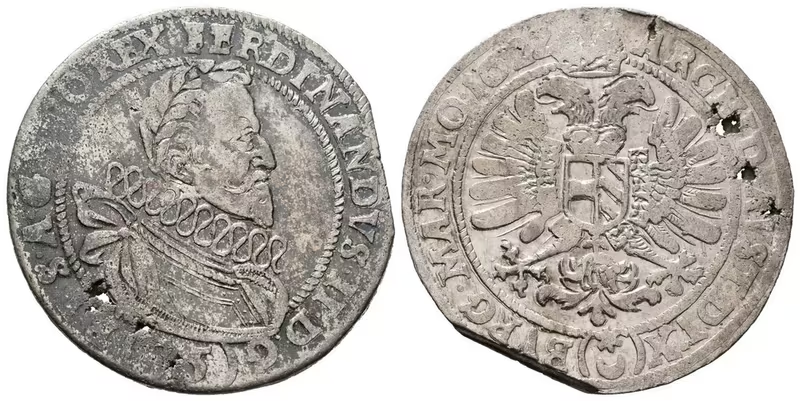
Ferdinand II., 1/2 Tolar (75 Krejcar) 1622, Praha
Ferdinand II. (1619 - 1637) 1/2 Tolar (75 Krejcar) 1622, Praha-Hübmer, Hal.699, ražební lesk v ploše, perfor. stř., konec stř.
Skladem 1 ks - Code: M58B-BAE1623
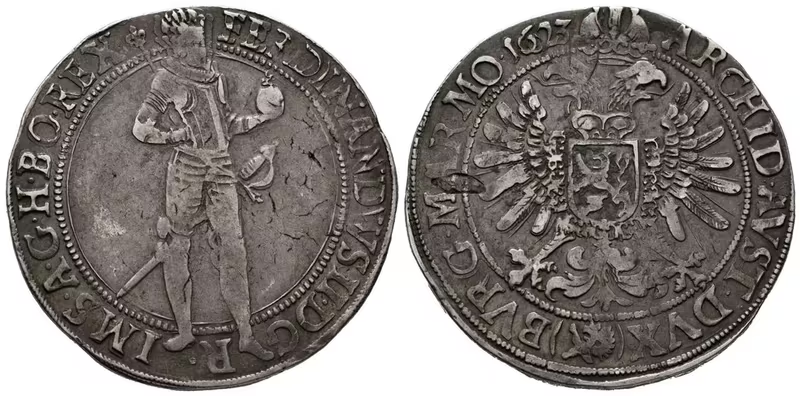
Ferdinand II., Tolar 1623, Praha
Ferdinand II. (1619 - 1637) Tolar 1623, Praha-Suttner, Hal.741
Skladem 1 ks - Code: M58B-BAE1624.1
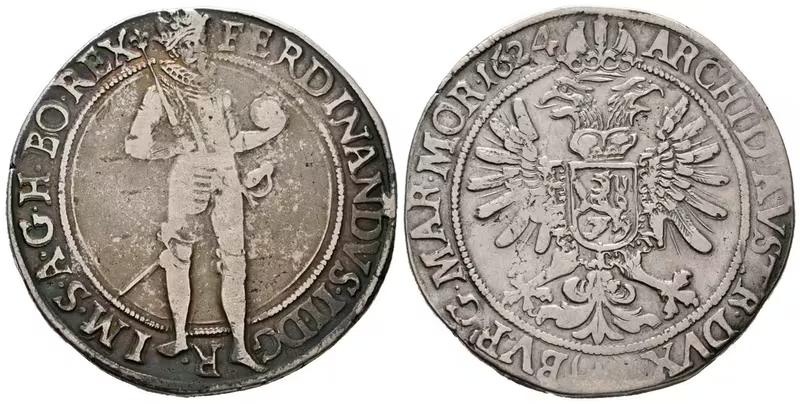
Ferdinand II., Tolar 1624, Kutná Hora
Ferdinand II. (1619 - 1637) Tolar 1624, Kutná Hora-Hölzl, Hal.798
Skladem 1 ks - Code: M94010-1842M
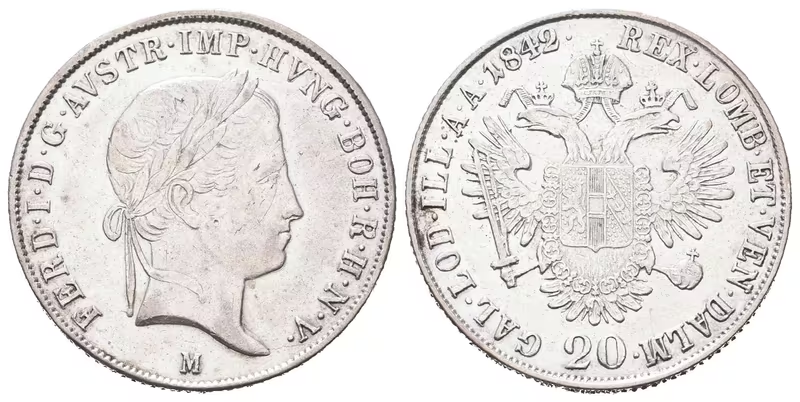
Ferdinand V., 20 Krejcar 1842 M, Milán
Ferdinand V. (1835 - 1848) 20 Krejcar 1842 M, Milán, Ves. 10
Skladem 1 ks