Fiji
Fiji is an island state in the South Pacific (Oceania), formed by an extensive archipelago with the main islands of Viti Levu and Vanua Levu. The capital is Suva, the currency is the Fijian dollar, and modern statehood is tied to the proclamation of independence in 1970.
The earliest history of Fiji is linked to Oceanic migration and to the emergence of island communities which, in isolation and in contact with the neighbouring areas of Melanesia and Polynesia, created their own social structures, languages and traditions. Long before the arrival of Europeans, there existed here a network of local chieftaincies and ties between the islands; navigation, the exchange of goods and prestige objects, and also the relationship to the land — which still influences the Fijian conception of identity — played an important role.
The European world began to take an interest in Fiji at the time of overseas voyages. Among the first known contacts is the voyage of the Dutch seafarer Abel Tasman in the 17th century; later, further navigators and traders reached the region. In the 18th and 19th centuries the European presence grew, especially because of trade, missionary activity and the maritime routes in the South Pacific. The contacts were not only "exploratory", however: they brought new goods, technologies and diseases, and at the same time changed the balance between local power centres.
In the 19th century Fiji gradually came into the sphere of British influence. Local politics was influenced by rivalry among chieftaincies and the effort to create a more stable framework of government. A significant figure of this stage was Ratu Seru Cakobau, who sought to strengthen his standing within the archipelago. In 1874 Fiji was ceded to Great Britain and became a colony. There followed a transformation of the economy, in which the cultivation of sugar cane and the development of the plantation model came to the fore. Related to this was the introduction of indentured workers from India, which fundamentally affected the demography and cultural composition of the population and over the long term brought sensitive political issues connected with citizenship and representation.
History
After the Second World War pressures for self-government and decolonisation grew in the colonial territories. Fiji gained independence on 10 October 1970 and initially remained within the Commonwealth as a constitutional monarchy. Internal political tension, however, in the second half of the 1980s led to the military coups of 1987 led by Sitiveni Rabuka, after which Fiji became a republic. The following decades brought repeated constitutional and political changes and the search for a balance between democratic institutions, the role of the army and questions of ethnic and civic equality.
A significant modern milestone is the constitution of 2013, which set the current framework of state administration. Modern Fiji thus stands on a layered experience: on pre-colonial traditions, on the colonial economy and migration, and on contemporary struggles over the shape of the political system. Nevertheless the country maintains a distinct cultural identity and within the Pacific belongs to the most renowned and most influential states of the region.
Fiji consists of an archipelago of more than three hundred islands and hundreds of smaller islets, of which only some are permanently inhabited. The centre of settlement and of the economy lies on the island of Viti Levu, where the capital Suva is located and where the key transport and trade infrastructure is found. Besides natural beauty (lagoons, coral reefs, tropical vegetation), vulnerability to cyclones and changeable weather is also important for life on the islands, which affects agriculture, transport and the prices of basic commodities.
Geography, Population and Means of Payment
The official language is English; Fijian and Fijian Hindi are also commonly used; the cultural image of the country is therefore naturally multi-layered. Traditional social ties on Fiji are strong, and in public life modern institutions interweave with local customs, especially in questions of land ownership and communal life.
From the numismatic point of view the Fijian dollar is important, which is the domestic means of payment. The issuance of coins and banknotes is provided by the Reserve Bank of Fiji. The banknotes and coins are known for motifs of local nature (flora and fauna), and with collector sets thematic issues linked to national symbols and anniversaries often appear. In the historical development of the currency the transition from the older system to the decimalised Fijian dollar in the second half of the 20th century is important; precisely these changes are reflected in the typology of currency, denominations and in the form of security and graphic features.
In our auction and shop
- Code: BFIDZ050A
- Code: BFIDZ050R
- Code: SFIJI90-S2012
Fidži, 2 Dollars 2012 - želva
Fidži (Fiji), Elisabeth II. (1952 - 2022) 2 Dollars 2012 - Fiji Taku - želvička Ag, 0,999, 40 mm (31,1 g), 1 Oz, PROOF
Skladem 2 ks - Code: SFIJI90-D1993
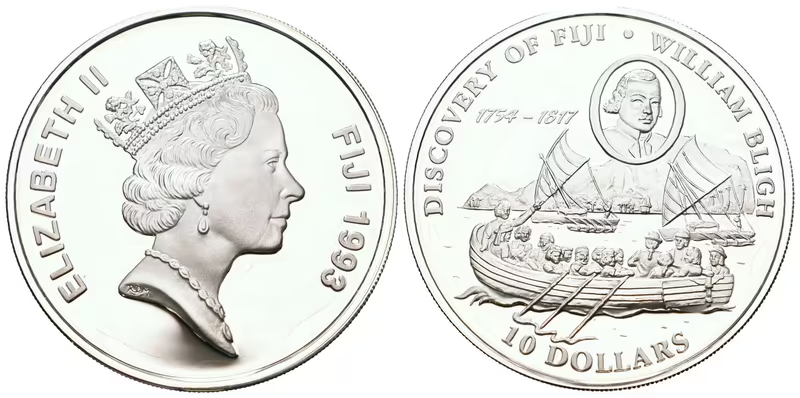
Fiji, 10 Dollars 1993 - William Bligh
Fiji, Elizabeth II. (1952 - 2022) 10 Dollars 1993 - William Bligh, KM# 64 Ag (.925), 38,6 mm (31,1 g), proof, v kapsli. Emise: 10 000 ks. Mincovna: Singapur. Lit.: KM# 64.
Skladem 1 ks