Philip III Arrhidaeus
Philip III Arrhidaeus was king of Macedon ruling from 323 to 317 BC, half-brother of Alexander the Great. His reign represented a transitional period in the disintegration of the Macedonian empire after Alexander's death.
Philip III Arrhidaeus was born around 359 BC as the son of the Macedonian king Philip II of Macedon and his secondary wife Philinna of Larissa. According to ancient sources he suffered from intellectual disability or epilepsy, which excluded him from the succession during Alexander the Great's lifetime. His disability may have been caused by poisoning at the hand of Olympias, Alexander's mother, who wished to secure the throne for her son. Throughout Alexander's reign Arrhidaeus lived in seclusion at the Macedonian court.
When Alexander the Great died in Babylon in June 323 BC without a clear successor, the Macedonian army proclaimed Arrhidaeus king under the name Philip III. This decision was a compromise between the infantry, who supported Arrhidaeus, and the cavalry, who wanted to wait for the birth of Alexander's offspring. When Alexander IV, son of Alexander the Great and Roxana, was born, he was proclaimed co-ruler. Owing to his disability, however, Philip III never ruled independently and was merely a puppet in the hands of regents.
History
The first regent was Perdiccas, who controlled the royal seal and issued orders in the name of both kings. After Perdiccas's death in 321 BC the regency was assumed by Antipater and later by Polyperchon. In 317 BC Philip III was seized by Cassander, son of Antipater, who used him as a tool of legitimisation for his own power. In the same year Philip's wife Eurydice was captured by Olympias, mother of Alexander the Great. Olympias had Philip III and Eurydice killed, thereby removing competition for her grandson Alexander IV.
Philip III Arrhidaeus was buried in the royal tomb at Aigai in Macedon. In 1977 the archaeologist Manolis Andronikos discovered an intact tomb which some scholars attribute to Philip III and Eurydice. The tomb contained a golden larnax with the Macedonian star, armour, and other funerary equipment befitting royal status.
Coinage of Philip III Arrhidaeus
The coinage system under Philip III continued the Alexandrian tradition without significant changes. Gold staters were struck with Athena on the obverse and Nike on the reverse, and silver tetradrachms with the head of Heracles and a seated Zeus. The coins bore the inscription Philippou instead of Alexandrou, which is the only difference from the strikings of Alexander the Great. The quality and weight of the coins were preserved according to the Attic standard, with the tetradrachm weighing 17.2 grams of silver.
Minting took place at many mints across the former empire of Alexander, from Macedon to Babylon. The greatest number of coins was struck in the first years after Alexander's death, when it was necessary to pay the army and secure the loyalty of military commanders. The coins of Philip III are today relatively common in numismatic collections, attesting to mass production. Their historical value lies in documenting the transitional period between Alexander's empire and the emergence of the Hellenistic kingdoms.
In our auction and shop
- Code: BE074-0003
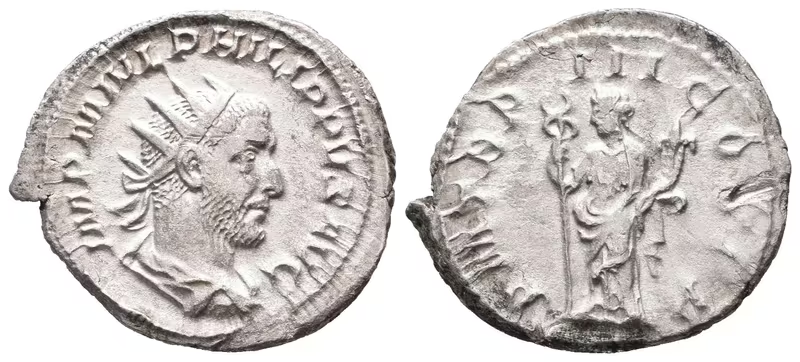
Philippus I., Antoninian, RIC.3
Philip I. Arab (244 - 249) Antoninian, 246, Roma, Rv: P M TR P III COS P P , Felicitas stojící zleva drží caduceus a roh hojnosti , RIC.3, RSC.124 pěkný Av. se zbytky lesku, pěkně vyražený portrét, patina, zbytky lesku, ned. Rv., vady střížku (3,78 g)
Skladem 1 ks