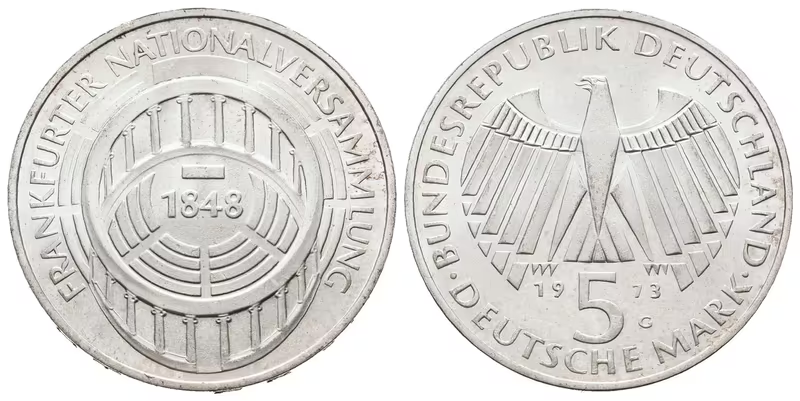
Frankfurt Mint
The Frankfurt Mint was a mint in Frankfurt am Main, which struck coins for the needs of the city and its market within the Holy Roman Empire. As an important trade and fair centre Frankfurt required reliable currency, and its strikings were therefore applied in wide regional circulation.
The Frankfurt Mint grew out of Frankfurt am Main's standing as one of the most important cities of the imperial space. Frankfurt was long connected with long-distance trade, finance, and trade fairs, and moreover had an exceptional political role: in the early modern period the elections of Roman-German kings and later also their coronations took place here. Such a city was a natural magnet for monetary circulation - various coins from neighbouring countries flowed here, and at the same time there arose a need for stable, well-accepted currency for markets, crafts, accommodation, transport, and financial services.
In the environment of the Holy Roman Empire the monetary situation was fragmented. Coins of principalities, bishoprics, imperial cities, and larger dynasties existed side by side, and their values were in practice judged by metal, weight, and the reputation of the issuer. The imperial cities, among which Frankfurt belonged, prided themselves on having credible currency - this was not only about the economy but also about prestige and the ability to assert their own rules on the market. The mint was in this sense part of municipal sovereignty: the coin bore the emblem and name of the city, and by this confirmed its independent standing and competence to manage its own finances.
The importance of Frankfurt's strikings increased especially at times when great crowds of merchants and visitors to the trade fairs flocked to the city. The trade fairs were a place where bulk transactions were concluded, currencies were exchanged, and credit was negotiated. It was precisely in such situations that the importance of having coins that were easily recognisable and accepted was shown. The municipal administration had moreover an interest in seeing "good" currency prevail in circulation and in restricting the penetration of underweight coins, which could disrupt the price level and trust in the market. For this reason as well, the monetary policy of the imperial cities used to be a sensitive theme, and minting practice had to come to terms with broader imperial standards, such as the joint agreements on the thaler or kreuzer currency.
History
In the early modern period monetary conditions were strongly marked by wars and financial crises, which in the German space repeatedly brought a shortage of quality metal and the effort of various issuers to address their expenses through less honest strikings. In such periods the reputation of a municipal mint was even more important: merchants were sensitive to the specifications of coins, and a city that wished to maintain its standing as a financial and commercial hub required trust. Frankfurt, thanks to its role in trade and later also in finance, sought to support this trust not only through institutions but also through monetary circulation, in which its strikings could become one of the pillars.
In the 19th century the monetary environment of the German lands was significantly transformed. It tended towards greater standardisation and gradually towards more unified monetary frameworks, which restricted the traditional space for independent municipal strikings. Frankfurt moreover underwent political transformations, and its standing as an independent city changed in the European balance of power. With this the era in which the municipal mint represented one of the key "signs" of self-government was closing. For numismatics, however, Frankfurt's coins remain valuable evidence of municipal sovereignty and economic strength.
The Frankfurt Mint struck primarily currency corresponding to the needs of the city and its region. From a practical viewpoint, this concerned especially the small and medium denominations used in everyday transactions, because precisely these were most needed in markets and at trade fairs. In larger transactions higher silver coins of the thaler range were used, the specifications of which had to be intelligible also to merchants from abroad. As a place of exchange and credit, Frankfurt was naturally sensitive to ensuring that its coins were legible and recognised.
Strikings, marks, and role in circulation
The typical mark of identification of municipal strikings is municipal symbolism - a coat of arms, an emblem, or an inscription referring to Frankfurt. Heraldry functioned precisely as a "mark of trust": in a fragmented monetary space people quickly recognised where a coin came from and could place it within their experience of quality. For collectors, therefore, Frankfurt coinage is interesting not only for its denominations but also for the variability of types, styles, and legends, which reflect the transformations of the period from mediaeval and early modern symbolism to the later, more standardised conception of coins.
The numismatic significance of Frankfurt strikings lies in the fact that they represent "city money" in the best sense of the word: coins which arose in an environment of high trade, finance, and political prestige. They show well how the city presented itself and how it sought to maintain the trust of the market. For the study of the history of money Frankfurt is an ideal example of a place where politics, trade, and coinage meet - and where coins are not just a metal object but also an instrument of municipal identity.
In our auction and shop
- Code: NG-C1973G
SRN, 5 Marka 1973 G - Frankfurtský sněm
Spolková republika (1949 - ) 5 Marka 1973 G - Národní shromáždění ve Frankfurtu 1848, J.412, ražební lesk, drobné rysky, patina Ag 0,625, 29 mm (11,2 g)