Duchy of Friedland
The Duchy of Friedland was a semi-independent territory in northern Bohemia which Albrecht of Wallenstein built up for himself during the Thirty Years' War. In the years 1622–1634 it functioned, with its centre in Jičín, as a "state within a state", with strong administration, an economic base, and its own representation.
The birth of the Duchy of Friedland is closely linked with the post-war confiscations after the defeat of the Bohemian Estates' Revolt and with the extraordinarily rapid career of Albrecht of Wallenstein. In the first years of the Thirty Years' War he was able to combine military skill, financial acumen, and imperial favour into a unique "entrepreneurial" model of power. After the Battle of White Mountain, a market in confiscated estates opened up in the Czech lands, and Wallenstein became one of the largest buyers and holders of the newly redistributed property. In 1621 he acquired the Friedland (Frýdlant) estate, with the eponymous town of Frýdlant, and it is from this that the later name of the whole entity derives.
The core of the future "state" did not arise all at once, but through the gradual accumulation of demesnes and towns in the north and east of Bohemia. Wallenstein bought, exchanged, and merged them, while at the same time striving to ensure that his possessions did not form a fragmented mosaic but rather a space that could be administered as a whole. The imperial court supported his rise, because Wallenstein was able to finance and equip an extensive army. It was precisely the ability to "produce an army" that became the key to privileges which an ordinary nobleman would not have obtained.
In the years 1622–1625 Wallenstein's social rank rose rapidly: first he was elevated among the imperial princes, and subsequently he was granted the title of duke. In 1624 his contiguous block of property was proclaimed the Principality of Friedland, which in 1627 was elevated to the Duchy of Friedland. Formally it was a territory within the Kingdom of Bohemia, but in practice the duke received such broad powers that the duchy behaved as a de facto separate unit: Wallenstein here applied his own administrative ordinance, reorganised the economy, and intervened in the life of the towns and the subjects with unprecedented energy.
History
The centre of the duchy became Jičín, which Wallenstein chose as the future residential town. He launched there an ambitious building programme: he planned modern Baroque urban design, a representative palace, new streets, and extensive economic facilities. He considered establishing a bishopric, a university, and a territorial diet, which shows that Friedland was not to be just a "cluster of estates", but a structured entity with the symbols of statehood. This vision was also politically sensitive: at a time when the imperial court was fighting for control over the Empire and over Bohemia, the excessive independence of a single magnate appeared as a latent threat.
Among the marks of sovereignty was also economic and legal privilege. Wallenstein received the right to grant certain noble and municipal privileges and also the right to mint his own coins. The mint production, associated above all with Jičín, had both a practical and representational purpose: it helped to supply circulation in a wealthy economic space and at the same time spread the duke's portrait and titulature. The same logic underlay other steps — the building of an administrative network, oversight of crafts and markets, or efforts to secure supplies, which was fundamental in the war years.
The duchy, however, stood and fell with the person of its founder. Wallenstein's position at the imperial court fluctuated: at one moment he was an indispensable general, at another a suspect "too powerful" player. After political disputes and growing distrust, the situation came to a head at the turn of 1633 and 1634. Wallenstein was ultimately assassinated in February 1634 at Cheb. Without him, the duchy lost its meaning and its protection: his property was confiscated, and the exceptional entity quickly broke up into ordinary estates and administrative units subject to the standard order of the Czech lands.
Administration, economy, and coins of the Duchy of Friedland
The Duchy of Friedland functioned as an exceptionally centralised whole, in which Wallenstein sought to combine the profitability of a great estate with the features of modern administration. He relied on officials, transparent accounting, and direct control of economic resources — from forests and ponds to breweries, crafts, and markets. An important element was the wartime economy: the duchy lay in a strategic space and had to manage the passage of armies, supply, and pressure for payments in kind. Wallenstein therefore strove to increase self-sufficiency and at the same time to maintain the flow of money, because without cash it was impossible to pay for services, transport, or mercenaries.
The coin strikes of the duchy today rank among the best-known relics of this brief episode. Silver thaler denominations and gold ducats appear, often with a striking portrait of the duke and a rich titulature. These coins did not serve only for circulation: they were also a deliberate "calling card" of power, because the portrait and arms made it clear who was master of the given space. For collectors, when identifying them, the year-date, denomination, mint mark, and style of the portrait or coat of arms are important, as more variants of dies exist and some pieces are rare. The high interest in Friedland strikes rests on the combination of a strong story, a short time-span, and an exceptionally impressive artistic level.
In our auction and shop
- Code: ZD-3005VALD
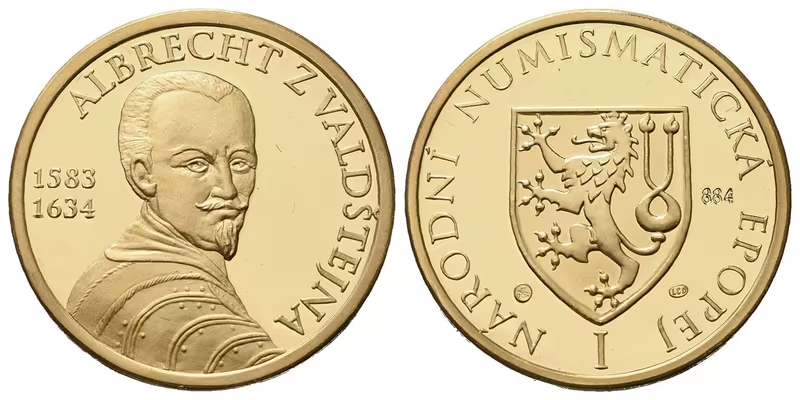
Medaile b.l. - Albrecht z Valdštejna - Národní numismatická epopej
Česká republika (1993 - ) Medaile b.l. (Luboš Charvát) - Albrecht z Valdštejna Au 0,999, 25 mm (7,15 g), certifikát, etue, PROOF Cyklus medailí Národní numismatická epopej Albrecht Václav Eusebius z Valdštejna (nebo také Vojtěch Václav Eusebius z…