Herennius Etruscus
Herennius Etruscus (c. 227–251) was a Roman co-emperor, the elder son of Emperor Decius. He briefly reigned as Augustus for a few weeks before his death in battle.
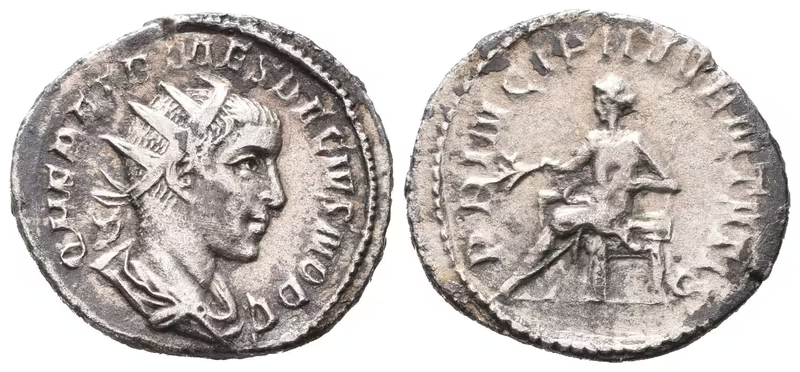
Quintus Herennius Etruscus Messius Decius was born around 227, the son of the future emperor Decius. When his father acquired the purple in 249, the young Herennius was named Caesar. As Caesar Herennius Etruscus accompanied his father to the Danube front against the Goths. He took part in the victorious Battle of Nicopolis ad Istrum in 250. The Senate granted him the title Princeps Iuventutis (Prince of Youth).
In the spring of 251 Herennius was promoted to Augustus and co-emperor. The title was meant to strengthen dynastic legitimacy at the time of the Gothic invasion. His reign as Augustus lasted only a few weeks. In June 251 he fell together with his father at the catastrophic Battle of Abritus against the Gothic king Cniva. He was the first Roman emperor killed in battle with barbarians. His death and the death of Decius marked the beginning of the worst phase of the Crisis of the 3rd Century.
Life and brief reign
Trebonianus Gallus, who survived the battle, became emperor and concluded an ignominious peace with the Goths. The younger brother Hostilian briefly reigned as co-emperor but soon died of the plague. The Decian dynasty ended after a mere two years. Herennius Etruscus remains a tragic figure—a young prince who perished in a hopeless battle.
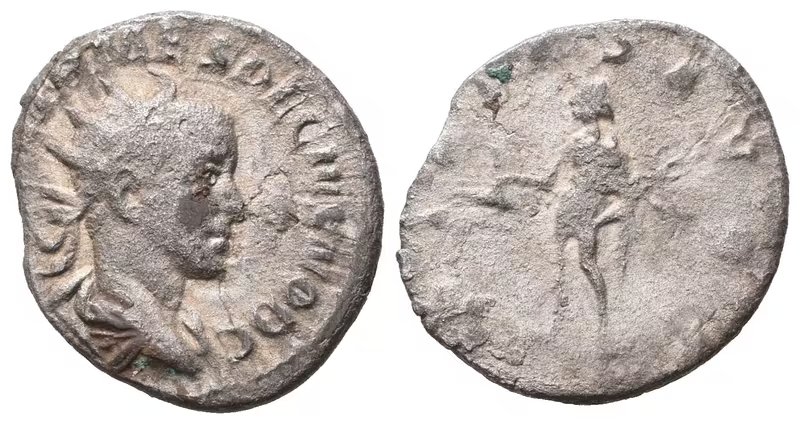
Herennius Etruscus is depicted on antoniniani and sestertii from the short period of 250–251. Coins with the legend HER ETR MES DECIVS CAES or HERENNI ETRVSC NOB C are relatively rare. The portraits show a youth with short hair. After his promotion to Augustus—IMP CAE Q HER ETR MES DECIO AVG—they are very rare.
Numismatic significance
The reverses typically depict Pietas, Spes, military motifs. Of interest are the coins PRINCIPI IVVENTVTIS with military standards. Most issues come from the Roman mint; provincial issues are rare. Joint issues with Decius legitimised the dynasty. Numismatically they are valuable as documentation of a brief reign and dynastic ambitions in the crisis.
In our auction and shop
- Code: BE081-0146Recommended
Herennius Etruscus, antoninián, Řím, RIC 146
Herennius Etruscus (250 - 251) mincovna Řím, sedící Apollo s ratolestí, PRINCIPI IVVENTVTIS, RIC 146
Skladem 1 ks - Code: BE081-0142
Herennius Etruscus, antoninián, Řím, RIC 142b
Herennius Etruscus (250 - 251) mincovna Řím, stojící Merkur držící caduceus a měšec, PIETAS AVGG, RIC 142b
Skladem 1 ks