Trebonianus Gallus
Trebonianus Gallus (c. 206–253) was a Roman emperor reigning from 251 to 253, who came to the throne after the catastrophe at Abritus and the death of Trajan Decius. He became famous for a controversial peace with the Goths and rule during one of the worst crises of the third century, but perished during a military uprising along with his son.
Gaius Vibius Trebonianus Gallus was born around 206, probably in Perugia in Italy, into a senatorial family. He grew up under the Severan dynasty and received the traditional education of the Roman aristocracy. He held various magistracies and governorships that prepared him for high state offices during the turbulent third century.
The position of legate of Moesia under Trajan Decius placed him in a key frontier province during the Gothic invasions. When Decius launched his campaign against King Kniva, Gallus commanded part of the Roman forces and witnessed the growing barbarian threat. His experience with Gothic tactics later influenced him in negotiating peace.
The catastrophe at Abritus in June 251 changed Gallus's fate. After the death of Decius and his son Herennius Etruscus in the marshes of northern Thrace, Gallus became the de facto commander of the remnants of the Roman army. The Pannonian legions proclaimed him augustus, which reflected the need for immediate leadership during the military crisis.
Recognition by the Senate followed quickly owing to the urgent situation on the Danubian borders. Gallus accepted the title of augustus and appointed his young son Volusianus as caesar in order to secure dynastic continuity. The Senate appreciated his experience with the barbarian invasions and supported him as a stabilising force.
The controversial peace with the Goths in 251 shocked Roman society. Gallus agreed to pay tribute to the Goths in exchange for their withdrawal from Roman territory and the return of captives. This precedent of paying "protection money" to barbarians provoked criticism, but Gallus argued for the necessity of gaining time to reorganise the army.
History
The plague epidemic (251–253) devastated the empire during Gallus's reign. The "Plague of Cyprian" — probably smallpox or typhus — decimated urban populations and weakened the economy and the army. Gallus tried to combat the epidemic through religious ceremonies and public measures, but the situation remained critical.
Economic problems characterised the whole of Gallus's reign. Payments to the Goths, war damage and the epidemic exhausted imperial finances. Gallus had to devalue the currency and raise taxes, which provoked unrest among the population and the army. Inflation and food shortages destabilised the provinces.
Persian problems in the East complicated Gallus's position. Shapur I exploited Roman weakness for new invasions of Mesopotamia and Syria. Gallus could not respond effectively because of his commitments in the north and the lack of resources to wage war on two fronts simultaneously.
The revolt of Aemilianus in 253 arose among the Moesian legions, dissatisfied with Gallus's policy towards the barbarians. Marcus Aemilius Aemilianus gained the support of the Danubian troops by promising a more aggressive policy against the Goths and an end to the tributes. Gallus had to leave Rome and lead the army against the usurper.
The deaths of Gallus and Volusianus in August 253 at Interamna during the march against Aemilianus ended their short reign. Their own soldiers killed them and went over to Aemilianus, who promised a better military policy. This incident illustrates the instability of imperial power during the crisis of the third century, when the army rapidly shifted its loyalties.
Trebonianus Gallus in numismatics
The legacy of Trebonianus Gallus is ambivalent — his realpolitik saved the empire from immediate collapse after the Abritus catastrophe, but the controversial peace with the barbarians created a precedent that weakened the Roman position in the long term. His reign exemplifies the difficulties of emperors during the worst crisis of ancient civilisation.
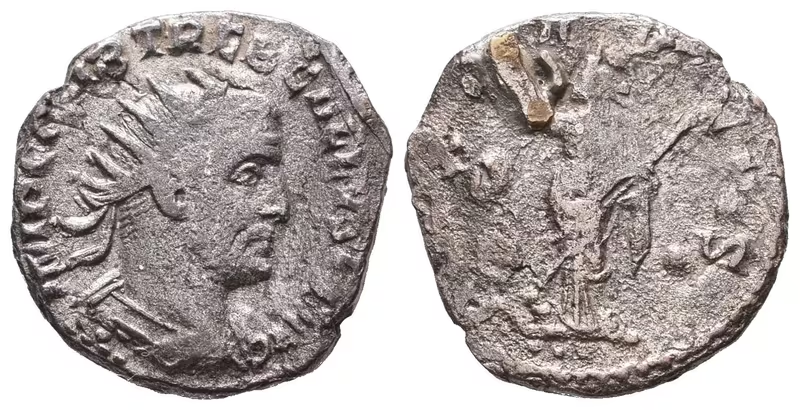
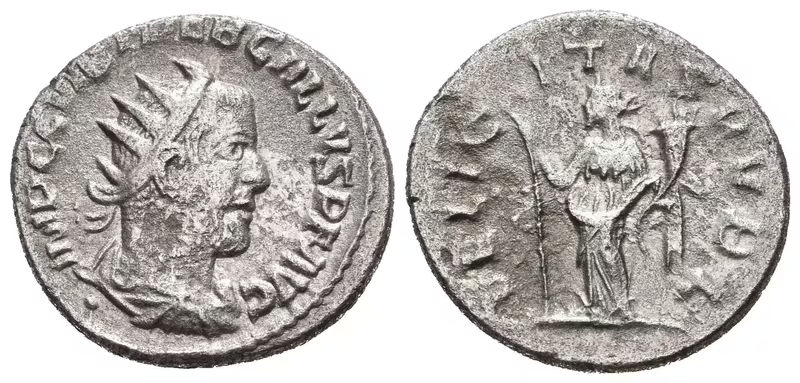
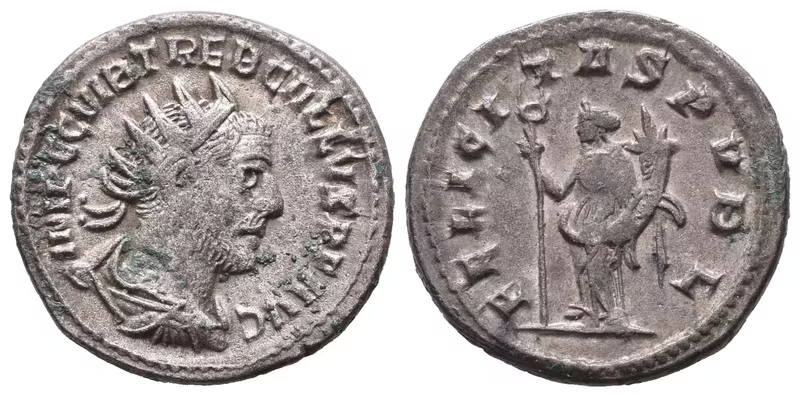
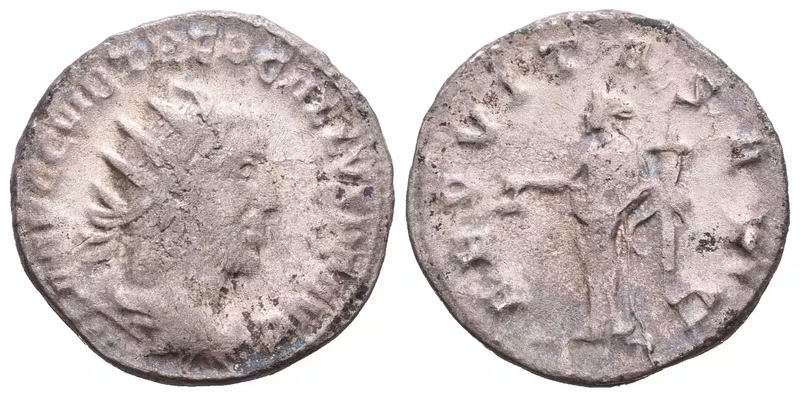
The coins of Trebonianus Gallus document his brief two-year reign during one of the most difficult periods of Roman history. The portraits show a middle-aged man with an anxious expression reflecting the weight of the crises he faced. The design often emphasises imperial authority and stability despite the chaotic circumstances of the reign.
Characteristic motifs are prosperity and peace — FELICITAS PVBLICA (public happiness), PAX AVG (imperial peace), VICTORIA AVG (imperial victory) and PROVIDENTIA AVG (imperial foresight). These optimistic legends contrast with the reality of the plague epidemic and the barbarian invasions, but reflect the propaganda needs of legitimising the reign.
Co-rule with his son Volusianus is documented by family issues depicting both augusti or allegories of dynastic continuity. These coins were intended to demonstrate the stability of the new dynasty after the death of Decius's line, although the reality was the opposite owing to growing military dissatisfaction.
The quality of Gallus's coins reflects the empire's economic problems — the gradual debasement of antoniniani and the reduction of weight document the financial crisis caused by tribute paid to the barbarians and the costs of fighting the epidemic. Regional variants are rare owing to the short duration of the reign and limited possibilities of striking in the provinces.
In our auction and shop
- Code: BE083-0086
Trebonianus Gallus, antoninián, Antiochie, RIC 86
Trebonianus Gallus (251 - 253) mincovna Antiochie, stojící Pax s ratolestí a obřadní holí, PAX AVGVS, RIC 86
Skladem 1 ks - Code: BE083-0082.1
Trebonianus Gallus, Antoninian, RIC 82
Trebonianus Gallus (251 - 253) raženo 251 - 252 v Antiochii, stojící Felicitas s žezlem a rohem hojnosti, FELICITAS PVBL, RIC 82
Skladem 1 ks - Code: BE083-0082
Trebonianus Gallus, antoninián, Antiochie, RIC 82
Trebonianus Gallus (251 - 253) mincovna Antiochie, raženo 251 - 252, stojící Felicitas s žezlem a rohem hojnosti, FELICITAS PVBL, RIC 82
Skladem 1 ks - Code: BE083-0080
Trebonianus Gallus, antoninián, Antiochie, RIC 80
Trebonianus Gallus (241 - 243) mincovna Antiochia, stojící Aequitas držící váhy a roh hojnosti, AEQVITAS AVG, RIC 80
Skladem 1 ks