Trajan Decius
Trajan Decius (c. 201–251) was a Roman emperor who reigned from 249 to 251, originally from Pannonia. He became famous as the organiser of the first systematic persecution of Christians in the history of the Roman Empire and died tragically alongside his son in the battle against the Goths at Abritus.
Gaius Messius Quintus Trajan Decius was born around the year 201 in Budalia in Lower Pannonia (today's Serbia) into an aristocratic Pannonian family. He grew up in the environment of the frontier provinces and received the military education typical of the Pannonian nobility. He adopted the name Trajan out of admiration for the great emperor and as a symbol of his ambitions to restore Roman glory.
His senatorial career unfolded under the Severan dynasty, when Decius held various magistracies and governorships. He proved himself an able administrator and military commander, which recommended him for high offices. Under Philip the Arab he attained the position of consul and gained the trust of the emperor, who appointed him legate on the Danube.
The governorship of Moesia (248–249) placed Decius at the head of a strategically key Danubian province with high-quality legions. His task was to defend the borders against barbarian incursions and to maintain discipline among the troops. His successes in fighting the Goths and the Carpi made him popular among the soldiers and a potential rival of Philip the Arab.
The revolt against Philip arose spontaneously in 249, when the Pannonian legions proclaimed Decius augustus out of dissatisfaction with the Arab dynasty. Decius initially hesitated to accept the imperial title, but eventually yielded to the army's pressure and marched on Italy against Philip. He claimed to be acting in the interest of restoring traditional Roman values.
The Battle of Verona in September 249 decided the empire's fate. Philip's army was defeated and the emperor himself fell in battle alongside his son Philip II. Decius entered Rome as victor and was recognised by the Senate as legitimate augustus. He launched the systematic destruction of monuments to the Arab dynasty.
History
Religious policy characterised the whole of Decius's reign. The emperor was a fervent traditionalist who saw the cause of Rome's troubles in the abandonment of the old gods in favour of foreign cults, especially Christianity. He resolved to restore traditional piety through compulsory sacrifices by all inhabitants of the empire.
The Edict of Decius (250) ordered all inhabitants of the empire to sacrifice to the Roman gods and to obtain an official certificate (libellus) confirming fulfilment of the duty. This first systematic persecution of Christians was intended to break the growing influence of the Church and to restore the religious unity of the empire. Thousands of Christians were imprisoned, tortured or executed.
The Christian persecution provoked mass resistance and destabilised significant parts of the empire with a large Christian population. Many believers fled to remote areas, others purchased false certificates or sacrificed under duress. The Church was severely struck, but the persecution also strengthened Christian solidarity and the ideal of martyrdom.
Gothic invasions on the Danube required Decius's personal intervention. King Kniva led the greatest barbarian invasion since the Marcomannic Wars, and Gothic warriors plundered Thrace and advanced as far as Philippopolis. Decius had to interrupt his religious policy and concentrate on the military crisis.
The Battle of Abritus in June 251 ended in catastrophe for Roman arms. Decius and his son Herennius Etruscus fell in battle along with a large part of the army after becoming stuck in the marshes and being surrounded by the Goths. Decius became the first Roman emperor killed by barbarians in open battle.
Trajan Decius in numismatics
The legacy of Trajan Decius is controversial — his persecution of Christians made him one of the most hated figures in Church history, but his effort to restore traditional values reflected the concerns of many Romans during the crisis of the third century. His death at Abritus symbolised the growing barbarian threat to the civilised world.
The coins of Trajan Decius document his brief two-year reign and his propaganda effort to restore traditional Roman values. The portraits show an energetic man of middle age with a military expression and an emphasis on strength and authority. The design often draws on Trajanic models, reflecting Decius's admiration for the great emperor.
Characteristic motifs are the traditional Roman virtues — VIRTVS AVG (imperial valour), PIETAS AVG (imperial piety), GENIVS EXERCITVS (the genius of the army) and DACIA (a reference to Trajanic successes). These legends emphasise Decius's role as the restorer of Roman grandeur and the defender of old values against decadence.
Religious motifs reflect Decius's restoration of the cults — depictions of traditional deities such as Jupiter, Mars, Victoria and Roma emphasise the return to the ancestral gods. The absence of Christian symbols contrasts with the tolerant policy of earlier emperors and documents the active anti-Christian campaign.
Commemorative coins for military successes celebrate the victory over Philip the Arab and the initial successes against the barbarians. Given the catastrophe at Abritus, these triumphal issues are ironic, but they document the optimism of the early months of the reign. The quality of Decius's coins is relatively good despite the brief duration of the reign and the military crises.
In our auction and shop
- Code: BE027-0275
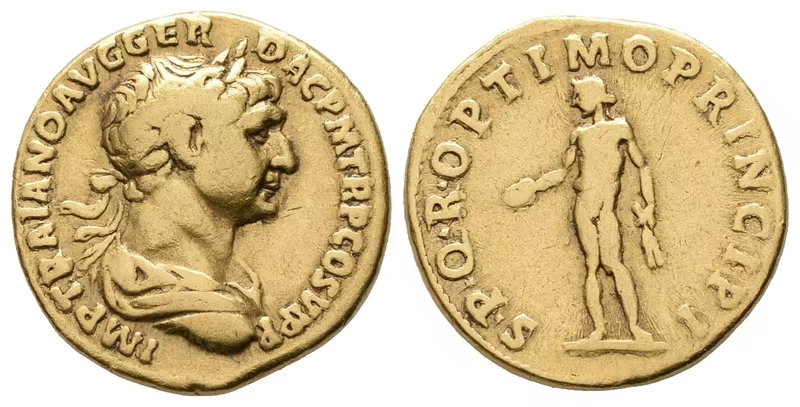
Traianus, Aureus, RIC.275
Traianus (98 - 117) Aureus, Řím, 112 - 114, Rv: S P Q R OPTIMO PRINCIPI, stojící Genius zleva drží pateru a klasy, RIC.275, Calicó 1067 (6,69 g)