Hugues de Payens
Hugues de Payens was a French knight of the early 12th century, traditionally considered the founder and first Grand Master of the Order of the Templars. He became famous for having helped to create, from a small group of protectors of pilgrims near Jerusalem, a powerful religious-military order, which influenced the history of the Crusader world and medi…
Hugues de Payens came from the Champagne region and his life is associated with the era when, after the capture of Jerusalem (1099), the Crusader states tried to maintain control over the territory and at the same time ensure the safety of pilgrims. It was precisely pilgrim traffic that was crucial for the Latin East - it brought people, money and prestige - but the roads between the coast and Jerusalem were dangerous. Around the year 1119 a small group of knights was therefore established in Jerusalem, who pledged themselves to protect pilgrims. Tradition names Hugues as their leader, who became the face and organiser of the new community.
The group initially operated modestly and its activity rested on the support of the Jerusalem authorities. A key role was played by Baldwin II of Jerusalem, who provided them with facilities on the Temple Mount in the space of the former al-Aqsa Mosque. From this also arose the designation "Templars" - the knights of the Temple. The original name of the order was "The Poor Knights of Christ and of the Temple of Solomon", which well captures the ideal: military service combined with monastic discipline and emphasis on humility. In practice, however, it was soon evident that for permanent functioning legal recognition, rules and broader European support were needed.
Hugues therefore undertook a journey to Europe to gain legitimacy and patrons for the new community. A fundamental point became the Council of Troyes in 1129, where the order was approved and at the same time its way of life was defined. Prominent spiritual authorities also participated in shaping the Templar order, especially Bernard of Clairvaux, who supported the Templars and helped them build the image of the order as defenders of Christendom. From this moment the small Jerusalem band became an internationally recognised order, capable of receiving gifts, founding commanderies and creating a network of facilities across Europe.
History
Hugues de Payens stood at the head of the order in the period when its basic pillars were being formed: the vow of poverty, obedience and chastity, military discipline, common life and a clear hierarchy. The Templars gradually became a key force in the Holy Land - not only in combat, but also in logistics, supply and the protection of roads. From the European point of view their economic model was equally important: gifts from the nobility and rulers, the administration of estates and a sophisticated organisation enabled the order to function as a stable institution with long-term revenues. This combination of spiritual authority, military usefulness and effective administration is one of the reasons why the Templars strengthened so significantly in the following generations.
Less has been preserved about the personal details of the life of Hugues than would correspond to his importance, which is common for the early 12th century. As founder and first Grand Master, however, he remains a key figure: without his organisational talent and capacity to negotiate, the Templars would probably have remained merely a short-term initiative. Hugues died in the first half of the 12th century and the order was taken over by successors, who already developed the institution with a European reach. All the more strongly his role of "founder" stands out in history, who gave the Templars the basic direction, face and legitimacy.
Hugues de Payens is most often commemorated through the legacy of the Templars, who became one of the best-known mediaeval orders. Already the early stage carries strong symbolism: the ideal of the "Poor Knights" contrasted with the later wealth of the order, and it is precisely this paradox that to this day feeds the interest of historians and the public. The typical mark of the Templars is the red cross on a white mantle, the emphasis on a disciplined life and the conception that military service can be a form of spiritual mission. In actual mediaeval reality this meant a strict order regime, obedience to the Grand Master and at the same time a high demand on service in dangerous conditions.
Templars, symbolism and the legacy of the Hugues era
The era of Hugues shows that the success of the order rested not only on combat, but also on good organisation. The Templars created a network of commanderies which gathered resources, ensured horses, equipment and finances for the eastern battlefield. It was precisely the ability to operate "between" Europe and the Levant that was their advantage: the order was so structured that it could survive changes of individual rulers and fluctuations of the political situation. This model became a pattern for other religious-military institutions and helped the Templars to attain an exceptional position.
From the point of view of historical memory Hugues is also linked with the fact that his name stands at the beginning of a story that later ended with the dramatic abolition of the order in the 14th century. It is precisely for this reason that Hugues is perceived as a figure of "the beginning", when the Templars represented above all practical defence of pilgrims and only gradually transformed into a great European institution. In numismatics and collecting his legacy appears rather indirectly - in interest in the Crusader period, the symbolism of the order and mediaeval seals or medals with Templar motifs - rather than in the form of specific coins that would be directly associated with his person.
In our auction and shop
- Code: NAKONS-1499
Konstanz - biskupství, Batzen b.l.
Konstanz - biskupství, Hugo von Hohen Landenberg (1496 - 1529) Batzen b.l. (1499 - 1533), Nau.55f, pěkná zachovalost, ned., patina
Skladem 1 ks - Code: SNIZ96-E1995
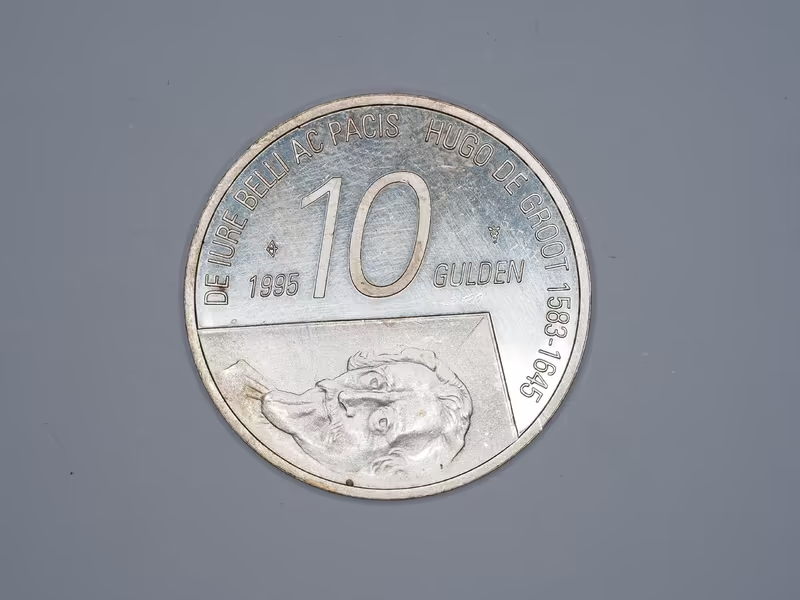
Nizozemí, 10 Gulden 1995 - Hugo de Groot
Nizozemsko, Beatrix (1980-2013) 10 Gulden 1995 - Hugo de Groot, KM# 220 Ag (.800), 33 mm (15 g). Mincovna: Královská holandská mincovna - Utrecht. Hrana s nápisem "★ GOD ★ ZIJ ★ MET ★ ONS". Stříbrná pamětní oběžná mince - vydaná k 350. výročí úmrtí…