J. P. Morgan
J. P.
John Pierpont Morgan (1837–1913) grew up in an environment of international trade and finance and from his youth moved between the United States and Europe. It was precisely the linking of American capital with European financial markets that was crucial for his career: in the era of the rapid industrialisation of the United States, Morgan represented the type of financier who could arrange large loans, organise issues of securities, and above all build confidence in the enormous enterprises that needed capital for railways, heavy industry and energy.
At the turn of the century his name became a symbol of so-called "Morganisation" — that is, the restructuring and consolidation of firms into larger, more stable units. Morgan did not move only at the level of financing, but often intervened in management: he pushed through reorganisations, supervisory boards and rules that were to restrict chaotic competition and ensure firms greater long-term stability. This model was attractive in an era of sharp economic cycles, since it could reduce the risk of bankruptcy and at the same time create giant enterprises that were to dominate the market.
Morgan's best-known step is connected with the creation of United States Steel at the beginning of the 20th century — a large industrial conglomerate that symbolised the era of gigantic corporations. Equally significant were his interventions in the railway sector, where he took part in the stabilisation and merging of lines. The public therefore perceived him ambiguously: on the one hand as "the man who knows how to bring order to the economy", on the other as a representative of the concentration of economic power in the hands of a narrow elite.
History
Morgan's reputation as a "saviour of the market" was strengthened considerably during the financial panic of 1907, when the United States found itself in a deep liquidity crisis. At a time when a modern central bank did not yet exist, Morgan's circle of bankers and industrialists played an extraordinary role in the coordination of loans and in ensuring confidence in the financial system. It is precisely the experience of this crisis that is often cited as one of the impulses that later led to the founding of the Federal Reserve System.
Alongside the financial world, Morgan had cultural significance as well. He was an important collector of art, supported museums and institutions, and his collections influenced the American cultural environment. After his death in 1913, the family and the banking house continued their activity, but the social mood was at the same time changing: pressure grew for the regulation of large financial houses and for the limitation of monopolistic structures. Morgan thus remains one of the central figures of the "Gilded Age" and the early 20th century, when modern American finance was only beginning to be institutionalised.
J. P. Morgan is important above all as a symbol of an era when banking houses helped shape industrial development and when finance and politics were often intertwined. In practice this meant that bankers could influence the direction of entire sectors: they decided who would receive capital, under what conditions and how the firm would be managed. From a historical point of view, Morgan's model is typical of the era before strong state regulation and before the fully developed role of a central bank.
Influence on Finance and Context for Collectors
For numismatics and notaphily his name appears indirectly: particularly in connection with American financial crises, the development of the banking system, and historical themes on commemorative medals or collectors' issues. He also belongs among the personalities who are often recalled in the context of the history of capital, the stock exchange and great mergers, which can be relevant when describing collection items connected with American industry and banking at the turn of the century.
In our auction and shop
- Code: BINDI104BJ
Indie, 50 Rupees 2012-2014, P.104b-j
Indie / India 50 Rupees 2012-2014, P.104b-j, v případě konkrétního roku vydání je foto pouze ilustrační N/UNC
Skladem 1 ks - Code: BVIET121AJ
Vietnam, 50.000 Dong 2003-2014, P.121a-j, plastová
Vietnam / Viet Nam 50.000 Dong 2003-2014, P.121a-j, plastová, v případě konkrétního roku vydání je foto pouze ilustrační N/UNC
Skladem 3 ks - Code: BNAM006S
Namíbie, 20 Namibia Dollars (2002), bankovní vzor, J 00000000, P.6s
Namíbie / Namibia 20 Namibia Dollars (2002), bankovní vzor, J 00000000, přetisk SPECIMEN, P.6s N/UNC
Skladem 1 ks - Code: ZN-PRUX1913.P
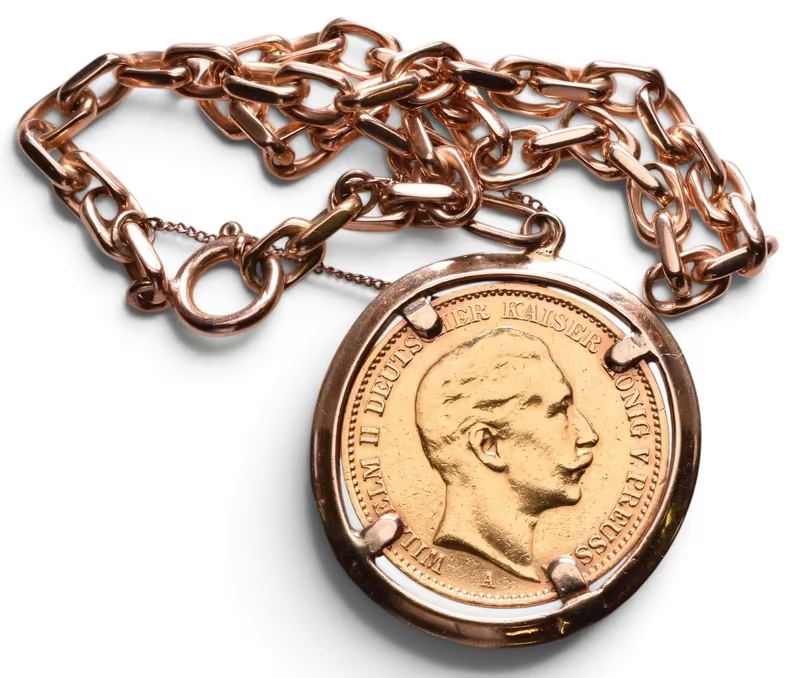
Prusko, 20 Marka 1913 A - přívěsek s řetízkem
Prusko, Wilhelm II. (1888 - 1918) 20 Marka 1894 A, J. 252, zasazena ve zlatém rámečku se závěsem a řetízkem Au 0,900, 22 mm (7,965 g), Au 0,585 (12,1 g), celková hmotnost 20,06 g (14,18 g ryzí zlato)
Skladem 1 ks