Henry II the Saint
Henry II the Saint (973/978–1024) was Roman-German king and Holy Roman Emperor, the last sovereign of the Ottonian dynasty. He was renowned for his support of the Church, the founding of institutions (especially in Bamberg) and his effort at firmer administration of the Empire; in 1146 he was canonised.
Henry II the Saint (Latin Heinricus, German Heinrich II) belongs among the most prominent rulers of the turn of the 10th and 11th centuries. He came from the Bavarian collateral line of the Ottonians: his father was Henry II the Quarrelsome and his mother Gisela of Burgundy. Already this family background foreshadowed that Henry's politics would rest on a sensitive balancing of relations within the Empire — between royal power, the dukes and the ecclesiastical institutions, which in the early Middle Ages formed the backbone of administration and learning.
In 1002 Henry was elected and crowned King of the East Frankish Realm (Roman king) at Mainz. In the following years he sought to ensure that his rule rested not only on dynastic prestige, but on real control over key areas. In 1004 he also obtained the Italian crown at Pavia, and thereby his power framework was extended to the traditional core of imperial politics — the relationship to Italy and the papacy. The pinnacle was the imperial coronation on 14 February 1014 in Rome, which was granted to him by Pope Benedict VIII. The image of Henry as an "emperor-churchman", however, rests not only on ceremonial acts, but above all on the long-term, systematic building of support in ecclesiastical institutions.
A fundamental act was the founding of the diocese of Bamberg. At the synod in Frankfurt am Main, opened on 1 November 1007, Henry established the new bishopric of Bamberg by separating parts of the dioceses of Würzburg and Eichstätt and endowed it with extensive gifts. Bamberg became his "heart" institution and at the same time an instrument of his rule: a bishopric with a firm economic base strengthened the royal presence in the region and made it possible to direct administration and power ties more purposefully. Henry thereby followed up on the Ottonian tradition of using the Church as a stable support of the state, but brought it to an exceptional consistency.
History
Henry's rule was at the same time a time of conflicts. The Empire had to deal with tensions in Central Europe, especially in the east, and the emperor repeatedly intervened in the affairs of neighbouring lands. His politics was not only "pious", but also harshly pragmatic: he consolidated authority, intervened in the appointment of offices and carefully ensured that power in the Empire did not break down into competing centres. A great role was played by the fact that he had no direct heir, and the question of succession remained open up to his death.
An important figure in his life was his wife Cunigunde of Luxembourg, who participated in religious and donor activities and was later also canonised (1200). Henry died on 13 July 1024 at Grone near Göttingen. More than a hundred years later, in 1146, he was canonised by Pope Eugene III. The sanctity of Henry II is traditionally interpreted as a connection of sovereign responsibility with support of church life: he remained in memory as a ruler who understood power as service to order, not merely as personal advantage.
Henry II is a typical representative of early medieval rule, when the administration of the Empire was based on ecclesiastical institutions. The founding and endowing of bishoprics and monasteries was not only an expression of piety, but also practical politics: the Church had its own written culture, administrative continuity and the capacity stably to administer property. For this reason Henry's "church policy" was reflected in the functioning of the state — from the collection of dues to the maintenance of order in the regions.
Sovereign, Church and coins
In numismatics his era falls within the period when in the German lands small silver coins of the denarius type (pfennig) dominated. The strikes arose in various mints and bore simple Christian motifs (crosses and their variants) and inscriptions associated with rule or the place of striking. The coin at this time was not only a practical currency but also a means of legitimation: the sovereign and ecclesiastical centres expressed authority through symbols intelligible even to those who could not read. With the denarii/pfennigs of Henry II it is therefore important when identifying to combine style, inscription, type of cross and provenance, since small deviations often mean a different mint or issue phase.
Henry's era is interesting for collectors also because of how closely it links politics, the Church and the economy. Firmer administrative centres (for example Bamberg) supported the market and the demand for small currency, while the coin at the same time carried the visual "language" of the time: Christian signs, emphasis on order and authority, and sometimes hints of regional identity. Precisely in this lies the numismatic value of the period: from small silver coins one can read how the early medieval Empire strove to act in unity, even though it was composed of many lands and centres of power.
In our auction and shop
- Code: SFRA87-D1586
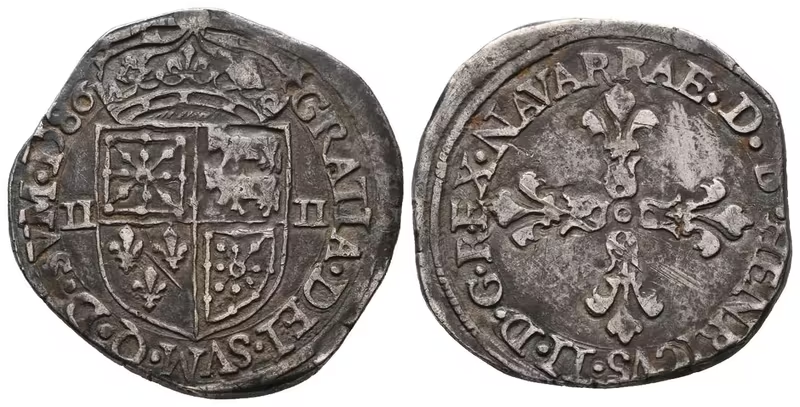
Francie, 1/4 Ecu d’Bearn 1586
Francie - Vikomtství Béarn, Jindřich II. Navarrský (1572 - 1589) 1/4 Ecu d´Bearn 1586, minc. Pau, PA.3501, pěkná zachovalost a patina_R!
Skladem 1 ks - Code: SKYP-A1310
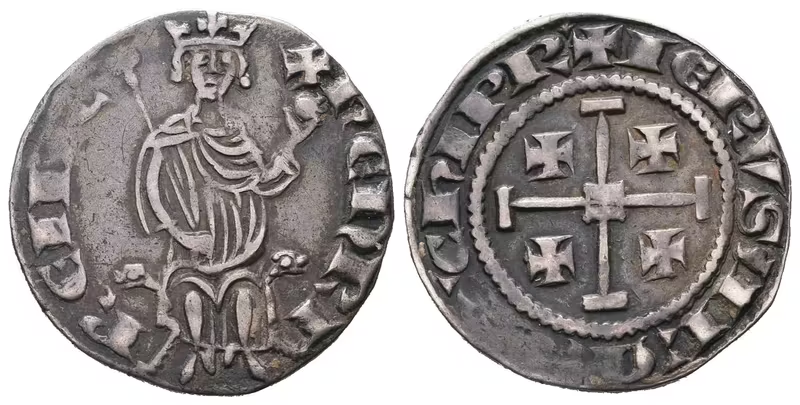
Kypr, AR Groš b.l.
Království Kypru a Jeruzaléma, Jindřich II. Kyperský (Lusignan) (1285 - 1324) AR Gros Grand b.l. (1310 - 1324), Sedící panovník s insigniemi čelně, opis HENRI REI De / IERVSL ED ChIPR, Metcalf 674/675, 687 Velmi pěkná zachovalost, kabinetní patina, pěkně…
Skladem 1 ks - Code: RAZEM-1978
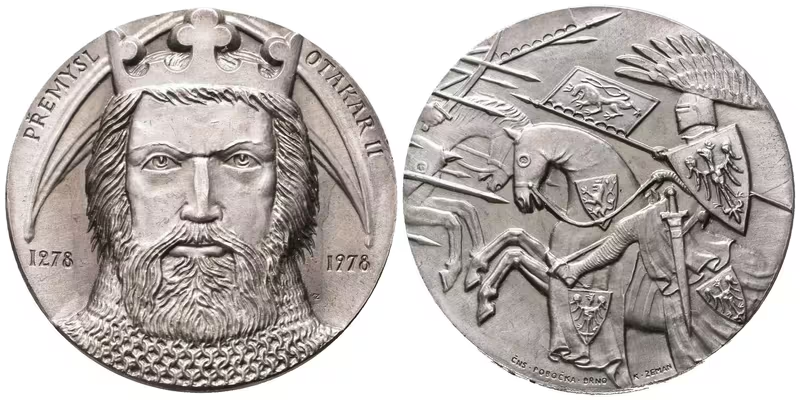
Zeman Karel - Přemysl Otakar II.
Zeman Karel (1949 - ) AR Medaile (1978) - k 700. výročí úmrtí krále Přemysla Otakara II. AG 0,900, 40 mm (50g), raženo 400 ks