Josef Šejnost
Josef Šejnost (30 May 1878, Těšenov near Horní Cerekev – 9 February 1941, Prague) was one of the supreme masters of Czech and Czechoslovak medallic art in the first half of the 20th century. Alongside Otakar Španiel he shaped the First Republic portrait medal and plaque, and his 1923 competition design for the St Wenceslas Ducat remains an icon of Czech n…
Biography, Studies and the Wind Castle at Křemešník
Born on 30 May 1878 in Těšenov in the Vysočina Highlands to a farming family, Šejnost first completed the State Vocational School of Ceramics in Bechyně (1894–1897) and worked as a modeller in ceramic factories in Rakovník, Vamberk and Šumperk. Only after saving sufficient funds did he enter the School of Applied Arts (UMPRUM) in Prague in 1901 (1901/1902–1908), studying figurative sculpture under Stanislav Sucharda and painting under Jan Preisler.
Under Sucharda's influence he devoted himself entirely from 1911 onward to small-scale sculpture, plaques and medals. An active member of the Mánes Union of Fine Artists and Sokol, he edited the art journal Dílo (1924–1926) and published the theoretical treatise The Problem of Progress in Sculpture (1924). Between 1929 and 1939 he built his dream residence and private coin-and-medal museum—the Wind Castle (Větrný zámek)—atop Křemešník Hill near Pelhřimov to plans by his friend, architect Kamil Hilbert. He died in Prague on 9 February 1941 before its completion; his son Zdeněk Šejnost carried on the family sculptural legacy.
Gallery of Portrait Medals and the "Men of 28 October"
Josef Šejnost excelled in penetrating psychological portraiture paired with rich allegorical reverses, creating a monumental gallery of figures from Czechoslovak history, science and sport:
- Men of 28 October: the celebrated memorial tablet bearing portrait plaques of Alois Rašín, Antonín Švehla, František Soukup, Jiří Stříbrný and Vavro Šrobár in Prague's Municipal House.
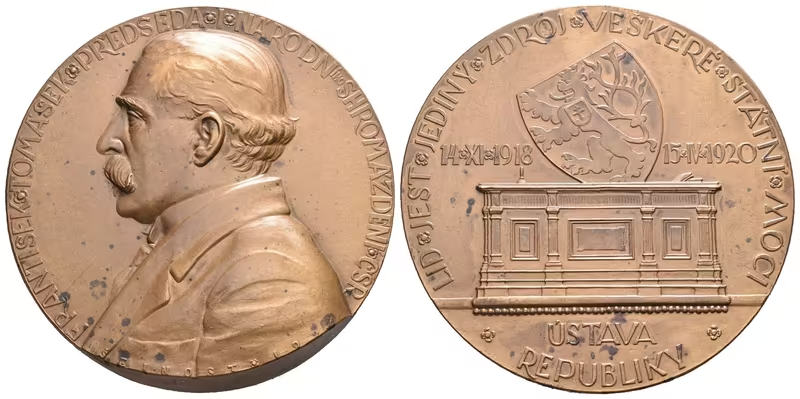
- Statesmen and scholars: extensive medallic portraits of T. G. Masaryk, Edvard Beneš, Josef Dobrovský, František Tomášek, Jan Malypetr, Karel Vrba and Josef Zubatý.
- Sport and culture: the famed medal for Czechoslovakia's first Olympic champion Bedřich Šupčík (1924), alongside memorial plaques at the birthplaces of Bedřich Smetana in Litomyšl and Karel Havlíček Borovský in Humpolec.
The St Wenceslas Ducat (1923) and Numismatic Legacy
In 1923 Šejnost entered the landmark competition held by the Czechoslovak Ministry of Finance for the first Czechoslovak trade gold ducat. Although the jury selected the design of Jaroslav Benda and Otakar Španiel for official state striking at Kremnica, Šejnost's dramatic portrayal of St Wenceslas in armour holding a banner earned immense acclaim—struck as jubilee pieces at the Paris Mint and in later limited collector editions. In 1929 he also designed a commemorative millennial replica of the St Wenceslas denar.
On the auction market, original First Republic cast and struck medals and plaques by Josef Šejnost (in bronze, silver and gold) constitute a prized benchmark of Czech medallic art. Specialist catalogues carefully distinguish interwar Kremnica, Vienna and Monnaie de Paris strikes from authorial cast bronze plaques and later commemoratives, recognised by his signature "J. ŠEJNOST" and deep sculptural relief.
In our auction and shop
- Code: RASEJ-1930-047B2
Šejnost Josef - František Tomášek
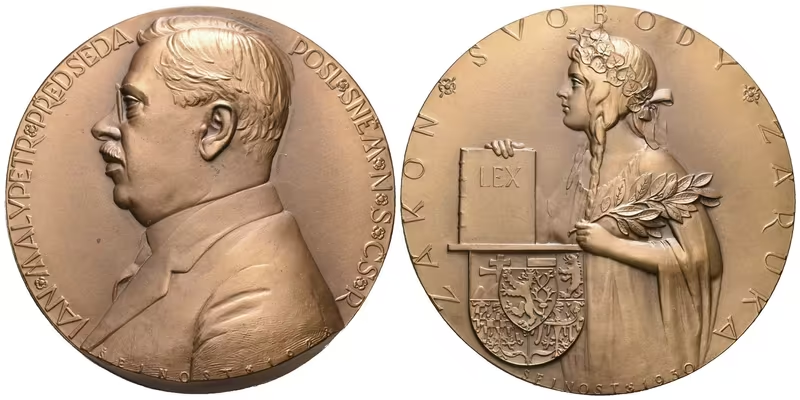
Šejnost Josef (1878 - 1941) AE Medaile 1928/1930 - Jan Malypetr, předseda vlády a poslanecké sněmovny ČR. Poprsí Zleva, opis / Dívka se zákoníkem a snítkou vavřínu drží zákoník, pod ním státní znak. Bronz 70 mm, Bo.047b (raženo 100 ks), na hraně vyraženo…
Skladem 1 ks - Code: RASEJ-1930-047B
Šejnost Josef - Jan Malypetr
Šejnost Josef (1878 - 1941) AE Medaile 1928/1930 - Jan Malypetr, předseda vlády a poslanecké sněmovny ČR. Poprsí Zleva, opis / Dívka se zákoníkem a snítkou vavřínu drží zákoník, pod ním státní znak. Bronz 70 mm, Bo.047b (raženo 100 ks), na hraně vyraženo…
Skladem 1 ks - Code: RASEJ-1925-108B
Šejnost Josef - Josef Zubatý
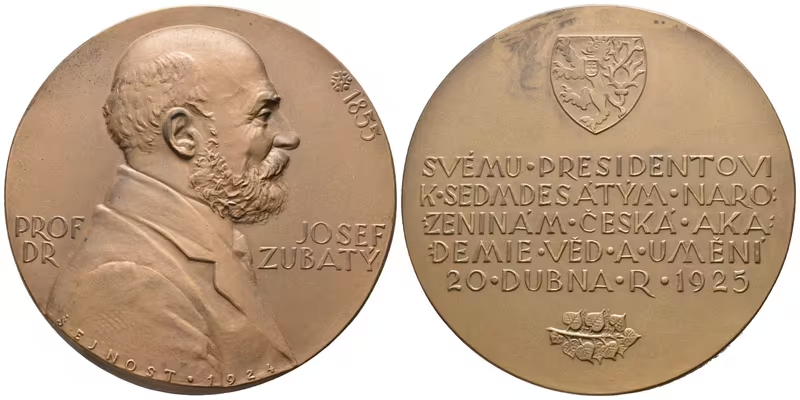
Šejnost Josef (1878 - 1941) AE Medaile 1924/1925 - Josef Zubatý, český jazykovědec. Poprsí zprava, nápis, letopočet / 5-řádkový nápis mezi čs. znakem a lipovou ratolestí. Br 60 mm, Bo.108b (raženo 400 ks)
Skladem 1 ks - Code: RASEJ-1915-104A
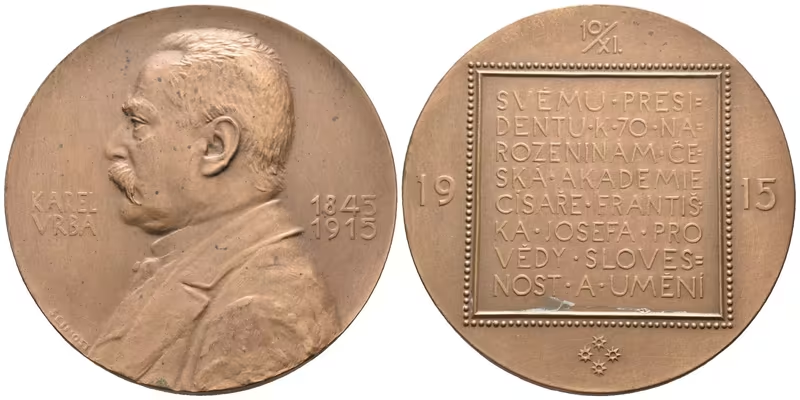
Šejnost Josef - Karel Vrba
Šejnost Josef (1878 - 1941) AE Medaile 1915 - Karel Vrba, mineralog, prezident ČSAV. Poprsí zleva, nápisy / 8-řádková nápis ve čtverci, datum. Br 59 mm, Bo.104a (raženo cca 45 ks)
Skladem 1 ks
Further in the encyclopaedia
More entries in the category Engravers. Continue browsing or return to the full encyclopaedia.