Lev
The lev has been the national currency of the Republic of Bulgaria since 1881, having gone through several redenominations and reforms while retaining its name to this day. The name lev means "lion" in Bulgarian, the national symbol of Bulgaria, and the plural form leva is used.
The Bulgarian lev was introduced by a law of 16 June 1880, two years after Bulgaria was liberated from Ottoman rule. It replaced the Ottoman kuruş and the various foreign currencies circulating in the territory of the new principality. The first lev was defined according to the principles of the Latin Monetary Union and contained 4.5 grams of pure silver, equal to the French franc. The name was chosen as a patriotic symbol: the lion represented the strength and independence of the young state. The first coins were struck by the Paris mint; banknotes were printed by Austrian and German printers.
The Balkan Wars and the First World War destabilised the lev. As a defeated country, Bulgaria faced reparations and hyperinflation. In 1928 a stabilisation was carried out, but the world crisis of the 1930s and the Second World War brought further problems. The communist takeover of 1944 meant the Sovietisation of the economy. In 1952 a monetary reform took place in which 100 old leva were exchanged for one new lev. The socialist lev was pegged to the Soviet rouble and later to a basket of socialist currencies. The quality of banknotes and coins was low and the design propagandistic.
History
After the fall of communism in 1989 the lev faced hyperinflation. In 1991–1997 it lost 97 percent of its value. The crisis culminated in 1996–1997, when monthly inflation reached 242 percent. A radical reform in 1997 introduced a currency board pegging the lev first to the German mark and then to the euro. In 1999 a redenomination was carried out at a ratio of 1,000 to 1. The new lev has been stable since then, firmly pegged to the euro at a rate of 1.95583 leva to the euro. Bulgaria plans to adopt the euro, but the date has repeatedly been postponed.
The Bulgarian lev is divided into 100 stotinki (singular stotinka). The modern lev exists in banknotes of 2, 5, 10, 20, 50 and 100 leva and coins of 1, 2, 5, 10, 20, 50 stotinki and 1, 2 leva. The design of the current banknotes features significant Bulgarian figures: Paisius of Hilendar, Ivan Vazov, Petar Beron. The coins bear the state emblem with a lion, the rose as the national flower, or historical monuments. It is of note that Bulgaria is the only EU country to use the Cyrillic script on its coins.
The lev in the Bulgarian monetary system
Technically, Bulgarian banknotes are well protected against counterfeiting, having a watermark, a security thread and microprint. Printing is done by the French firm Oberthur; coins are struck by the state mint in Sofia. The Bulgarian National Bank also issues gold and silver commemorative coins in denominations of 10, 20 and 100 leva. These coins, with motifs of Bulgarian history, culture and nature, are popular among collectors. The currency board system ensures that every lev in circulation is backed by euro reserves, which guarantees stability. The transition to the euro is a politically sensitive topic: the lev is perceived as a symbol of national sovereignty.
In our auction and shop
- Code: BBULH087A.0
- Code: SBUL-M1989.1
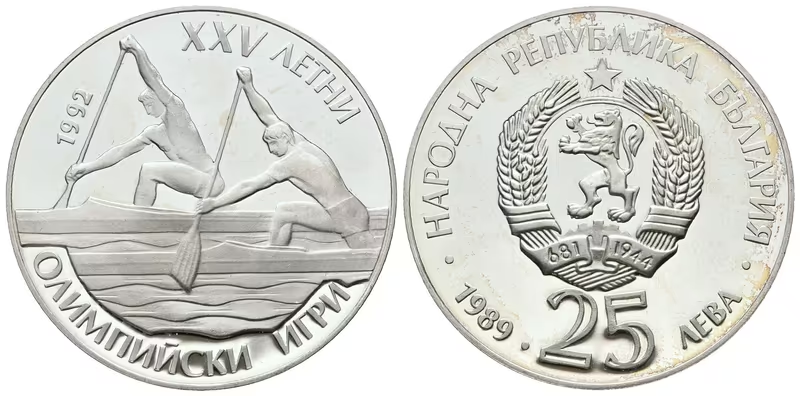
Bulharsko, 25 Leva 1989 - Olympijské hry - kanoistika
Bulharská lidová republika (1946-1990) 25 Leva 1989 - Olympijské hry - kanoistika, KM# 185 Ag (.925), 38,61 mm (23,33 g), v kapsli. Stav mince odpovídá fotografii.
Skladem 1 ks - Code: ZSBUL-1999
Bulharsko, 100 Leva 1999 - Todor Burmov
Bulharsko / Bulgaria 100 Leva 1999 - Todor Burmov - 120 let Rady ministrů Au 0,900 , 30 mm (16 g), raženo pouze 5000 ks, PROOF РЕПУБЛИКА БЪЛГАРИЯ, 100 ЛЕВА 1999 - 120 ГОДИНИ МИНИСТЕРСКИ СЪВЕТ ∙ БЪЛГАРИЯ, ТОДОР БУРМОВ
Skladem 1 ks - Code: YL-341222
Ochranný obal na bankovky, 210 x 127, 50 ks
Ochranné obaly Leichtturm na vaše bankovky až do rozměru 210 x 127 mm (š / v). Obaly jsou svařeny na 3 stranách (spodní, levá a pravá), otevřené nahoře. Snadné vkládání a vyjímání bankovek. Křišťálově čistý ochranný obal zajišťuje, že bankovky lze…
Skladem (>5 ks)