Lirot
Lirot is the plural of the Israeli lira, the currency of the State of Israel from its founding in 1948 until 1985, when it was replaced by the shekel. The name comes from the Hebrew transcription of the Italian lira and symbolised a connection with European tradition in the building of the new state.
The Israeli lira was introduced on 9 June 1948, just a month after the proclamation of the independence of the State of Israel. It replaced the Palestine pound, which had been administered by the British Mandate authority since 1927. The first issues were provisional: overprinted Palestine banknotes with a Hebrew inscription. The Israeli government needed to create its own monetary system quickly for the new state in the middle of the war of independence. Anglo-Palestine Bank (later Bank Leumi) took over responsibility for the first issues, before the Bank of Israel was created in 1954.
The first decade of the Israeli lira was marked by high inflation caused by mass immigration, which doubled the population, and by the costs of defence. In 1960 the lira was devalued and a new Israeli lira introduced at a ratio of 10:1. This reform was intended to stabilise the economy, but inflationary pressures continued. The Six-Day War of 1967 and the Yom Kippur War of 1973 required enormous military spending. In the 1970s inflation accelerated, reaching 111 percent annually in 1979.
History
At the beginning of the 1980s inflation got out of control: in 1984 it reached 445 percent. Prices changed daily and wages were indexed, but still not enough. In July 1985 the government carried out a radical stabilisation programme and introduced the new shekel at a ratio of 1,000:1. The Israeli lira thus came to an end after 37 years as a symbol of the young state's economic problems. The name shekel was chosen as a return to biblical tradition and a departure from the European lira.
The Israeli lira was divided into 100 agorot (singular agora) on the decimal system. In Hebrew the form lira jisraelit (singular) and lirot (plural) was used. Banknotes existed in denominations from 500 prutot (half a lira) up to 100, later 500, 1,000, 5,000 and finally even 10,000 lirot. Coins were struck from 1 agora up to 10 lirot, later up to 100 lirot due to inflation.
The lira in the Israeli economy
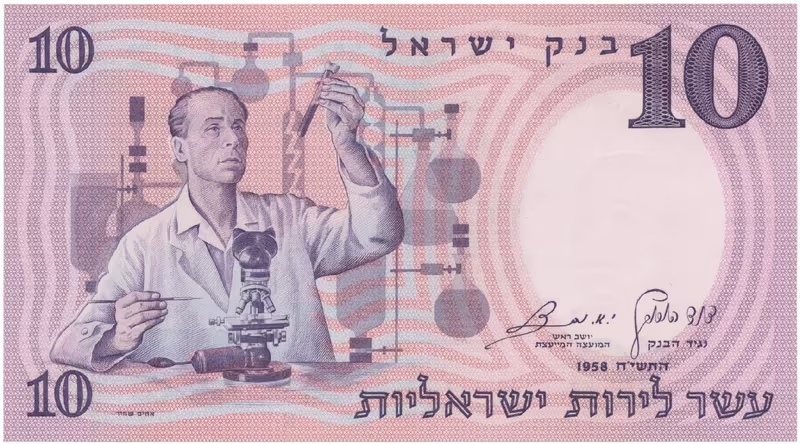
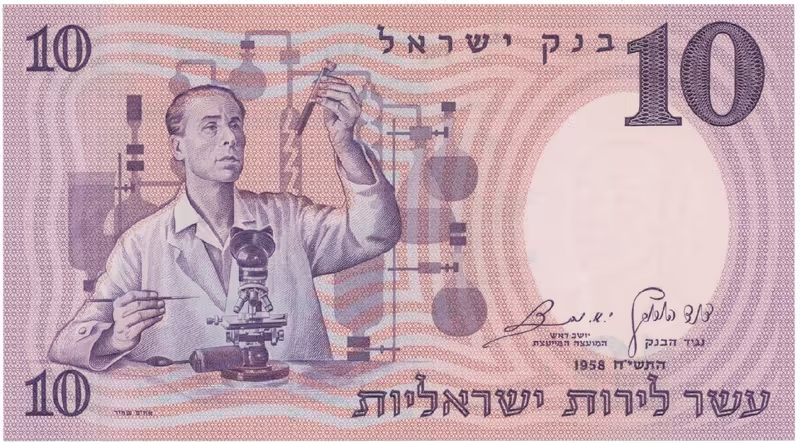
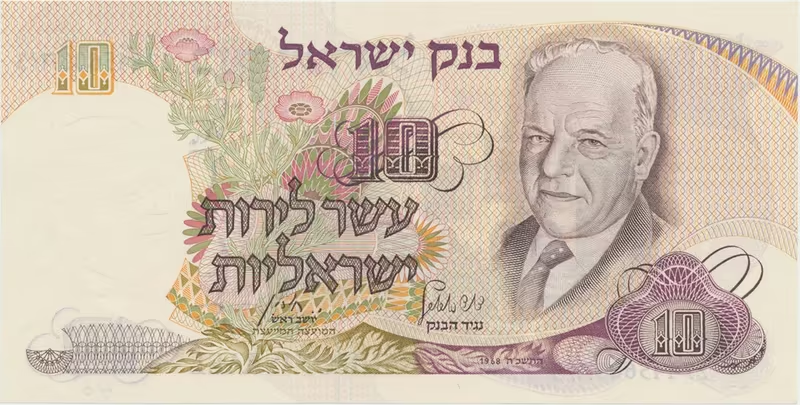
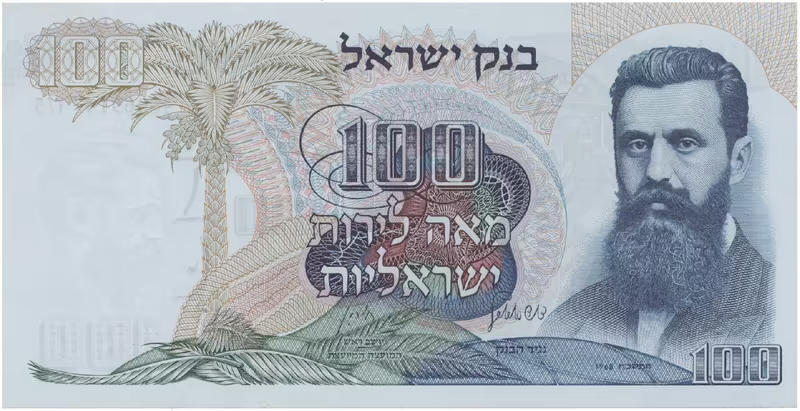
The design of the Israeli lirot reflected national symbols and history: the menorah, the Star of David, archaeological finds. Banknotes depicted significant figures such as Herzl, Weizmann, Ben-Gurion, and later Maimonides and the poetess Rachel. Coins bore motifs from ancient Jewish coins and the flora and fauna of Israel. Technically Israeli means of payment were of high quality: banknotes were printed by the Dutch firm Enschede, later by a domestic printer. Coins were struck by various European mints, including Kremnica. Of interest were the special issues for the occupied territories after 1967 with Arabic inscriptions. Commemorative coins in lirot documented significant events: anniversaries of independence, victories in wars, the memorial of the Holocaust. Today these numismatic memorials are valuable for understanding the formative years of Israel.