Mainz
Mainz (Czech Mohuč) is the capital of the federal state of Rhineland-Palatinate at the confluence of the Rhine and the Main. It is among the oldest German cities, growing out of the Roman Mogontiacum, and was for centuries an ecclesiastical and political centre, known also thanks to Johannes Gutenberg.
Mainz has roots in antiquity. The Romans founded here the military and administrative centre of Mogontiacum, which protected the Rhine frontier and at the same time profited from the river as an artery of transport. Thanks to its position on a great waterway, the place soon became a hub of trade and supply: goods, raw materials and people flowed along the river, and it was precisely such cities that had a long-term capacity to survive political upheavals.
In the Middle Ages Mainz gradually developed into one of the most influential ecclesiastical centres in the German space. A turning point was the elevation to a metropolitan archbishopric (at the close of the 8th century), after which the archbishops of Mainz acquired an ever more prominent standing not only in the Church but also in secular politics. Within the Holy Roman Empire the archbishops of Mainz ranked among the most powerful imperial princes and for centuries belonged to the electors — that is, to the narrow circle of those who chose the emperor. This made Mainz a city where spiritual authority, diplomacy and administration met.
History
In the 15th century Mainz also entered European history as the city of printing. It was here that Johannes Gutenberg was active, whose printing with movable type changed the spread of texts, education and communication. The impact was not merely cultural: printing accelerated the work of offices, legal practice and commercial life, because information and documents became more accessible and could be reproduced more quickly.
The modern period brought Mainz both prosperity and upheavals. Its strategic position on the Rhine meant an advantage for trade, but at the same time attracted military interests and the city repeatedly found itself at the centre of conflicts. Fundamental changes came at the end of the 18th and the beginning of the 19th century, when the old ecclesiastical principality fell apart and the city was gradually incorporated into more modern state structures. In the 20th century Mainz was severely damaged by war, but afterwards underwent reconstruction and today functions as the administrative, university and cultural centre of Rhineland-Palatinate.
Coins, trade and the Mainz tradition
Mainz is important for numismatics above all thanks to the long tradition of strikes associated with the archbishops of Mainz. As ecclesiastical princes they held the right of coinage, and their coins bore a titulature and heraldry which in circulation confirmed both the origin and the authority of the issuer. In the environment of Rhenish trade, moreover, coins spread rapidly among towns and markets, so that confidence in the weight and quality of mintage was crucial.
For collectors, both the medieval and early modern strikes of the Mainz milieu and the wider Rhenish context are attractive, where the coins of cities, principalities and ecclesiastical states met side by side. Mainz thus represents a typical "river" centre: a city whose significance is reflected not only in chronicles and architecture but also in the coins which accompanied everyday trade and administration.
In our auction and shop
- Code: ZN-MAIN1636
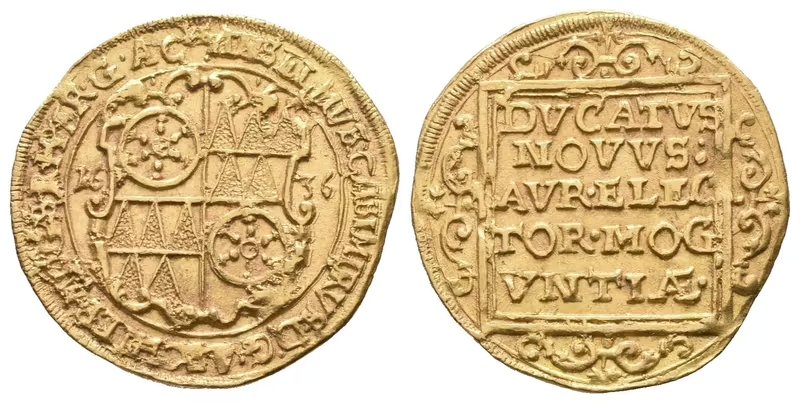
Mainz - arcibiskupství, Dukát 1636
Mainz (Mohuč) - arcibiskupství, Anselm Casimir Wamboldt von Umstadt (1629 - 1647) Dukát 1636, Mainz, Fb. 1652; Slg. Walther 252 (3,51 g), krásná zachovalost
Skladem 1 ks - Code: NE-Z1917MO
Nouzové ražby, 10 Pfennig 1917 - Mainz
Nouzové platidlo - Německo 10 Pfennig 1917 - Mainz/Mohuč, Al 22 mm
Skladem 1 ks - Code: ZN-MAIN1397
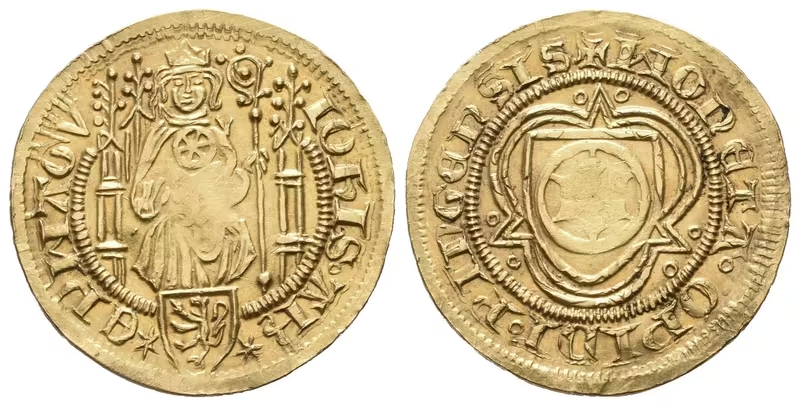
Mainz - arcibiskupství, Goldgulden b.l.
Mainz (Mohuč) - arcibiskupství, Johann II. von Nassau (1397 - 1419) Goldgulden b.l. (1397-1399), Bingen, Fb. 1615; Felke 582 var.; Link 25; Slg. Walther 9 (3,46 g), písmena M v opise na av. i rev. otočená vzhůru nohami