Margaret of Austria
Margaret of Austria (1480–1530) was a Habsburg princess and a significant early modern stateswoman who, as governor, administered the Habsburg Netherlands. She was renowned for her diplomacy, capable administration and extraordinary patronage of art and learning at her residence in Mechelen.
Margaret of Austria was born on 10 January 1480 in Brussels as the daughter of Maximilian I and Mary of Burgundy. From childhood she was drawn into wider European politics: the Burgundian inheritance and the rivalry between the Habsburgs and France made her a valuable dynastic "bridge" between the great powers. While still a small child she was betrothed to the French Dauphin, the future king, but the plan collapsed amid shifting treaties and alliances. There followed a marriage to the heir to the Spanish throne, Prince John, who died shortly after the wedding. A third marriage was concluded with the Duke of Savoy, but here too she was widowed early. The repeated personal loss is often cited as one of the reasons why she did not remarry and fully realised her role in politics and administration.
Margaret's principal significance lies in her activity in the Habsburg Netherlands (that is, the part of the Low Countries under Habsburg rule). She became governor for her nephew Charles V, and in the years 1507–1515 and again from 1519 until her death in 1530 she ensured continuity of government in the region during periods when the monarch resided mainly outside the Netherlands. Her court in Mechelen became an administrative centre and a diplomatic hub: there Margaret conducted negotiations, balanced the interests of cities, estates and dynasty, and sought to maintain stability in an area that was economically extremely important and politically sensitive.
Margaret excelled as a negotiator. She took part in major peace and dynastic agreements of her time, and on both Central and Western European scales she was among the most influential women ever to rule in the Netherlands. Her authority was not merely formal: it rested on experience, knowledge of court politics and the ability to work through compromise. At the same time she was able to draw on learned advisers and an administrative apparatus that helped manage finances, law and the everyday running of offices.
History
Alongside politics, Margaret made her mark in history as a notable patron. She maintained an extensive library and art collections and supported painters, musicians and scholars. Her Mechelen palace functioned as a cultural centre of the Burgundian–Habsburg sphere and created an environment in which the representation of power was interwoven with learning. She died on 1 December 1530 in Mechelen; she was succeeded in office by another Habsburg regent, Mary of Austria.
Margaret's government in the Netherlands had a practical, "administrative" dimension: it dealt with taxes, court disputes, relations with cities and the defence of the territory, in a region that was among the wealthiest parts of Europe. The court in Mechelen was not only a place of ceremony but also a working centre where correspondence, negotiations and decision-making were concentrated. Her style of administration is described as firm but at the same time capable of seeking agreement with local elites, without whom government in the Low Countries could not have been sustained.
For numismatics, Margaret is interesting chiefly indirectly: as governor she stood at the head of the administration of a territory where coinage and the circulation of money had great importance for trade and public finances. In the Netherlandish and Burgundian lands of the 16th century, various denominations were struck, building on the Burgundian tradition while expressing Habsburg sovereign authority. Coinage here was not merely a technical matter but also an instrument of state prestige and economic control — the quality of the metal, the stability of the currency and trust in the means of payment were directly linked to the collection of taxes and the functioning of the market.
Administration, court and connections with coinage
On the cultural level, Margaret became a symbol of "female regency" in the Netherlands: she demonstrated that even within dynastic politics, otherwise strongly masculine, an educated and experienced ruler could long and successfully represent an absent sovereign. Her legacy therefore rests on the combination of diplomacy, administration and culture — and it was precisely this combination that helped shape the image of Habsburg power in a wealthy and strategically vital part of Europe.
In our auction and shop
- Code: NASA-1181
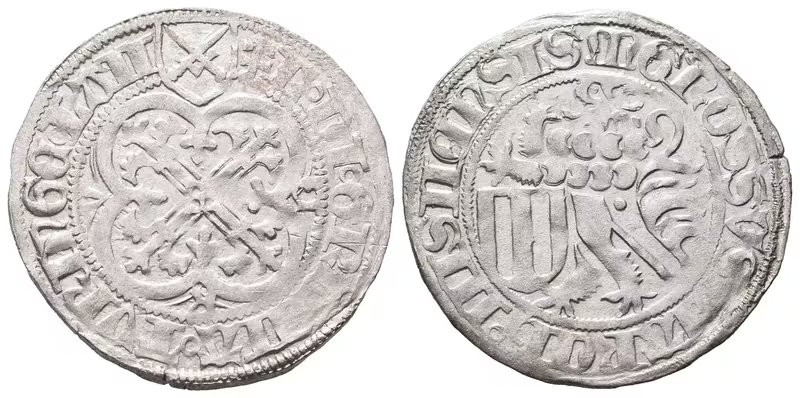
Sasko - Míšeň, Mečový groš, Colditz
Sasko - Míšeň, Friedrich II. a Margaretha (1456 - 1464) Schwertgroschen b.l. (1457 - 1464), Colditz, Krug.1181/77-78, stav 1/1, pěkná zachovalost, pěkně vyražený, drobné rysky
Skladem 1 ks - Code: SDANS89-C1958
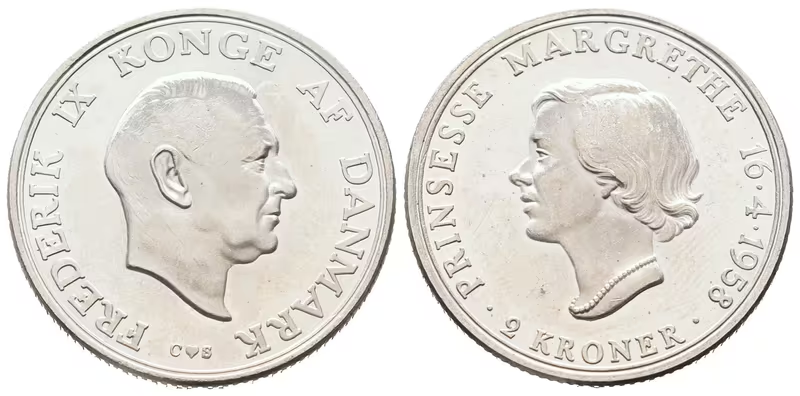
2 Kroner 1958 - Narozeniny princezny
Dánsko, Frederik IX. 1947 - 1972 2 Kroner 1958 - 18. narozeniny princezny Margarety, KM.845, krásná zachovalost, ražební lesk Ag 0,800, 31 mm (15,0 g)
Skladem 1 ks - Code: SDANS89-C1958.1
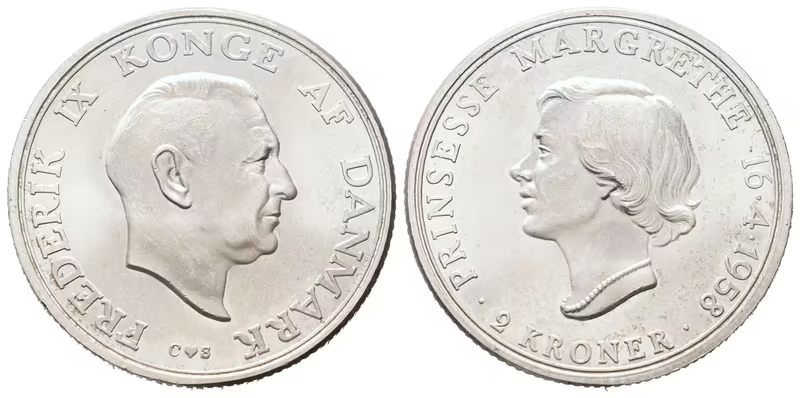
2 Kroner 1958 - Narozeniny princezny
Dánsko, Frederik IX. 1947 - 1972 2 Kroner 1958 - 18. narozeniny princezny Margarety, KM.845, krásná zachovalost, ražební lesk Ag 0,800, 31 mm (15,0 g)
Skladem 1 ks - Code: NARAD-1317
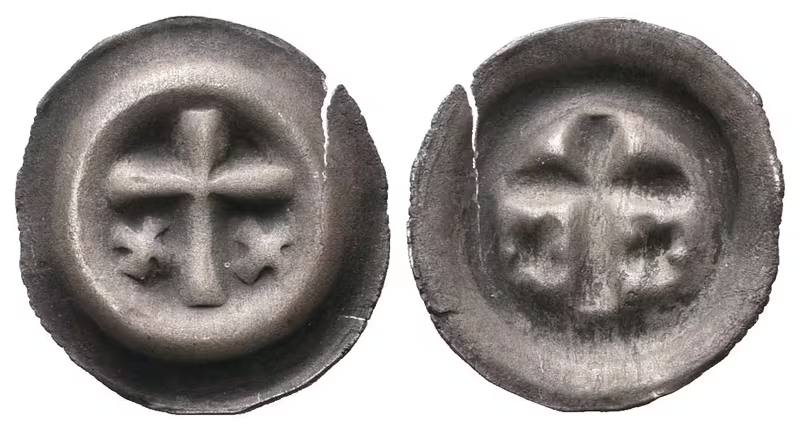
Němečtí rytíři, Brakteát
Řád německých rytířů, Werner von Orseln?,1317 - 1328 Malý brakteát - Latinský kříž, pod. Paszkiewicz T9.32, pěkná zachovalost a patina, lehce napr.
Skladem 1 ks