Maximianus Herculius
Maximianus Herculius was Roman emperor (Augustus) in the western part of the empire from 286 to 305, co-ruler of Diocletian during the period of the Tetrarchy. The epithet "Herculius" referred to Hercules and was meant to emphasise his role as an energetic executor of imperial power, especially in military campaigns.
Maximianus Herculius (Marcus Aurelius Valerius Maximianus) came from the milieu of the late Roman army, which in the 3rd century represented the main route to the highest offices. He reached the summit thanks to his abilities in the field as well as his personal bond with Diocletian, who after his accession to power sought a reliable partner for the administration and defence of the vast empire. First Maximian was elevated to the lower rank of Caesar (285) and soon afterwards to Augustus (286), creating a firmer dual rule that was to respond to frequent usurpations, barbarian incursions and crises on the borders.
In propaganda their cooperation was stylised by religious epithets: Diocletian appeared as Iovius (linked with Jove), while Maximian as Herculius (linked with Hercules). This was not a "deification" in the modern sense, but a symbolic language of power: Jove represented order and authority, Hercules strength and deed. Practically it also corresponded to the division of work. Maximian concentrated mainly on the western provinces — Gaul, Hispania and Italy — and his task was to stabilise territory where both military and social problems were accumulating.
In Gaul he faced, among others, rebel groups designated as Bagaudae and at the same time had to react to the pressure of Germanic tribes on the Rhine frontier. The western part of the empire was crucial for Diocletian's system: if the defence and the collection of taxes were to collapse here, it would have threatened the functioning of the entire empire. Maximian therefore combined the role of supreme commander and administrator, who was to restore order, strengthen fortresses and maintain the army's loyalty. At the same time, the demanding stabilisation of the coast and sea routes also took place, since the safety of transport was vitally important for supplying Italy.
History
By extending the original dual rule, the Tetrarchy arose in 293 — a system of two Augusti and two Caesars. In the west, Constantius Chlorus became Maximian's Caesar, taking over part of the military tasks and gradually profiling himself as the successor. The Tetrarchy was meant to limit the struggle for the throne by having the succession determined in advance and supported by the authority of the reigning emperors. In practice it was one of the most carefully thought-through attempts to make the Roman Empire a more manageable whole in a time of permanent threats.
On 1 May 305 Maximian, at Diocletian's prompting, abdicated and withdrew into seclusion. His story did not end there, however. After the death (or fall) of further authorities and the outbreak of new conflicts, he repeatedly returned to politics: he supported his son Maxentius in Italy, later attempted to play the role of "restorer" of the old order, but ran into the resistance of rivals and the distrust of the army. At the conference at Carnuntum in 308 he was again forced to renounce his claims to the imperial dignity. His last coup attempt was made in 310 against Constantine I the Great; it ended in failure and Maximian died shortly afterwards in Massilia (today's Marseille) — traditionally cited as a suicide forced by defeat and political pressure. His fate clearly shows that even the carefully thought-out system of the Tetrarchy could quickly collapse without the wider agreement of the army and the elites.
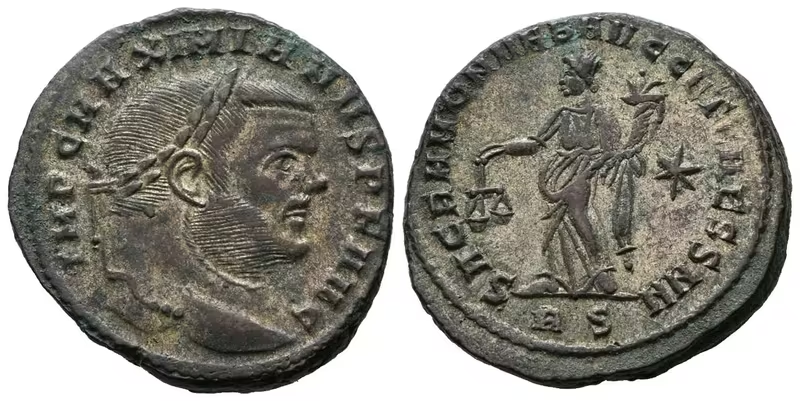
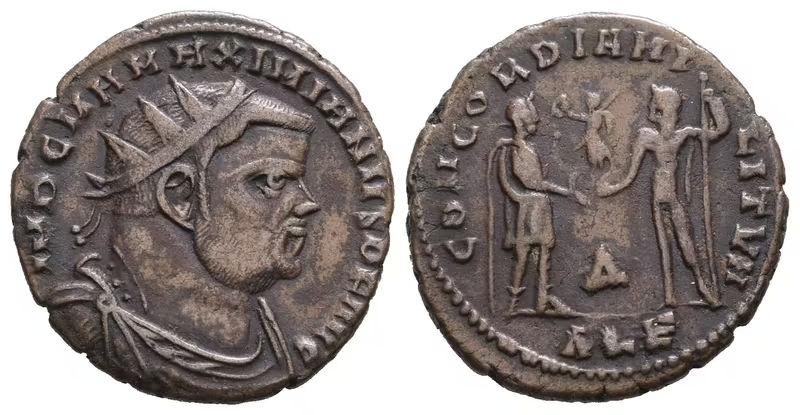
As Maximianus Herculius he was one of the central faces of Tetrarchic propaganda, which is exceptionally well visible on the coins. On the obverse appears his portrait with emphasis on military authority (laureate, armour, stern expression) and with legends of the type IMP C MAXIMIANVS P F AVG, which emphasise the imperial title, piety and "successful" rule. The Tetrarchy generally promoted a unified, easily recognisable style of portraits — less individualised than before — so that the principle of collective rule and stability would stand out.
Role in the Tetrarchy and numismatics
Reverse motifs often work with the idea of the renewal of the empire, victory and divine protection. With Maximian, references to Hercules are frequent: he may appear directly as a figure with club and lion skin, or indirectly through motifs of strength and bravery. Alongside these, personifications such as Virtus (bravery), Providentia (foresight) and motifs promising peace and security are employed. From the turn of the 3rd and 4th centuries, the large bronze denominations introduced by Diocletian's reform (often designated as the follis) are typical, bearing prominent messages about "renewal" and the unity of the rulers. For collectors, Maximian's mintages are interesting also because they capture several political phases: the period of stable cooperation with Diocletian, the period of abdication, and his later returns to the game, which are reflected in more exceptional issues and titulature.
In our auction and shop
- Code: BE120-0103B
Maximianus Herculius, Follis, RIC.103b
Maximianus Herculius (286 - 310) Follis, Roma, 302 - 303, Rv: SACRA MON VRB AVGG ET CAESS NN, stojící Moneta zleva drží váhy a roh hojnosti, RIC.103b, nep. exc., pův. postříbření
- Code: BE120-AA46
Maximianus Herculius, antoninian
Maximianus Herculius (286 - 310), antoninian - mincovna Alexandria, Maximinus přebírá glóbus od Jupitera RIC VI 46