Sword type of Czech denarii
The sword type of Czech denarii designates a group of early medieval denarii on which a short sword or dagger is depicted, often laid across a stylised hand. In the specialist literature it is classed within the circle of coins influenced by Anglo-Saxon models, and today it is usually associated with mintages from the time of Duke Boleslav II.
The sword type of Czech denarii is among the best-known pictorial motifs of early Czech coinage of the 10th century. The Czech denarius became at that time the key means of payment of the Přemyslid state: it served for payments, trade and the strengthening of sovereign authority, since on a small silver planchet it bore clear marks of the ruling power and at the same time conveyed that the coin proceeded from a recognised monetary order of Christian Europe. It is precisely within this environment that the "sword" denarii must be understood — as part of a wider set of types differing in symbolism and artistic conception, but together showing how domestic mintages developed under the influence of foreign coinage traditions.
The characteristic motif of a short weapon (sword or dagger) was long connected in numismatic interpretation with the idea of a northern, or Anglo-Saxon, impulse. For this reason the sword denarii were classed among the so-called Anglo-Saxon types of Czech denarii, that is, the circle of mintages whose pictorial language resembles contemporary coins from the area of north-western Europe. This is not merely a "borrowed picture", but rather the acceptance of a certain way of expressing authority and order on a coin: by a simple, easily recognisable symbol that functions even with imperfect striking and rapid circulation.
The interpretation of the chronology of this type changed significantly during the course of the 20th century. In older literature, sword denarii were often considered the very oldest Czech type and were attributed to Duke Boleslav I. Subsequent research, however, corrected this view. Studies and arguments associated with the names of Karel Chaur (1926) and Viktor Katz (1935) showed that the sword type cannot stand at the very beginning of Czech coinage. As chronologically older is today usually designated the so-called Regensburg type (sometimes described as Bavarian-Swabian), immediately followed by the type with the "broad hand", and only then come the sword denarii in the narrower sense. This change is not merely a detailed dispute over order: it influences the overall understanding of how rapidly Czech coinage established itself and what impulses it accepted in its first phases.
History
Contemporary numismatics most often places the sword type in connection with the reign of Duke Boleslav II (972–999). The motif of a short weapon laid across a hand, however, also appears on denarii of Soběslav Slavnikovic (981–995), which in the past led to various interpretations — sometimes even to the idea that it could be a deliberately "threatening" image aimed against the ruling Přemyslids. More convincing, however, is the interpretation that understands the motif as a Christianly legible symbol of justice and punishment, often associated with the idea of the "punishing hand of God", or as a combination of the sword motif with a depiction of the so-called narrow Anglo-Saxon hand. The sword denarii are therefore not today perceived as a political provocation in the modern sense, but rather as part of a symbolic repertoire that was to give the coin an intelligible and authoritative "language".
The sword type can be recognised primarily by the pictorial scheme: on one side of the coin (rarely on both) a short sword or dagger is depicted, often laid across a stylised hand. The artistic rendering is deliberately simple so that the motif remains recognisable even with weaker striking. The hand is usually reduced to a basic shape with an indication of fingers; the weapon is expressed by the straight line of the blade and a more pronounced hilt; precisely the relation "weapon across hand" is decisive for the type.
In specialist practice the sword type is assessed together with other "hand" and Anglo-Saxon-tinged types. It is important that this is not an isolated curiosity but a link in the development: it builds on older pictorial and stylistic currents and at the same time participates in the formation of later motifs that combine religious symbolism (cross, hand, letters) with sovereign representation. For this reason, in the literature you will encounter the sword type described not only by motif but also by the style of engraving, the composition of inscriptions, the shape of the planchet and the overall "handwriting" of the dies, since precisely these details help with placement within the wider chronology and with identifying workshops.
Typology and distinguishing features of the motif
The symbolic interpretation of the motif holds rather to the religious and legal level than to a literal "warlike" message. The weapon here can function as a sign of punishing justice, and the hand as an instrument or sign of higher power, which corresponds to the mentality of an era in which a coin often bore simple yet strong symbols. At the same time, the meaning may have been perceived in a multi-layered way: part of the audience could understand the motif religiously, others as a general sign of authority. It is precisely this intelligibility and memorability that is the reason why the sword type remains to this day one of the most easily recognisable motifs among the Czech denarii of the 10th century.
In our auction and shop
- Code: NASA-1181
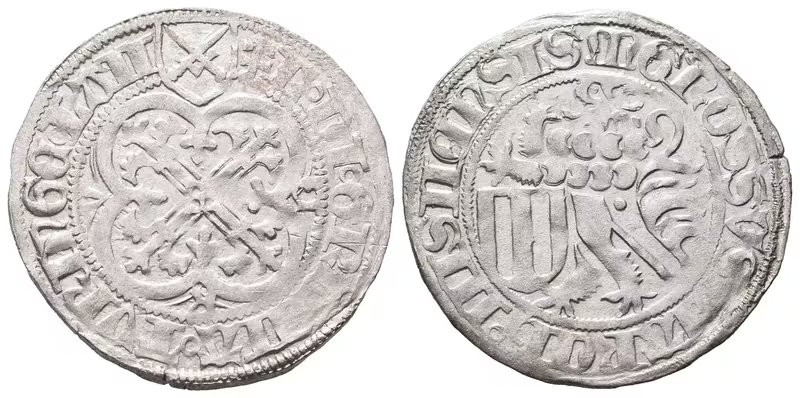
Sasko - Míšeň, Mečový groš, Colditz
Sasko - Míšeň, Friedrich II. a Margaretha (1456 - 1464) Schwertgroschen b.l. (1457 - 1464), Colditz, Krug.1181/77-78, stav 1/1, pěkná zachovalost, pěkně vyražený, drobné rysky
Skladem 1 ks - Code: NASA-1456
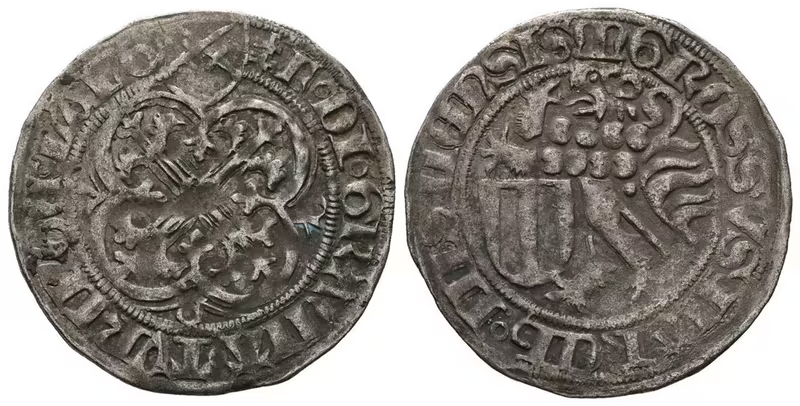
Sasko - Míšeň, Mečový groš, Colditz
Sasko - Míšeň, Friedrich II. a Margaretha (1456 - 1464) Schwertgroschen b.l. (1457 - 1464), Colditz, Krug.1191, Mehn.19/30, stav 2/1-, patina, ned.