Planchet
A planchet (or blank) is a metal disc prepared for striking a coin, which must have a precise weight, diameter and composition. It is produced in several stages — from metal processing through rolling and blanking to cleaning and edge preparation — because the quality of the planchet directly affects the resulting strike.
Without a planchet a coin could not exist: it is the "semi-finished piece" into which the image and legend are only later pressed. In the earliest periods of coinage, the production of blanks was not as standardised as it is today. The metal was often prepared by simple casting into bars or sheets and then divided by hand into smaller pieces. Blanks tended to have an irregular shape, variable thickness, and their precise weight was adjusted only afterwards. This is one of the reasons why older coins are often oval, with a shifted image and an uneven edge — the planchet itself was not the perfect circle we know from modern production.
In the Middle Ages, when hammer striking prevailed, blanks were usually prepared from thin strips or sheet metal and were cut or trimmed by hand. With small denarii and heller strikes we therefore often encounter very thin planchets which deformed under the blow and sometimes acquired the characteristic "bowl" shape. The production of blanks was a crucial point of control at that time: if a blank was lighter, a coin with a lower metal content was produced; if too heavy, the mint lost valuable material. For this reason, even in the pre-modern era, emphasis was placed on weighing and on the oversight of mint officials, who had to ensure that the correct number of coins was produced from a given quantity of metal.
Early modern monetary practice reinforced the need for standardisation. With the spread of larger silver coins of the thaler family and the rise in commercial payments, it became necessary for coins to have more uniform parameters and to be easily verifiable. Metal preparation therefore improved, sheet rolling developed, and more precise cutting of circular blanks gradually prevailed. The development of the rim and edge is also linked to this: as soon as the blank was better shaped and "closed" into a regular circle before striking, the resulting coin could be considerably more uniform and better protected against clipping.
History
The industrial age brought the greatest change. Planchet production was transformed into a precise technological process in which the chemical composition of the alloy, the thickness of the strip, the weight of each piece and the surface are all monitored. Modern mints no longer produce blanks "by eye" but within tolerances that allow machine processing during circulation while minimising waste. The planchet has thus become not only a semi-finished piece but also an important element of safety and quality: a poorly prepared blank can ruin the entire impression of a coin, while a good planchet allows a sharp relief, a clean field and a regular edge.
Planchet production usually begins with the preparation of the alloy in the required ratio of metals. The material is cast and then rolled into a strip or sheet of precise thickness. Circular blanks are punched from it, which are further treated: cleaned, deburred and often annealed to acquire the correct ductility for striking. Many coins are then rimmed (a raised rim is created) — this helps to lock the flow of metal during striking and to protect the relief.
The quality of the planchet directly influences the appearance and legibility of the coin. If the blank is dirty, the strike may show spots and patches; if it is unevenly thick, the relief will be weak in some places and over-pressed in others. Material defects appear on the coin as cracks, blisters or "lamination" (layered peeling). On modern coins the surface structure is also monitored, because on collector issues the planchet has a fundamental influence on the cleanliness of the mirror fields and on the contrast between field and relief.
Planchet production and its influence on the strike
For collectors, production errors associated with the blank are also of interest: for example a poorly cut blank, an unstruck rim, a blank of foreign material or surface defects arising before striking. These deviations may be either merely an aesthetic flaw or a sought-after collector's peculiarity — although it always depends on the type of coin and on whether the error is clearly demonstrable and consistent with mint technology.
In our auction and shop
- Code: SKAM-D2021E
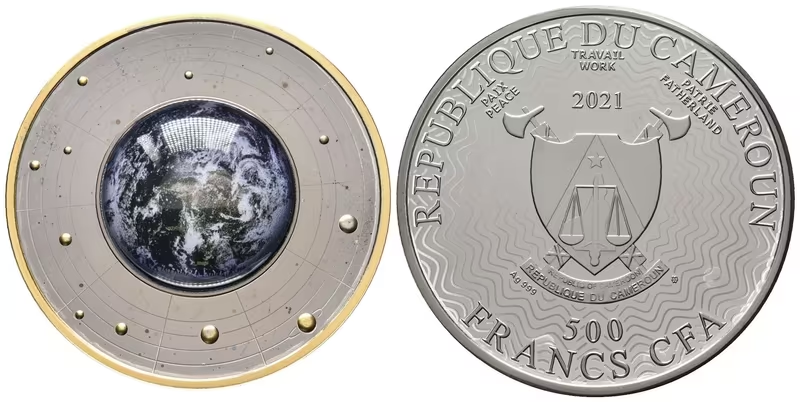
Kamerun, 500 Franků 2021 - Planeta Země
Kamerunská republika (1960 - ) 500 Francs 2021 - Planeta Země - ze série Sluneční soustava Ag 0,999, 50 mm (17,5 g), patinováno, vložená čočka, pokoveno rutheniem a zlatem, "tzv. laser frosting", certifikát, prezentační kapsle a papírový přebal, vyraženo…
Skladem 1 ks - Code: ZD-2018STO2
Sada mincí 2018 - 100 let od konce I. světové války
Česká republika (1993 - ) Sada tří mincí 2018 (Luboš Charvát) - 100 let od konce první světové války 3x Au 0,9999, 22 mm (7,78 g), náklad 200 ks, certifikát, etue, papírový přebal, PROOF První světová válka byla konfliktem, jaký lidstvo do té doby…
Skladem 1 ks - Code: SGIB-D1991
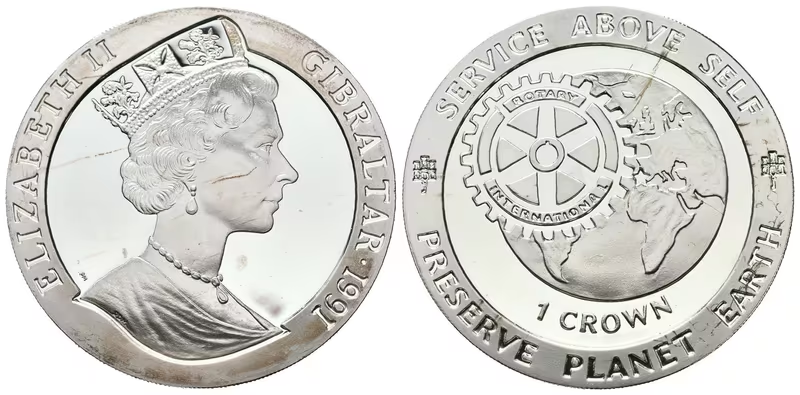
Gibraltar, 1 Crown 1991 - Rotary International - Preserve Planet Earth
Gibraltar (britské zámořské území) 1 Crown 1991 - Rotary International - Preserve Planet Earth Ag (.925), 38 mm (28,7 g), v kapsli. Stav mince odpovídá fotografii.
Skladem 1 ks - Code: MCZ071
200 Kč 2009 - Keplerovy zákony pohybu planet
Česká republika (1993 - ) 200 Koruna 2009 - 400. výročí formulování Keplerových zákonů pohybu planet, autor Vojtěch Dostál, Aurea C171, kapsle, certifikát, běžná kvalita Ag 0,900, 31 mm (13 g), raženo 10 186 ks (běžná kvalita), 19 042 ks (proof)
Skladem (>5 ks)