Mithridates VI of Pontus
Mithridates VI Eupator was the Pontic king who ruled from 120 to 63 BC, who created a vast empire in the Black Sea region and became the most dangerous opponent of Roman expansion in the east. This learned monarch, said to have mastered twenty-two languages, waged three great wars against Rome, and his defeat marked the definitive end of the independent H…
Mithridates VI Eupator Dionysus was born in 134 BC in Sinope as the son of the Pontic king Mithridates V Euergetes. After his father's assassination in 120, he was to rule jointly with his younger brother Mithridates Chrestus under the regency of their mother Laodice VI. The mother, however, favoured the younger son, and according to later tradition even attempted to poison the elder Mithridates. The young prince fled to the Pontic mountains, where he lived for seven years in the wilderness, giving rise to the legend of his superhuman strength and resilience.
Around the year 113, Mithridates returned to Sinope, overthrew his mother's government and had her and his brother imprisoned, where both perished. He launched an ambitious expansionist policy. First he subjugated the territory around the entire Black Sea including the Bosporan Kingdom, Colchis and the Sarmatian tribes. He built a powerful army combining the Greek phalanx with eastern fighting techniques including scythed chariots and war elephants. His fleet, numbering over four hundred warships, dominated the Black Sea.
The First Mithridatic War broke out in 89 BC, when Mithridates exploited Roman weakness during the Social War to invade Asia Minor. His most controversial act was the order to massacre all the Italians in Asia, in which 80,000 people allegedly perished in a single day. He conquered most of Asia Minor and Greece, where many cities welcomed him as a liberator from Roman oppression. The Roman commander Sulla, however, defeated him in 86–85 in the battles of Chaeronea and Orchomenus, forcing him to withdraw back to Pontus.
History
The Second War in 83–81 was short and indecisive, ending with a peace that restored the prewar state. The Third and longest war began in 74, when Mithridates occupied Bithynia. The Roman generals Lucullus and later Pompey gradually conquered his territory. After his definitive defeat in 66, Mithridates fled to the Crimea, where he planned a new campaign across the Danube into Italy. His son Pharnaces II, however, rose against him.
In 63 BC, surrounded by rebels in the palace at Panticapaeum, Mithridates attempted suicide by poison. Because he had used small doses of poisons throughout his life to build up immunity, the poison did not work. In the end he asked his Celtic bodyguard Bituitus to stab him with a sword. His death marked the end of the last significant resistance to Roman hegemony in the eastern Mediterranean.
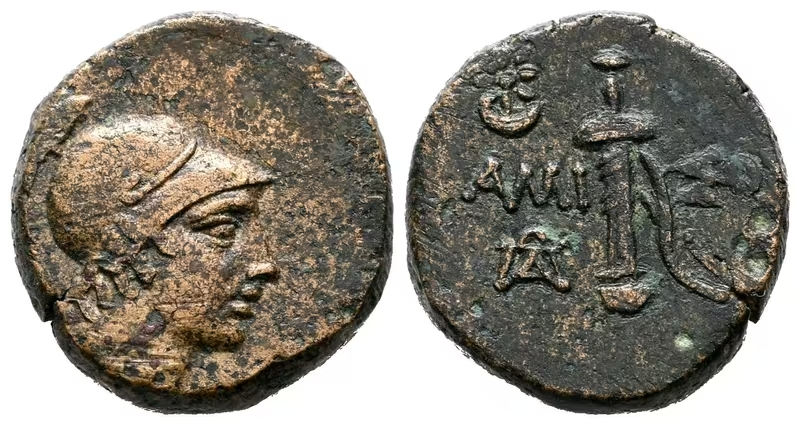
Mithridates's coinage system represented a synthesis of Greek and oriental traditions. The gold staters struck according to the Attic standard weighed 8.4 grams and depicted the ruler's idealised portrait with flowing hair evoking Alexander the Great. The silver tetradrachms, weighing 16.8 grams, bore on the reverse Pegasus, the symbol of the Pontic dynasty, surrounded by a star and crescent. The quality of striking, especially on the early issues, reached an extraordinary level with fine modelling of the portrait.
Coinage system and numismatic legacy
The iconography of Mithridates's coins expressed his political ambitions. The portrait with a lion skin identified him with Heracles, while Dionysian symbols such as ivy and the thyrsus alluded to his epithet Dionysus. On some strikings he appears with a Persian tiara or with a diadem with a radiate crown, combining western and eastern insignia of power. Special issues from the period of the wars depict Nike with a trophy or an eagle on a thunderbolt, symbols of military triumph.
For collectors the most prized are the cistophoroi, large silver coins struck in the cities of Asia Minor during the First War. These coins, with their characteristic depiction of the cista and serpents, represent a unique testimony to the extent of Mithridates's power. Dated bronze strikings from Pontus use the Bosporan era beginning in 297 BC, which allows precise chronological dating. Posthumous strikings by his son Pharnaces attest to the continuing prestige of Mithridates's name.
In our auction and shop
- Code: BB-HGC0007Recommended
Mithradates VI. Eupator, Pontos, AE, Amisos, HGC 7,241
Mithradates VI. Eupator (120 - 63 př.n.l.), Pontos mincovna Amisos, Ares s helmou doprava / meč v toulci, HGC 7,241 ,
Skladem 1 ks