Nelson Mandela
Nelson Mandela was a South African anti-apartheid revolutionary, politician and the first black president of the Republic of South Africa, who governed from 1994 to 1999 after twenty-seven years of imprisonment for his fight against racial segregation. He has appeared on South African coins on all rand denominations since 2012, while the Mandela gold rand…
Nelson Rolihlahla Mandela was born on 18 July 1918 in the village of Mvezo in Eastern Cape Province as the son of a chief of the Thembu people of the Xhosa nation. His birth name Rolihlahla literally means "the one who shakes the branches of the tree", which proved to be prophetic in view of his future role. After his father's death in 1927 he became a ward of the regent of the Thembu tribe, who enabled him to receive education at mission schools. He studied at Fort Hare University, the only university for blacks in South Africa, from which, however, he was expelled for participation in a student strike. In 1941 he fled to Johannesburg to avoid an arranged marriage, where he completed his bachelor's degree by correspondence and later studied law at the University of the Witwatersrand.
Mandela's political activity began in 1943, when he joined the African National Congress and co-founded its Youth League. After the victory of the National Party in 1948 and the introduction of the apartheid system, Mandela became one of the leaders of nonviolent resistance. He led the Defiance Campaign in 1952 and organised boycotts and protest actions against the racial laws. After the Sharpeville Massacre in 1960, when the police shot sixty-nine unarmed demonstrators, Mandela concluded that nonviolent resistance was not enough. He co-founded the armed wing Umkhonto we Sizwe, which carried out acts of sabotage against government installations but avoided loss of life.
History
On 5 August 1962 Nelson Mandela was arrested and in the Rivonia Trial in 1964 was sentenced to life imprisonment for sabotage and conspiracy to overthrow the government. He spent most of his twenty-seven years in the prison on Robben Island, where he broke stone in a limestone quarry and secretly studied Afrikaans in order to better understand his jailers. Despite the harsh conditions he became a moral authority for his fellow prisoners and gradually won the respect of even some of the warders. His refusal in 1985 of conditional release in exchange for the renunciation of armed struggle strengthened his status as an icon of resistance. The international campaign for his release made Mandela the world's most famous political prisoner.
After his release on 11 February 1990 by President Frederik de Klerk, Mandela led complex negotiations on the transition to democracy. His ability to forgive and to seek reconciliation rather than revenge averted the civil war that many had predicted. In the first free elections on 27 April 1994 he was elected president and focused on national reconciliation symbolised by the Truth and Reconciliation Commission. His support for the South African rugby team during the World Cup in 1995, when he put on the jersey of captain François Pienaar, became an iconic moment of racial reconciliation. After a single term he voluntarily left office in 1999 and devoted himself to charitable activity until his death on 5 December 2013 at the age of ninety-five.
Mandela on South African coins
The first official coin with Mandela's portrait was issued in 2000 as a commemorative five-rand coin marking the inauguration of President Thabo Mbeki. A fundamental change occurred in 2012, when the South African Reserve Bank replaced the animals from the so-called Big Five on all rand coins with Mandela's smiling portrait. The Mandela rands in nominal values from 10 cents to 5 rands became a symbol of the new Republic of South Africa and are the first South African coins depicting a black leader.
The South African Mint regularly issues collector editions including gold rands, Krugerrands and platinum coins with various depictions of Mandela from different periods of his life. Of special importance are the coins issued for his ninetieth birthday in 2008 and the posthumous commemorative series from 2014. Some mintages combine Mandela's portrait with national symbols such as the protea or the map of Africa.
In our auction and shop
- Code: SKAN90-N2011G
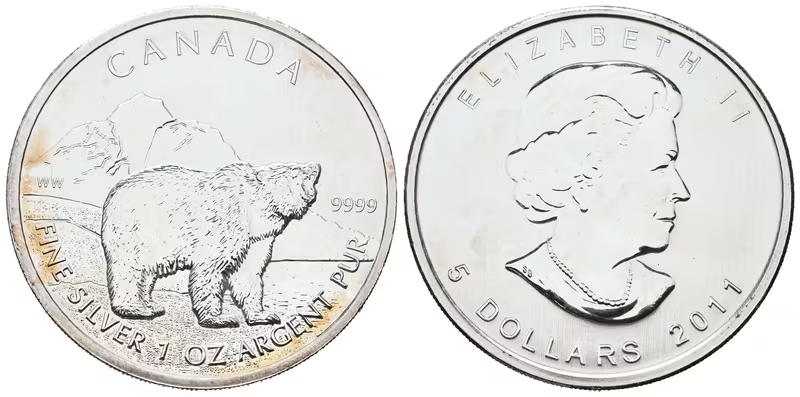
Kanada, 5 Dollars 2011 - Medvěd Grizzly
Elizabeth II. (1952 - 2022) 5 Dollars 2011 - Medvěd Grizzly Ag 0,9999, 38 mm (31,1 g), 1 Oz, běžná kvalita Medvěd grizzly (Ursus arctos horribilis) známý také jako medvěd hnědý severoamerický nebo jednoduše grizzly, je populace nebo poddruh medvěda…
- Code: SKAN90-N2011GZ
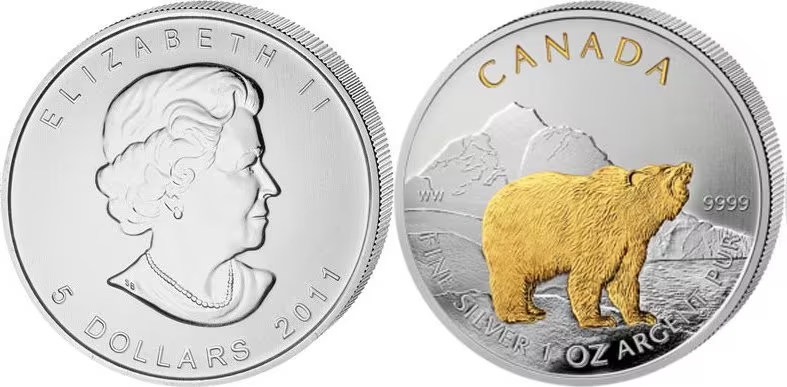
Kanada, 5 Dollars 2011 - Medvěd Grizzly
Elizabeth II. (1952 - 2022) 5 Dollars 2011 - Medvěd Grizzly částečně zlacené Ag 0,9999, 38 mm (31,1 g), 1 Oz, běžná kvalita Medvěd grizzly (Ursus arctos horribilis) známý také jako medvěd hnědý severoamerický nebo jednoduše grizzly, je populace nebo…