
Porcelain coins
Porcelain coins are means of payment made of porcelain, issued mainly as emergency money (Notgeld) in Germany after the First World War. Since they were not struck from metal, they are more often classified as tokens or medals.
History and manufacture
The main period of production of porcelain coins falls in the years 1920–1922. The impulse was the critical shortage of metals for the striking of currency after the First World War. The pioneer in this field was the Meissen porcelain manufactory (Staatliche Porzellan-Manufaktur Meissen), which used its technology to produce these substitute means of payment for the town of Meissen and subsequently for dozens of other German towns and municipalities.
Porcelain coins were produced by pressing into moulds and subsequent firing at high temperatures. They existed in several variants: of white glazed porcelain, of unglazed (biscuit) porcelain and of brown, very hard porcelain, the so-called Böttger stoneware. Nominal values ranged from pfennigs to marks. Outside Germany, porcelain means of payment were also experimented with in Siam (modern Thailand) as early as the 18th and 19th centuries, where they served as gaming tokens in gambling houses.
Collector significance
Porcelain coins constitute a specific and sought-after area of collecting, especially within the Notgeld category. Their attractiveness lies in the unusual material, the variety of colours, shapes and motifs. They often depict local coats of arms, landmarks, historical events or allegorical scenes. Owing to their fragility it is difficult to find specimens in perfect condition, which increases their value.
Collectors distinguish various colour variants, types of glaze and manufacturing specifics. These coins were not intended for long-term circulation, and their validity was limited in time. As soon as the German economy stabilised and a sufficient supply of metals was restored, porcelain coins were withdrawn and replaced by standard currency.
In our auction and shop
- Code: ZSFRA-96K2015.1
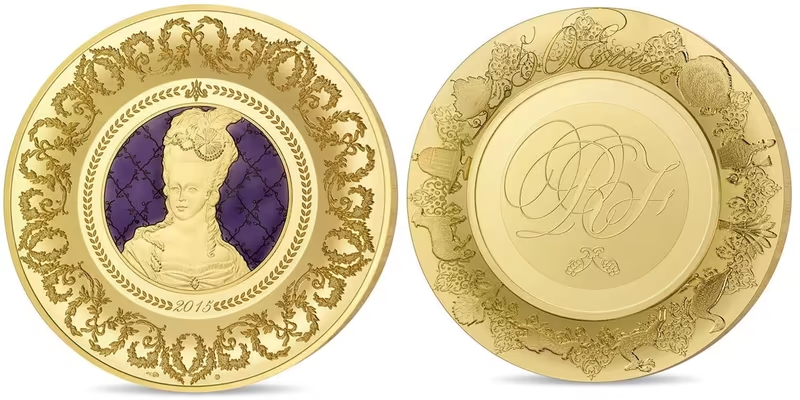
Francie, 50 Euro 2015 - Manufaktura v Sévres
Francie, V. republika (1958 - ) 50 Euro 2015 - Porcelánová manufaktura v Sévres Au 0,920, 22 mm (8,45 g), 1/4 Oz, limitovaná edice, náklad 1000 ks, certifikát, etue, kartonový přebal, PROOF Sèvreský porcelán – výrobky z porcelánu , produkované dodnes v…
Further in the encyclopaedia
More entries in the category zetony. Continue browsing or return to the full encyclopaedia.