
Rechenpfennig
Rechenpfennig, also known as a counting penny or jeton, is a non-monetary token which did not serve as money but as a mathematical aid. These tokens were used on counting cloths or boards (an analogue of the abacus) for carrying out arithmetic operations such as addition, subtraction, multiplication and division.
The use of counting tokens has its roots in mediaeval Europe, especially in France and Italy. From the 15th to the 18th centuries, the main centre of their production became Nuremberg in Germany, whose products were exported throughout Europe. Merchants, officials and financiers moved tokens along lines on a counting board, where each line represented a particular numerical order (units, tens, hundreds), thereby visualising and simplifying complex calculations.
History and use
While early tokens were simple and functional, Nuremberg Rechenpfennigs gradually became more artistically elaborate. They often bore portraits of rulers, allegorical scenes, coats of arms, religious motifs or even political satire. They were produced mainly of brass or copper. Today, counting tokens are the subject of a specialised collecting field called exonumia and are valued for their historical worth and craftsmanship.
Iconography and collecting
In our auction and shop
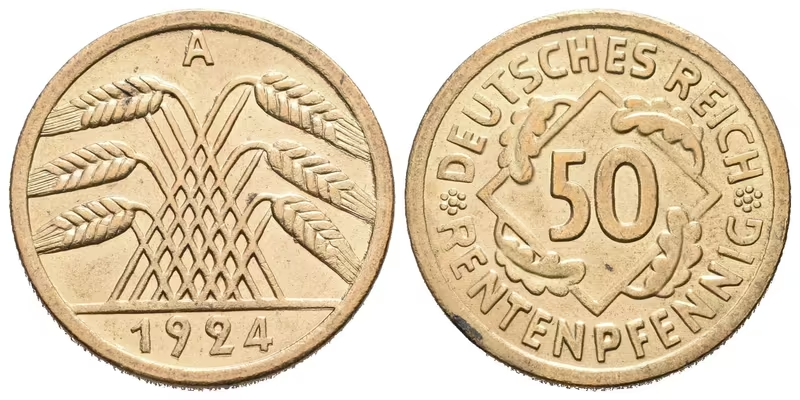
- Code: NE-I1924A.1
Výmar, 50 Rentenpfennig 1924 A
Výmarská republika (1919 - 1933) 50 Rentenpfennig 1924 A, krásná zachovalost, ražební lesk
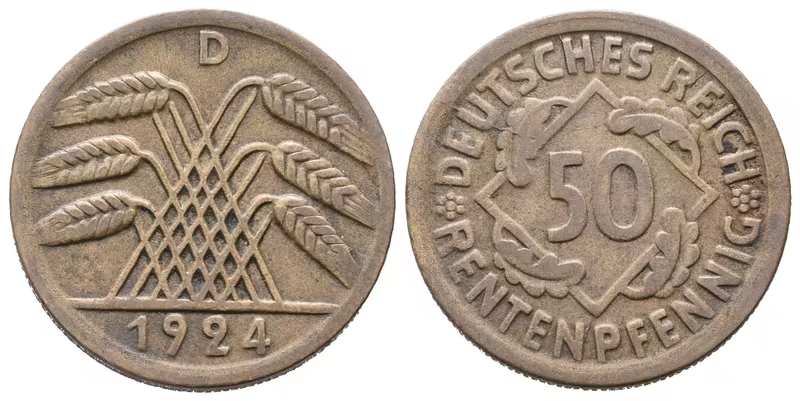
Skladem 1 ks - Code: NE-I1924D
Výmar, 50 Rentenpfennig 1924 D
Výmarská republika (1919 - 1933) 50 Rentenpfennig 1924 D, Mnichov, patina, oběh, J.310
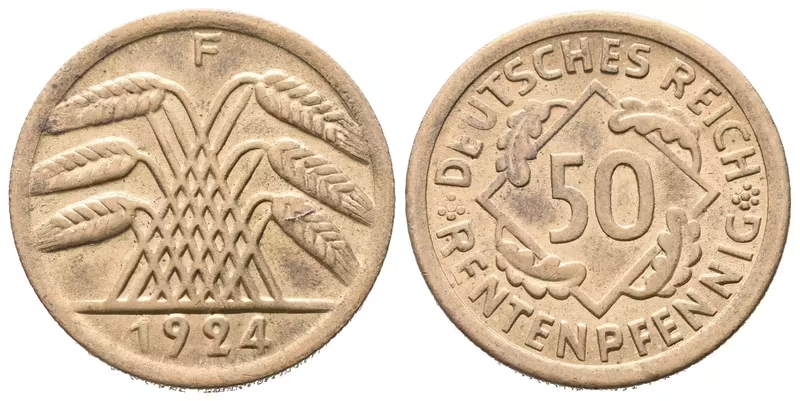
Skladem 1 ks - Code: NE-I1924F
Výmar, 50 Rentenpfennig 1924 F
Výmarská republika (1919 - 1933) 50 Rentenpfennig 1924 F, Stuttgart, pěkná zachovalost, zbytky lesku, patina
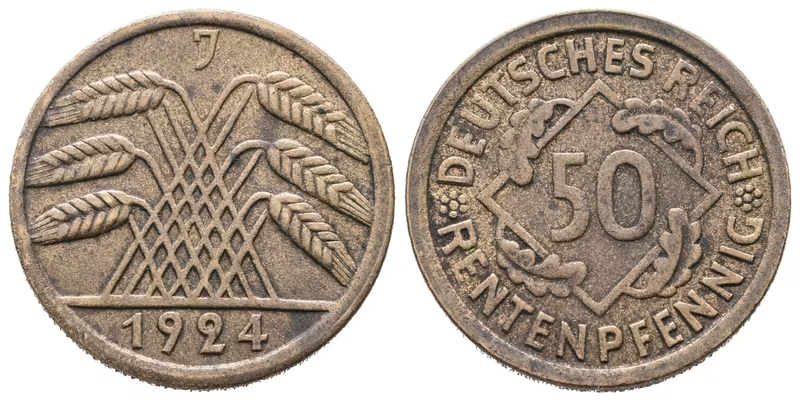
Skladem 1 ks - Code: NE-I1924J
Výmar, 50 Rentenpfennig 1924 J
Výmarská republika (1919 - 1933) 50 Rentenpfennig 1924 J, Hamburg, patina, oběh
Skladem 1 ks
Further in the encyclopaedia
More entries in the category zetony. Continue browsing or return to the full encyclopaedia.