Rama
Rama is the seventh incarnation of the god Vishnu and the hero of the Indian epic Ramayana; his depiction on coins symbolises the ideal ruler, justice and devotion to dharma. In numismatics, Rama appears above all on Indian royal strikes as a model of the virtuous sovereign, often shown with a bow, with his wife Sita, or in the company of his faithful com…
Rama, prince of Ayodhya, is the central figure of the ancient Indian epic Ramayana, which arose between the 5th century BC and the 4th century AD. His story of exile, the struggle with the demon Ravana and the rescue of his abducted wife Sita became the foundation of Hindu ethics and of the ideal of just rule. Rama's reign, Ramarajya, represents in Indian tradition a golden age of perfect justice and prosperity, which makes him a significant model for monarchs.
The first numismatic depictions of Rama are found on the coins of the Gupta dynasty from the 4th to 6th centuries AD, where he appears as one of the incarnations of Vishnu. A more significant development of Rama's iconography on coins was brought by the South Indian dynasties. The Cholas in the 10th to 13th centuries struck gold and silver coins with Rama as an archer, often accompanied by his brother Lakshmana. The Kakatiya dynasty of the 12th to 14th centuries created a characteristic depiction of Rama with Hanuman kneeling at his feet.
The Vijayanagara Empire of the 14th to 17th centuries, which considered itself the heir of Rama's empire, made extensive use of Rama-related symbolism on its coins. Gold varaha coins often depicted Rama's coronation or his encounter with Hanuman. The Nayak dynasty in Thanjavur and Madurai continued this tradition with silver strikes depicting various scenes from the Ramayana. The Maratha rulers, especially Shivaji, professed Rama's legacy and struck coins with his depiction as a symbol of just Hindu rule.
History
The Rajput principalities used Rama as a dynastic deity, and his depiction appears on the coins of states such as Mewar, Marwar and Jaipur. The state of Travancore in Kerala, whose rulers considered themselves servants of Rama as Padmanabha, struck coins with Rama themes right up to the 20th century. The princely state of Orchha in central India, dedicated to Rama, used his name and symbols on all its strikes. In the period of British rule, the Hindu states were able to preserve religious symbolism on local issues.
After India's independence, Rama appears above all on commemorative coins issued to mark religious holidays such as Rama Navami and Diwali. Controversial was the issue of a commemorative coin to mark the start of construction of Rama's temple in Ayodhya. Nepal, with its significant Hindu tradition, regularly issues coins with Rama. Thailand, where the Ramayana is known as the Ramakien and the kings bear the name Rama, has its own tradition of Rama strikes. Modern collector coins often depict dramatic scenes from the epic using advanced technologies.
In numismatics, Rama is depicted as an ideal prince with an athletic figure, dark blue or green skin and royal attributes. The most characteristic attribute is the bow Kodanda, with which he is shown as an unerring archer. He often holds arrows symbolising his ability to strike and destroy evil at any distance. The royal crown and jewellery emphasise his position as the legitimate heir to the throne of Ayodhya.
Iconography and modes of depiction
A frequent motif is Rama with Sita and Lakshmana, representing the ideal family and fraternal devotion. Hanuman, the monkey god and Rama's devoted servant, is shown kneeling at Rama's feet or carrying a mountain bearing healing herbs. Scenes from the Ramayana on coins include the breaking of Shiva's bow, life in exile, the building of the bridge to Lanka and the victory over Ravana. The coronation scene symbolises the establishment of just rule.
The technical execution makes use of various levels of relief to create depth in compositions with many figures. Modern strikes use colour printing to distinguish figures and to highlight important elements such as Rama's blue skin or Hanuman's monkey face. Microengraving makes it possible to inscribe verses from the Ramayana around the main motif. Some premium editions contain set precious stones symbolising divine light or arrows.
In our auction and shop
- Code: ZSSVY-90F1930ZAV
Švýcarsko, 20 Frank 1930 - přívěsek
Švýcarsko 20 Frank 1930 B, ve zlatém rámečku se závěsem na řetízek Au 0,900, 21 mm (6,4516 g), rámeček se závěsem ze 14 ct zlata, celková hmotnost 8,30 g (6,89 g ryzího zlata)
Skladem 1 ks - Code: RX-CINA3000
Čína - Medailon s Čínskou zdí
Medailon s Čínskou zdí, červený plast a mosazný rámeček, etue, 62 mm
Skladem 1 ks - Code: SFRA90-A1726L
Francie, Ecu 1726 L, Bayonne
Francie, Ludvík XV. (1715 - 1774) " Écu aux rameaux d'olivier" 1726 L, Bayonne, Dy.1675 , zbytky lesku
Skladem 1 ks - Code: ZN-PRUX1913.P
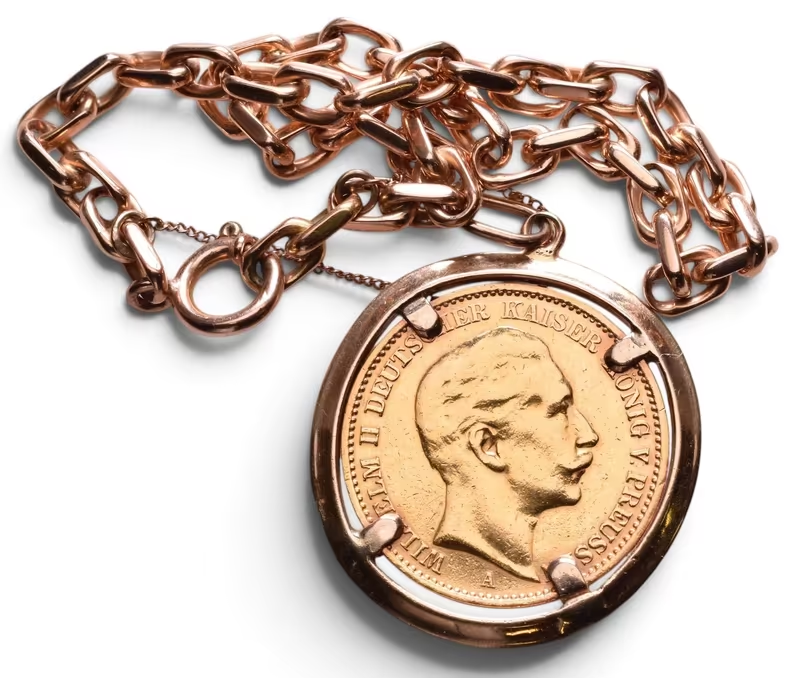
Prusko, 20 Marka 1913 A - přívěsek s řetízkem
Prusko, Wilhelm II. (1888 - 1918) 20 Marka 1894 A, J. 252, zasazena ve zlatém rámečku se závěsem a řetízkem Au 0,900, 22 mm (7,965 g), Au 0,585 (12,1 g), celková hmotnost 20,06 g (14,18 g ryzí zlato)
Skladem 1 ks