
Reichsmark
The Reichsmark (imperial mark, abbreviation RM) was the currency of Germany from 1924 to 1948. It was introduced following the stabilisation of hyperinflation as the successor to the paper mark (Papiermark) and the transitional Rentenmark; it was divided into 100 Reichspfennig.
During the Weimar Republic silver 1, 2, 3 and 5 Reichsmark coins were struck, among which the commemorative 3 and 5 RM pieces marking anniversaries of cities, historical figures and events rank today among sought-after collector series. After 1933 the silver 2 and 5 RM carried the portrait of President Hindenburg or the motif of the Garrison Church in Potsdam; minor denominations were struck in bronze, aluminium-bronze and nickel. During the Second World War minor coinage shifted to zinc and aluminium and silver disappeared from circulation.
Introduction in 1924
After the war the Reichsmark remained in circulation in the Allied occupation zones until the currency reform of June 1948, when it was replaced in the western zones by the Deutsche Mark and in the eastern zone by the mark of the later GDR. Of greatest interest to collectors are the Weimar commemorative issues, Hindenburg five-mark pieces and wartime zinc coins in uncirculated condition.
Coins and collecting
End in 1948
In our auction and shop
- Code: BNEM02A
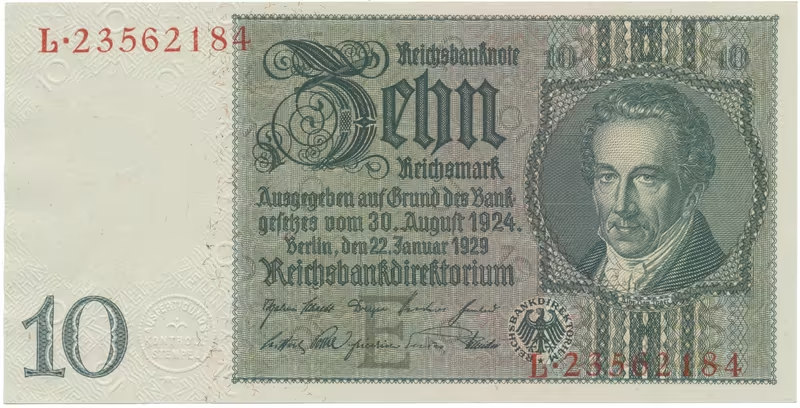
Německo, 10 Reichsmark 1929, typ H/H, Hej.D2a
Německo / Germany 10 Reichsmark 1929, typ H/H, Hej.D2a, v případě konkrétní série je foto pouze ilustrační N/UNC
Skladem 2 ks - Code: BNEM02C
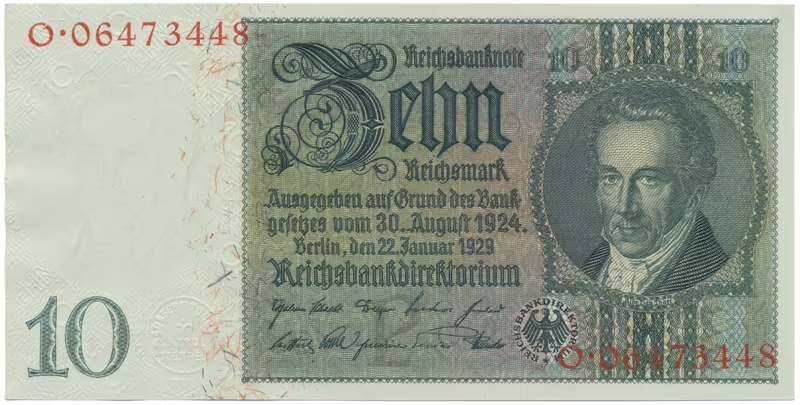
Německo, 10 Reichsmark 1929, typ O/O, Hej.D2c
Německo / Germany 10 Reichsmark 1929, typ O/O, Hej.D2c, v případě konkrétní série je foto pouze ilustrační N/UNC
Skladem 4 ks - Code: BNEM02D
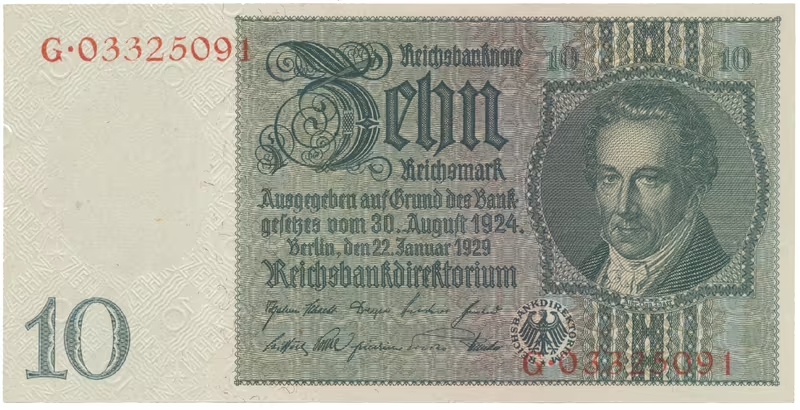
Německo, 10 Reichsmark 1929, válečná s průběžným vodotiskem, Hej.D2d
Německo / Germany 10 Reichsmark 1929, válečná s průběžným vodotiskem, Hej.D2d, v případě konkrétní série je foto pouze ilustrační N/UNC
Skladem 2 ks - Code: BNEM02DA
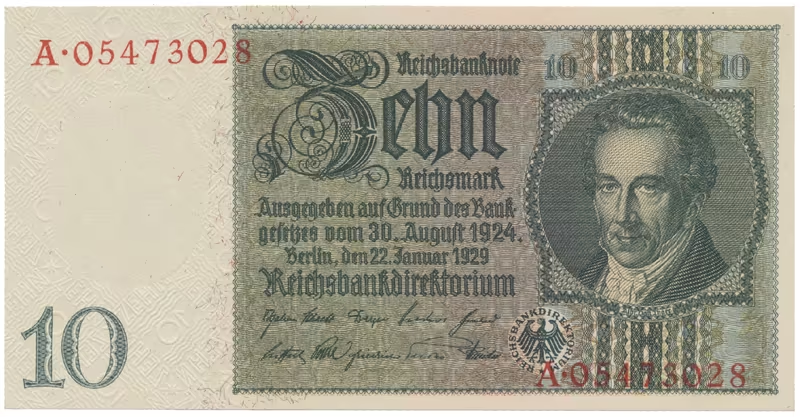
Německo, 10 Reichsmark 1929, válečná s průběžným vodotiskem, první série A, Hej.D2d
Německo / Germany 10 Reichsmark 1929, válečná s průběžným vodotiskem, první série A, Hej.D2d N/UNC
Skladem 2 ks
Further in the encyclopaedia
More entries in the category ekonomika. Continue browsing or return to the full encyclopaedia.