Mali Empire
The Mali Empire was a powerful mediaeval state in West Africa which between the 13th and 16th centuries controlled important trade routes of the Sahara and grew rich on the export of gold and salt. Its centres, particularly the area around the upper Niger, belonged among the most important political and cultural hubs of the Sahel of the time.
The emergence of the Mali Empire was related to the transformation of West African power relations after the decline of the older Ghana Empire and to the growing importance of the Sahelian trade routes. In the area between savanna and Sahara, long-distance trade developed over centuries: from the north flowed salt and other goods, from the south came gold, hides or slaves. Whoever controlled the crossings and markets gained revenues from customs duties, the safety of routes and the organisation of exchange. It was on this economic logic that the power of Mali was gradually built, whose core is usually associated with the Mandinka (Mandé) people and with the region of the upper Niger.
The traditional founding figure is Sundiata Keita, who in the 13th century united several competing groups and laid the foundations of the Keita dynasty. His reign is enveloped in an epic tradition transmitted orally; nevertheless, historical interpretation generally agrees that it was at that time that a more stable political structure arose, capable of collecting taxes, organising an army and protecting trade. Mali gradually expanded, and in various periods controlled or subjugated a number of towns and territories important for the exchange of goods – and thus for access to gold, which belonged among the most prized commodities of the mediaeval Mediterranean.
The peak of power is associated particularly with the 14th century and with the name of Mansa Musa. His reign became a symbol of the wealth of Mali and at the same time a testimony of how interconnected the world of that time was: the mansa (sovereign) maintained relations with Islamic centres of learning and trade and supported the development of cities along the trans-Saharan routes. Mali was at this time known not only as the "land of gold" but also as a space where, in the Sahelian cities, literature, law and Arabic-language education developed. An important role was also played by cities in the Niger region, which functioned as markets, warehouses and administrative bases – their significance changed in time according to where the liveliest trade currents flowed.
History
The political structure of Mali was based on a combination of central power and ties to local elites. The empire maintained itself thanks to the loyalty of subject regions, the collection of tribute and the ability to intervene when some regions attempted to become independent. Such a system had natural limits: it required a strong sovereign, stable revenues and control of the key hubs of trade. From the 15th century, pressures began to manifest themselves which weakened the power of Mali – particularly rivalry with new regional powers, changes in trade routes and the gradual breaking-away of peripheral territories. A significant rival was the rising Songhai Empire, which gradually took over part of the space and prestige associated with trade on the Niger.
By the 16th century Mali was no longer the hegemon of the region, although its dynastic and cultural trace remained discernible. Some regions gained independence, others passed under the control of rivals, and long-distance trade adapted to the new conditions. The Mali Empire thus transformed from a dominant power into one of several players in the wider Sahelian space. It nevertheless remains one of the most important historical examples of statehood in sub-Saharan Africa: it shows how a great empire can arise and function on the basis of control of trade, taxes and a strategic position between desert and savanna.
The economic foundation of Mali was long-distance trade and the ability to draw revenue from it. Gold from regions further south of the Sahel belonged among the most sought-after commodities and reached North Africa via Saharan caravans and beyond as far as the Mediterranean. Equally important was salt, indispensable for the preservation of food and for everyday life, which came from the salt regions of the Sahara. The empire also profited from agriculture in the fertile belts along the Niger, from pastoralism and from crafts linked to the markets and caravan stations.
Administration, economy and cultural significance
Administration was built on the sovereign's court and on a network of local rulers and chiefs who recognised the authority of the mansa and rendered tribute. Important were the control of routes, security and the ability to respond quickly to revolts or external threats. Culturally, Mali contributed significantly to the spread of learning in the Sahelian cities and to the region's interconnection with the Islamic world. Alongside the oral tradition, which preserved the histories and legitimacy of dynasties, in the urban environment a written culture asserted itself too, associated with scholarship, law and commercial contacts.
From a broader perspective, the Mali Empire is also important for understanding that mediaeval globalisation was not only European. West Africa was part of extensive networks of exchange and information, and its states were able to form complex political units of long-term stability. This is also why Mali frequently appears in history as a symbol of wealth, but also as an example of a functioning state organisation under Sahelian conditions.
In our auction and shop
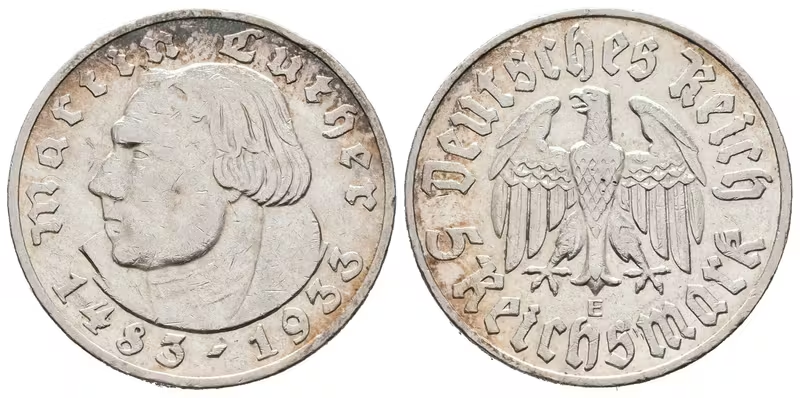
- Code: NF-G1933ERecommended
III. říše, 5 Marka 1933 E
III. říše (1933 - 1945) 5 Marka 1933 E, mincovna Muldenhütten, Německo Ag 0,900 , 29 mm (13,88 g), raženo 100 000 ks
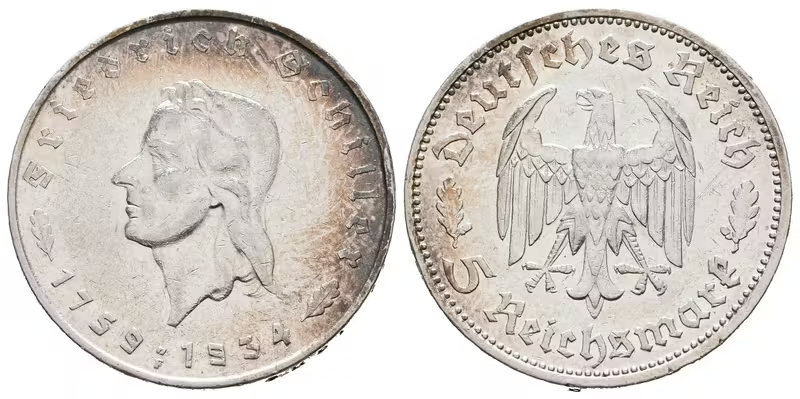
Skladem 1 ks - Code: NF-G1934FV
III. říše, 5 Marka 1934 F
III. říše (1933 - 1945) 5 Marka 1935 F, Státní mincovna ve Stuttgartu, Německo, R! Ag 0,900 , 29 mm (13,89 g), raženo 100 000 ks
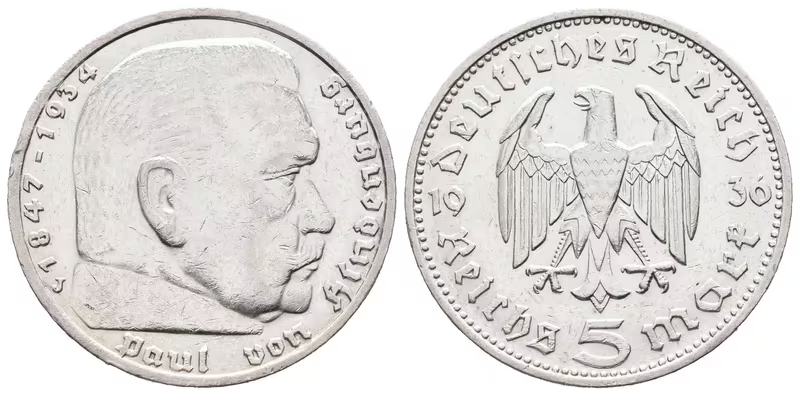
Skladem 1 ks - Code: NF-G1936J.4
III. říše, 5 Marka 1936 J
III. říše (1933 - 1945) 5 Marka 1936 J - Hamburská mincovna , pěkna zachovalost, ilustrační fotografie Ag 0,900, 29 mm (13,88 g), raženo 3 705 800 ks
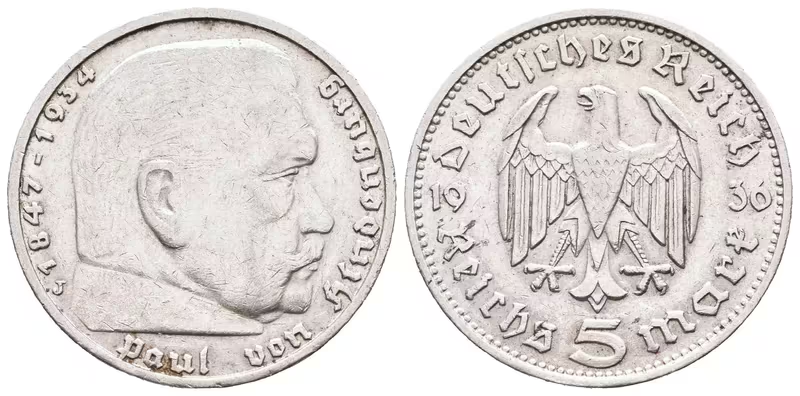
Skladem 1 ks - Code: NF-G1936J.3
III. říše, 5 Marka 1936 J
III. říše (1933 - 1945) 5 Marka 1936 J - Hamburská mincovna , pěkna zachovalost, ilustrační fotografie Ag 0,900, 29 mm (13,88 g), raženo 3 705 800 ks
Skladem 1 ks