Rudolf of Habsburg
Rudolf of Habsburg (Rudolf I) was King of the Romans (1273–1291) and the founder of the lasting power of the Habsburgs in the Austrian lands. With the defeat of Přemysl Otakar II at Dürnkrut and Jedenspeigen in 1278 he opened the way for the dynasty to Austria and Styria.
Rudolf of Habsburg was born in 1218 into a family that, while belonging to the noble elite of south-western Germany, did not yet rank in the first half of the 13th century among the "great" European dynasties. Rudolf gradually built his standing as a capable administrator and warrior, drawing on family holdings and on a network of vassals in the area of present-day Switzerland and Alsace. His rise was connected with the weakening of central power after the extinction of the Hohenstaufen dynasty: the empire was fragmented, part of the royal rights dissolved into the hands of princes and towns, and the election of the sovereign became above all a political compromise among the electors.
In 1273 Rudolf was elected King of the Romans. The election was not accidental: the electors sought a candidate who would not be so strong as to threaten their interests, but at the same time capable enough to restore at least part of the order and authority of royal power. After the election Rudolf launched a policy of "restoration of royal rights" — he sought to have part of the unjustly held estates and privileges returned under royal control, while at the same time striving for recognition of his legitimacy across the empire. An important goal was also to anchor the dynasty in a firm territorial base, because without one royal power in the conditions of the time was fragile.
The most pronounced confrontation of Rudolf's rule took place with the Bohemian king Přemysl Otakar II. In the previous years he had taken control of vast territories in the Danube region and the Alps (especially Austria and Styria) and was among the most powerful sovereigns of the region. After his election Rudolf demanded that Přemysl recognise his royal power and settle the question of the Alpine lands, which were perceived as imperial fiefs. The dispute gradually grew into open conflict. In 1276 Přemysl was forced into an agreement, but tensions did not subside, and a decision came only with the battle of 1278 on the Marchfeld at Dürnkrut and Jedenspeigen, in which Přemysl fell. The outcome of the battle marked a fundamental turning point: the Bohemian kingdom lost its Alpine expansion, and Rudolf gained the room to reshape power relations in the Danube region.
History
After the victory Rudolf proceeded cautiously but purposefully. He sought to stabilise the situation in Bohemia, where the question of rule during the minority of Wenceslas II had opened up, while simultaneously building the Habsburg position in Austria. A key step was that he handed over Austria and Styria to his sons as hereditary holdings, thereby laying the foundation of the future Habsburg "state" base. Precisely this transformation — from a family with scattered estates to a dynasty backed by a strong territorial centre — is the core of Rudolf's historical significance. Although Rudolf did not seek the imperial coronation and in the empire he constantly had to balance the interests of the princes, he managed to create the conditions for the Habsburgs to become in the following centuries one of the most influential families in Europe.
Rudolf's rule was also a period when royal power tried to reassert law and order in an environment marked by a long weakening of central authority. In practice this meant numerous negotiations, confirmations of privileges, interventions in property disputes and the building of support in towns and in ecclesiastical institutions. Rudolf at the same time had to deal with the Hohenstaufen heritage in Italy and relations with the papacy, which had its own political goals. His policy was therefore not only about wars but also about patient negotiation and administration.
Rudolf of Habsburg died in 1291. He left behind a dynasty firmly settled in the Austrian lands and at the same time a new framework of power for Central Europe. For Czech history his rule represents a watershed: the death of Přemysl Otakar II and the loss of the Alpine holdings closed one great-power chapter of the Přemyslids and opened space for a new rivalry in which the Habsburgs already played an ever more significant role.
Rule, symbolism and connections with coinage
Rudolf's era falls in the high Middle Ages, when in the monetary circulation of Central Europe small silver currency predominated — above all pfennigs and other local "denier" types, which differed by country and mint. In such an environment political stability had a direct impact on confidence in circulation: the safety of roads, functioning administration and the enforceability of law supported markets and the collection of revenues that the sovereign needed for financing the court and military undertakings. Rudolf's effort to consolidate royal rights and to create firm Habsburg holdings in the Danube region thus also had an economic dimension — a strong territorial centre could better organise revenues, administration and indirectly also the minting environment.
For collectors Rudolf is important above all as a "turning point" in Central European history, which is reflected also in the numismatic context: after 1278 the political map of the area in which Bohemian, Austrian and southern German strikes circulated changed. Coins from the end of the 13th century often bear simple symbolism of power (crosses, devices, stylised figures or heraldic motifs) and in some areas also inscriptions that help with attribution. Direct "Rudolfine" strikes are not the typical core of a Czech-lands collection, but Rudolf's period is useful for understanding the wider context: why trade ties shifted, why control of power over the Alpine lands changed and how Central Europe gradually realigned itself towards the long-term Habsburg dominance.
In the collecting study of this period it is worth following the wider picture: which mints worked for the individual lands, what types of small currency predominated and how strikes from various areas mingle in the finds. Rudolf of Habsburg is in this sense a "historical key" — not necessarily because of a single famous coin, but because of how his rule changed the framework in which Central European coins were produced and circulated.
In our auction and shop
- Code: SCZVEL-011
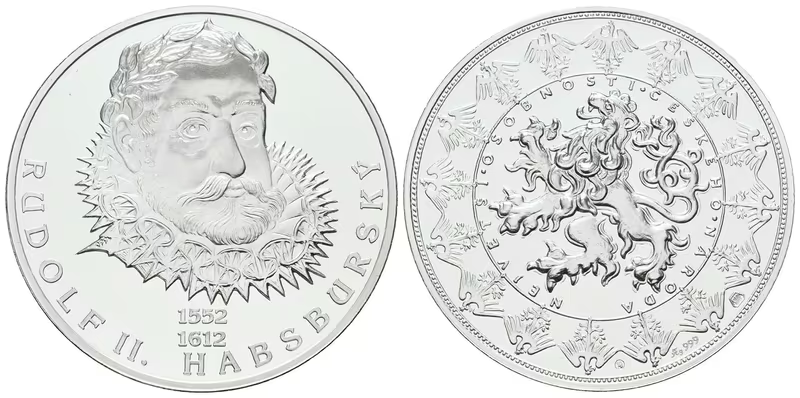
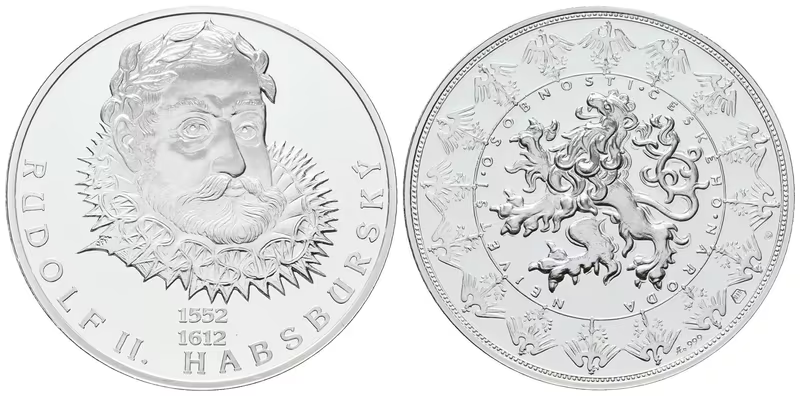
Stříbrná investiční medaile - Rudolf II. Habsburský - Ag 29 g - 999/1000 + Certifikát
Stříbrná investiční medaile - Rudolf II. Habsburský - Ag 29 g - 999/1000 + Certifikát Z cyklu: Velké osobnosti Českého národa
- Code: RAOPP-2011RUD
Oppl Vladimír - Rudolf II. Habsburský
Oppl Vladimír (1953 - ) AR Medaile b.l. (2011) - Rudolf II. Habsburský, habsburský panovník na českém trůně Ag 0,999, 40 mm (29g), kapsle, certifikát autentičnosti, PROOF Pamětní stříbrné medaile z čistého stříbra (999/1000) z kolekce Největší osobnosti…
- Code: MSRAK2-H1991
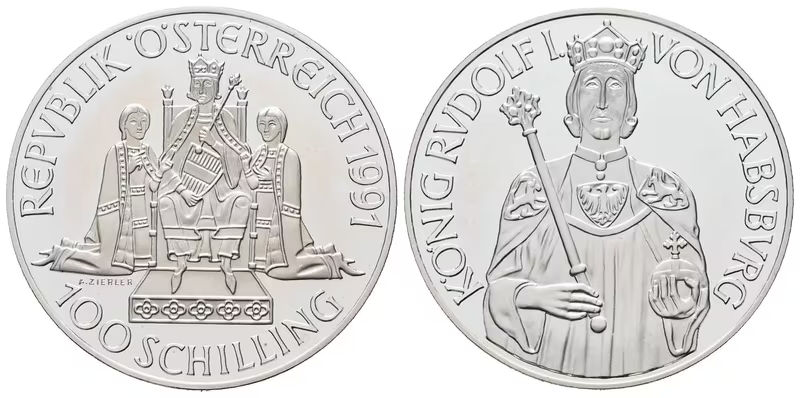
Rakousko, 100 Schilling 1991 - Král Rudolf I. Habsburský
Rakousko, II. republika (1945 - ) 100 Schilling 1991 - Král Rudolf I. Habsburský, Ag 0,900, 34 mm (18 g), kapsle, certifikát, PROOF