Holy Alliance
The Holy Alliance was an alliance of Russia, Austria and Prussia concluded in 1815 with the aim of preventing the spread of revolutionary and liberal ideas in Europe. It became the foundation of the conservative order of the continent after the Napoleonic Wars.
The Holy Alliance arose as an immediate reaction to the Napoleonic Wars and the French Revolution, which had shaken the traditional monarchic order of Europe. The initiator of the alliance was the Russian tsar Alexander I Pavlovich, who conceived the idea of cooperation among Christian monarchs on the basis of religious and moral principles.
The founding document, the so-called Act of the Holy Alliance, was signed on 26 September 1815 in Paris by three monarchs: the Russian tsar Alexander I, the Austrian emperor Francis I and the Prussian king Frederick William III. Remarkably, the signatories represented three different Christian denominations: the Romanovs were Orthodox, the Habsburgs Catholic and the Hohenzollerns Lutheran. Despite this, they pledged to cooperate on the basis of "Christian solidarity" and gospel principles.
The practical politics of the alliance, however, were shaped above all by the Austrian chancellor Klemens Wenzel von Metternich, after whom the entire system is called the Metternich system. While Alexander I invested in the alliance idealistic notions of fraternity between monarchs, Metternich used it as a tool for suppressing revolutionary movements and maintaining political stability.
History
In the treaty, the allies pledged to prevent the spread of liberal and secular ideas in Europe. The alliance gradually gained further members: at the Congress of Aachen in 1818 defeated France joined as well, being readmitted among the equal European powers. In the end most European states acceded to the alliance, with the exception of the United Kingdom, the Papal States and the Ottoman Empire.
The activity of the Holy Alliance was manifested above all through international congresses: Aachen 1818, Karlovy Vary 1819, Opava 1820, Ljubljana 1821 and Verona 1822. The Karlovy Vary Congress dealt with student and national demonstrations in the German Confederation and led to the issue of the repressive Karlovy Vary resolutions. The Opava Congress adopted the principle of the legitimacy of military interventions against revolutionary movements in other states.
A blow to the Holy Alliance was the death of Tsar Alexander I in 1825. His successor Nicholas I continued conservative politics, but disagreements between member states grew. The July Revolution in France in 1830 and the rise of a constitutional monarchy meant the loss of an important ally. The revolutions of 1848-1849 were militarily suppressed, but conflicting interests of the powers in the Balkans led to the definitive break-up of the alliance. The symbolic end was the Crimean War of 1853-1856, when Austria failed to support Russia in its conflict with the Ottoman Empire.
Numismatic significance
The Holy Alliance became the subject of a number of commemorative medals which document the international cooperation of the conservative monarchies in the first half of the 19th century. The most important are the medals issued for the founding of the alliance itself in 1815, depicting portraits of the three founders: Tsar Alexander I, Emperor Francis I and King Frederick William III.
A characteristic element of these strikes is their allegorical treatment with Christian symbolism referring to the religious basis of the union. Motifs of joined hands, the cross, the dove of peace and allegories of justice and peace appear. Some medals bear Latin inscriptions emphasising the unity and fraternity of Christian monarchs.
The individual congresses of the Holy Alliance were also occasions for the issue of commemorative strikes. Medals from the congresses in Aachen, Opava, Ljubljana and Verona document diplomatic negotiations and their results. These strikes are today prized collectors' pieces, as they capture significant moments of European diplomacy of the Restoration period.
Points of interest
For numismatists the period of the Holy Alliance represents an interesting stage of the stabilisation of European monetary systems after the chaos of the Napoleonic Wars. The return to the metallic standard and the restoration of confidence in the currency were important economic goals of the allied powers.
Metternich himself described the founding document of the alliance as "empty and resounding", yet he was able to use it as an effective tool of his politics. The British Foreign Secretary Castlereagh considered the alliance "a piece of sublime mysticism and nonsense". Tsar Alexander I originally also proposed the reduction of the armed forces of the member states, but the other signatories rejected this. The Holy Alliance inspired later attempts at collective security in Europe and is considered a forerunner of modern international organisations.
In our auction and shop
- Code: SSVAH-G2024
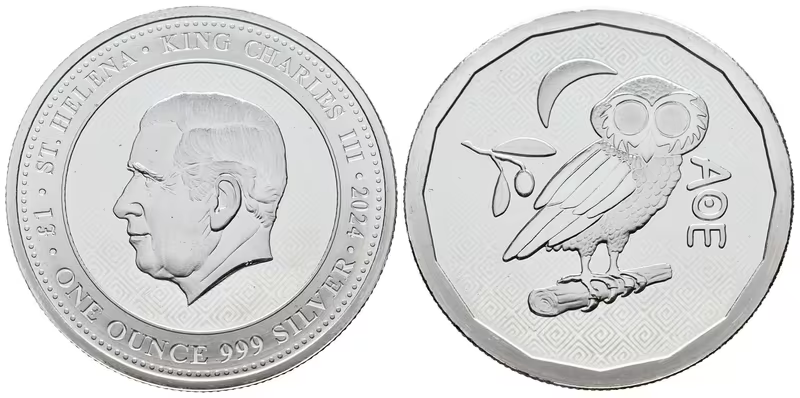
Svatá Helena, 1 Pound 2024 - 1 Oz (Athénská sova)
Svatá Helena, Karel III. (2022 -) 1 Pound 2024 - 1 Oz (Athénská sova), KM# 236 Ag (.999), 39 mm (31,1 g), v kapsli. Emise: 10 000 ks. Mincovna: Silver Towne Mint - USA. Stříbrná uncová investiční mince - 1 Oz. Lit.: KM# 236.
Skladem 1 ks - Code: BSVHE005A
Svatá Helena, 50 Pence (1979), P.5a
Svatá Helena / Saint Helene 50 Pence (1979), P.5a N/UNC
Skladem 2 ks - Code: BSVHE009A
Svatá Helena, 1 Pound (1981), P.9a
Svatá Helena / Saint Helene 1 Pound (1981), P.9a N/UNC
Skladem 2 ks - Code: MC184VBack in stock
50 Kčs 1990 - Svatá Anežka Česká, bez signatury autora
Československo (1953 - 1993) 50 Koruna 1990 - 1. výročí svatořečení Anežky České (varianta bez signatury autora na averzu), autor Michal Vitanovský, Aurea 184, běžná kvalita, ilustrační foto Ag 0,500, 27 mm (7 g), raženo 97 510 ks (běžná kvalita), 1 598…
Skladem 1 ks