Alexander I Pavlovich
Alexander I Pavlovich was Russian tsar (1801–1825), who reigned during the Napoleonic Wars and transformed Russia's position in Europe. His era is associated with initial reforming efforts, a later turn towards more conservative policy and also with abundant coin material of the rouble system.
Alexander I Pavlovich ascended the Russian throne in 1801 after the death of Tsar Paul I, and already in his first years of rule he tried to act as a sovereign more open to changes. In the milieu of the Russian Empire, where the tradition of autocracy intersected with growing pressure for modernisation, this meant above all an effort to improve the functioning of state administration, education and legal institutions. An important role in this period was played by advisory circles around the tsar and also by personalities connected with reform thinking, who sought a more effective running of the immense state.
A fundamental break in Alexander's plans was brought by European politics and the wars with revolutionary and later Napoleonic France. Russia gradually became one of the main rivals of France, and Alexander was forced to combine diplomacy with military force. The peak of the conflict was the French invasion of Russia in 1812 led by Napoleon Bonaparte. The war and the subsequent campaign of the Russian army into Central Europe transformed the tsar's position: from a ruler manoeuvring among alliance possibilities he became one of the defining actors of the European settlement.
After Napoleon's defeat, Alexander belonged among the principal figures of the post-war arrangement of Europe. The outcomes of the negotiations at the Peace Congress of Vienna (1814–1815) confirmed the new power relations, and Russia emerged from them as one of the most influential great powers. Alexander at the same time promoted the idea of the Holy Alliance, which was to emphasise Christian principles in politics and assist in maintaining the post-war order. In practice, however, this concept often served as an ideological framework for the suppression of revolutionary and liberal movements in Europe.
History
The internal development of Alexander's later years is often described as a gradual departure from the early reforming expectations. Part of society — particularly the more educated strata and the officer milieu which had come to know Europe during the wars — began to press for a deeper modernisation of the state. The tension between expectations of change and the reality of the autocratic system manifested itself, after Alexander's death, in the Decembrist uprising of 1825 among other things. Although this rising did not succeed, it showed that Russian society was entering a period in which the question of a constitution, of rights and of the form of government was becoming ever more urgent.
Alexander died in 1825, and the succession after him was accompanied by confusions that today still rank among the most discussed moments of Russian 19th-century history. In a wider view his rule remains the symbol of a great European turn: Russia transformed itself from being "one of the powers" into one of the chief arbiters of post-war Europe, while at home disputes opened over whether the empire could be modernised without a fundamental change of political system.
Alexander I Pavlovich is interesting for numismatics not only as a historical figure but also as a "name on a coin". The Russian circulation money of his time arose from the rouble system, in which in practice one meets above all copper kopeks and higher silver denominations. For Russian strikes a prominent state symbolism is typical — above all the double-headed eagle — and also the sovereign's marking, which may be executed by monogram, titulature or a combination of both. The style of lettering, the form of the eagle and the arrangement of the legends are important in identification, because they help to distinguish types as well as individual issues.
Sovereign symbolism on coins and the rouble system
The period of the Napoleonic Wars was reflected in finances and monetary circulation in many European states, and Russia was no exception. War expenditure, the need for rapid payments and the pressure on the state budget led to a situation in which, alongside coins, paper forms of money and credit also played an important role. For the collector this means that Alexander's time can be approached more broadly than just through the coins themselves: into the picture of the age belong banknotes and state financial policy, which affected trust in circulation.
In a collector's assessment of coins from Alexander's years, the legibility of the legends and the quality of surface are decisive. Older Russian copper coins tend to be heavily circulated, with knocks and sometimes also surface damage from the environment in which they circulated. With silver pieces, on the contrary, a natural patina and the overall "cleanness" of the relief are important; harsh cleaning is usually easily visible and reduces value. Given that some types exist in a number of variants, it is worth following also minor differences in the details of the emblem, in the dating and in mint marks, where these occur on a particular type.
Alexander's strikes are well collected thematically: as a memorial of the Napoleonic Wars, as part of the series of Russian tsars of the 19th century, or as a cross-section of the rouble system from small copper denominations to more representative silver pieces. It is precisely the combination of great history with tangible circulating money that makes this era a rewarding collector field.
In our auction and shop
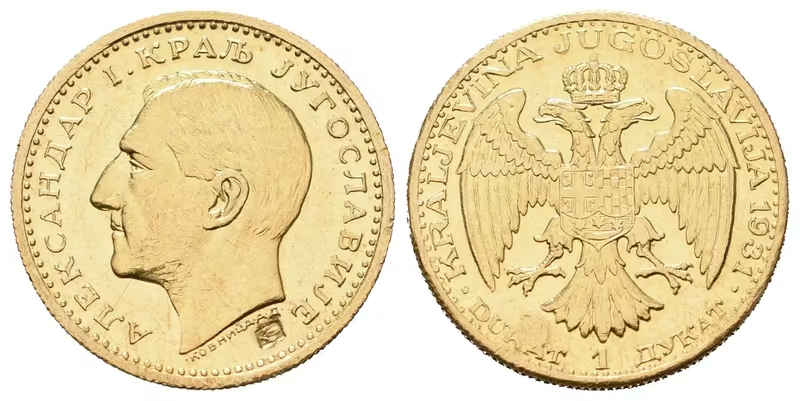
- Code: ZSJUG-90C1931
Jugoslávie, Dukát 1931 s kontramarkou
Jugoslávie, Alexandr I. (1921 - 1934) Dukát 1931 s kontramarkou "klas", KM.12.2, nádherná zachovalost Au 0,986, 20 mm (3,48 g)
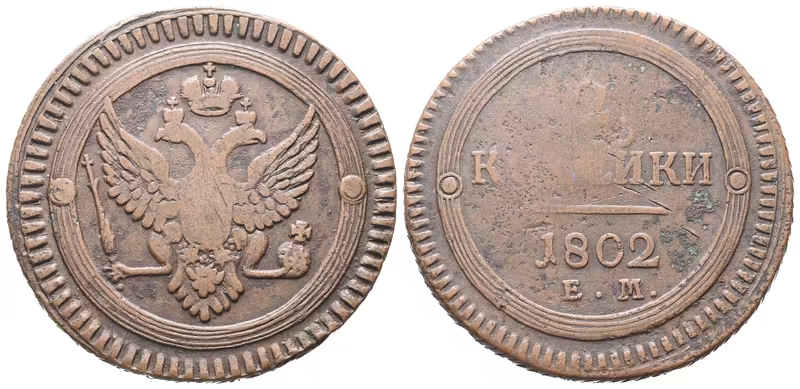
Skladem 1 ks - Code: SRUS86-E1802
Rusko, 2 Kopějka 1802 EM
Rusko, Alexander I., 1801 - 1825 2 Kopějka 1802 EM, Jekaterinburg, Bitkin2.307, Uzd.3006, patina, rysky
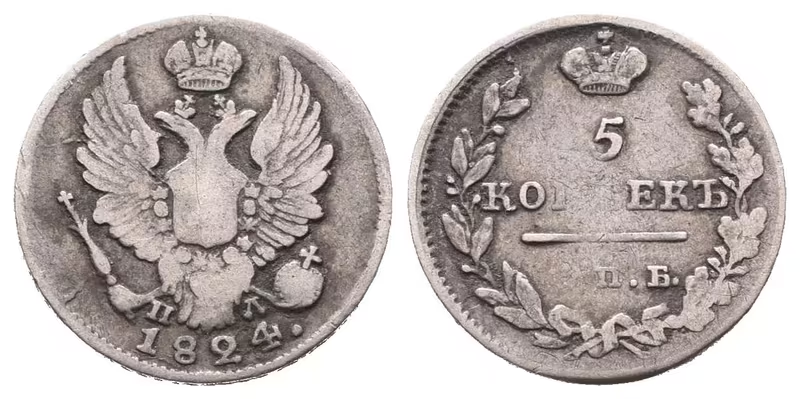
Skladem 1 ks - Code: SRUS86-F1824
Rusko, 5 Kopějka 1824 SPB
Rusko, Alexander I., 1801 - 1825 5 Kopějka 1824 SPB-PD, St. Peterburg, Bitkin2.280, Uzd.1487, patina, oběhový stav
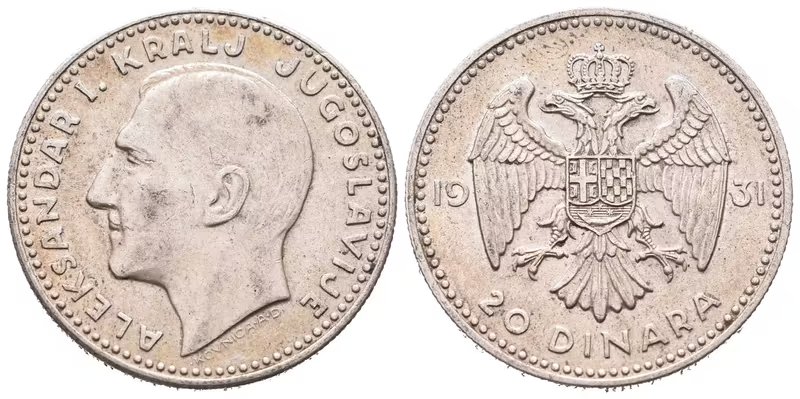
Skladem 1 ks - Code: SJUG98-B1931
Jugoslávie, 20 Dinar 1931
Království Jugoslávie, Alexander I. (1921 - 1934) 20 Dinara 1931, KM.11, zbytky lesku, patina, rysky
Skladem 1 ks