Frederick William III of Prussia
Frederick William III of Prussia (1770–1840) was the King of Prussia reigning from 1797 to 1840, who led Prussia through the Napoleonic Wars, the catastrophic defeats at Jena and Auerstedt, the subsequent reforms, and the Wars of Liberation, which restored Prussia's position as a European great power. Frederick William III is significant in numismatics fo…
Frederick William was born on 3 August 1770 in Potsdam as the son of King Frederick William II and Frederica of Hesse-Darmstadt. He grew up during the turbulent period of the French Revolution and received the military education typical of Prussian princes. His formative years were shaped by mounting European tensions and the need to modernise the Prussian state in competition with revolutionary France.
His accession to the throne in 1797 at the age of 27 brought expectations of continued Prussian expansion under the leadership of a young and energetic king. Frederick William, however, displayed a more cautious nature than his predecessors and sought to avoid conflict with France through neutrality. This policy worked for several years, but Napoleon's expansion ultimately drew Prussia into the European wars.
His marriage to Louise of Mecklenburg-Strelitz in 1793 became one of the most celebrated royal unions in German history. Louise was not only beautiful but also an intelligent and politically active queen who significantly influenced Frederick's decisions. Their harmonious marriage and many children made the royal couple a symbol of Prussian national identity.
The Fourth Coalition (1806) against Napoleon led to the catastrophic defeat of the Prussian army at the battles of Jena and Auerstedt. In a single day the military reputation of Prussia built up by Frederick the Great was destroyed, and French armies occupied almost the entire kingdom. Frederick William had to flee to Königsberg and later to Russia.
The Peace of Tilsit in 1807 deprived Prussia of half its territory and population. Napoleon humiliated Frederick William by compelling him to take personal part in the negotiations, and Queen Louise vainly appealed to the French emperor for milder terms. This national catastrophe, however, paradoxically sparked the Prussian reform movement that modernised the state.
History
The reforms led by Stein and Hardenberg (1807–1815) transformed Prussia from a feudal state into a modern bureaucratic monarchy. The abolition of serfdom, municipal self-government, school reforms, and the reorganisation of the army laid the foundations of future German power. Frederick William supported these changes, albeit with concerns about preserving royal authority.
The Wars of Liberation (1813–1815) restored Prussian national pride and royal prestige. After Napoleon's defeat in Russia, Frederick William joined the Sixth Coalition, and his armies under Blücher played a key role in the victories at Leipzig and Waterloo. Prussia returned to the front rank of European powers.
The Congress of Vienna (1815) brought Prussia territorial compensation in the west, including the Rhineland and Westphalia, which strengthened its economic base and strategic position in Germany. Frederick William also acquired the title "Victor at Waterloo" and international respect as a liberator of Europe from Napoleonic rule.
Post-war reaction and the Holy Alliance characterised the later years of Frederick's reign. The king feared liberal and nationalist movements and supported Metternich's system of suppressing revolutionary tendencies. He refused the promises of a constitution given during the Wars of Liberation, which caused disappointment among the Prussian intelligentsia and the bourgeoisie.
The death of Frederick William on 7 June 1840 in Berlin ended a 43-year reign that had transformed Prussia from a provincial power into a European great power. The throne was inherited by his son Frederick William IV, who had to face the revolutionary changes of 1848. Frederick's legacy lies in the modernisation of the Prussian state and the laying of the foundations for future German unification.
Frederick William III in numismatics
The Prussian coins of Frederick William III document the dramatic changes of his long reign from the Napoleonic Wars to the period of Restoration. The early thalers (1797–1806) depict the young king in traditional Prussian regalia with crown and sceptre, emphasising continuity with the Fredrician tradition. The portraits are idealised in the classicist manner of the time.
Coins from the period of the Wars of Liberation (1813–1815) often contain national and military symbols — the Prussian eagle, lions, swords, and references to the victory over Napoleon. The Iron Cross as a motif reflects the introduction of this decoration by the king during the war. The quality of these issues is often lower due to war conditions and the shortage of precious metals.
Particularly prized are the coins bearing the portrait of Queen Louise, which rank among the most beautiful Prussian issues of the 19th century. Louise is depicted with an elegant coiffure and classicist motifs emphasising her beauty and virtue. Posthumous coins after her death in 1810 became a symbol of Prussian national mourning and resistance to Napoleon.
Later issues (1815–1840) reflect post-war prosperity and constitutional debates. The quality of the coins improved with the use of modern technologies and precise portraits documenting Frederick's ageing from a young king into an old monarch. Commemorative coins for the anniversaries of the Wars of Liberation and royal jubilees celebrate Prussian victory and dynastic continuity.
In our auction and shop
- Code: NAPRU97-B1861
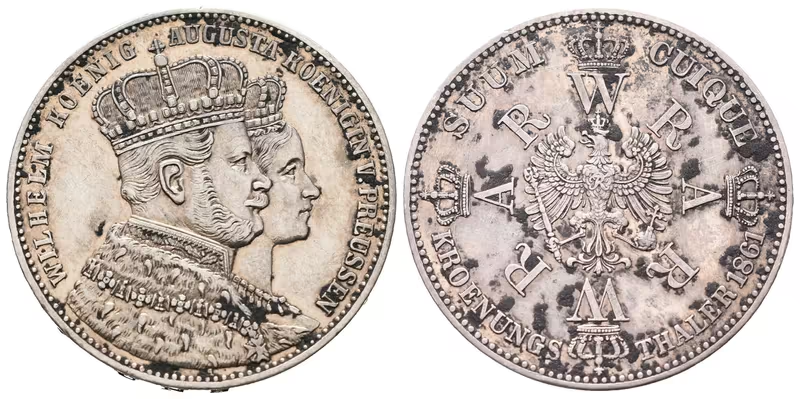
Prusko, Tolar 1861 - Korunovační
Pruské království, Friedrich Wilhelm IV. (1840 - 1861) Tolar 1861 A - Ke korunovaci Viléma a Augusty Sasko-Výmarské, KM.488, Dav.778, tmavá patina, rysky, oběh