Tehran
Tehran is the capital of Iran in the north of the country near the Alborz mountains and the largest political, economic and cultural centre of the state. In history it established itself as the metropolis of the Qajar dynasty, and in numismatics it is important as the seat of state power and of modern Iranian coinage.
The area of today's Tehran was settled long before it became a capital. In the wider region, nearby Rey, one of the traditional centres on the old trade routes, was of older importance. Tehran was for centuries rather a smaller settlement in its hinterland, benefiting from its position between the desert areas and the more fertile slopes of the north. Gradually, however, it began to develop as a market and administrative point, especially as the security and political conditions in the region changed.
A decisive turning point came at the end of the 18th century, when Tehran became the capital of Persia under the Qajar dynasty. With it, the institutions of the court, the bureaucracy, the military hinterland and the representation of power concentrated in the city. During the 19th century Tehran expanded, new palaces, bazaars and administrative buildings arose, and the city gradually changed into a more modern metropolis, although its everyday life was still determined by the traditional structures of market and crafts. Contact with European powers and the pressure of modernisation were reflected in state administration, the army and the economy, and this was also reflected in monetary circulation.
History
In the 20th century Tehran underwent rapid modernisation and growth, linked with the centralisation of the state and the development of infrastructure. The city became the centre of politics and of the social changes that shaped modern Iran: from rebuilding and urbanisation to a period of fundamental political upheavals. Today, therefore, Tehran feels like a city of great contrasts, where, alongside traditional quarters and bazaars, modern districts, institutions and transport hubs extend.
Tehran is the seat of key state institutions and at the same time a centre of financial administration, which is also reflected in monetary culture. The Iranian currency is in everyday language often expressed in terms of the toman, while the official unit is the rial; this dual mode of expression has practical impact on daily payments and on the perception of values. In numismatics Tehran is important especially as the place where state control over issues is concentrated and where decisions are made on the form of currency, denominations and state symbolism.
City, currency and numismatic connections
On the coins and banknotes connected with modern Iran appear motifs of statehood, architecture, cultural tradition and symbolic elements meant to express the continuity and identity of the country. For collectors, Tehran is interesting above all in the context of transitions between dynasties and political stages: a change of regime is often reflected in the iconography, the inscriptions and sometimes also in the structure of denominations itself. With modern pieces, the year, preservation grade, possible variants and, with commemorative issues, also the mintage and quality of execution are decisive.
In our auction and shop
- Code: ZD-2008DUK
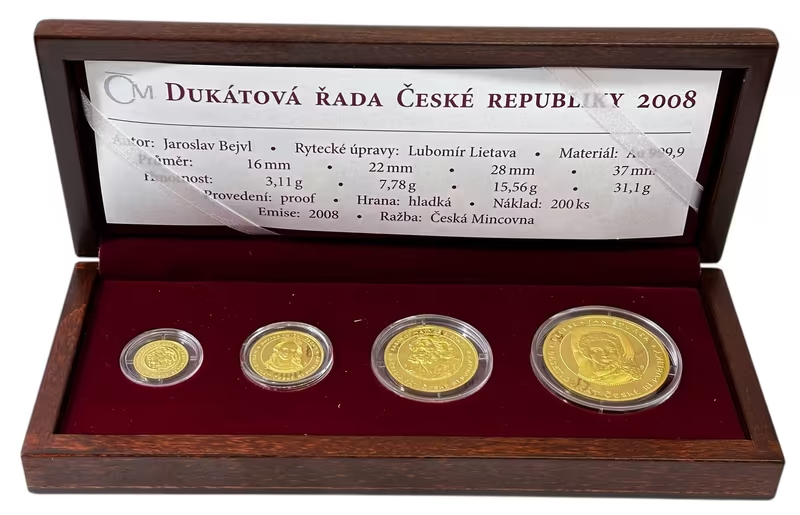
Medaile 2008 - Dukáty České republiky 2008
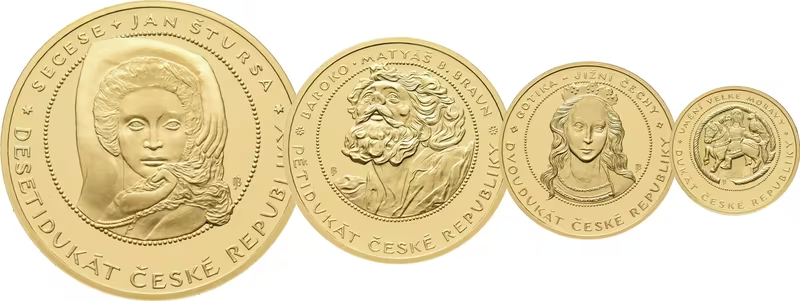
Česká republika (1993 - ) Medaile 2008 (Jaroslav Bejvl) - Dukátová sada České republiky 2010 - umělecké slohy 1 dukát Umění Velké Moravy, 16 mm (3,11 g) 2 dukát Gotika - Jižní Čechy, 22 mm (7,78 g) 5 dukát Baroko - Matyáš Braun, 28 mm (15,56 g) 10 dukát…
- Code: ZD-2010DUK
Medaile 2010 - Dukáty České republiky 2010
Česká republika (1993 - ) Medaile 2010 (Jaroslav Bejvl) - Dukátová sada České republiky 2010 - umělecké slohy 1 dukát Umění Velké Moravy, 16 mm (3,11 g) 2 dukát Gotika - Jižní Čechy, 22 mm (7,78 g) 5 dukát Baroko - Matyáš Braun, 28 mm (15,56 g) 10 dukát…