Valerian I
Valerian I (c. 193–260/264) was the Roman emperor who ruled in the years 253–260, famed as the last significant persecutor of Christians before Constantine, but above all as the first emperor in Roman history to be captured alive by enemies when, in the year 260, he was seized by the Sasanian king Shapur I during the Persian campaign. Valerian is signific…
Publius Licinius Valerianus was born around 193, probably in northern Italy, into an older senatorial family with a tradition of public service. He received the classical education of the Roman aristocracy and gradually held various magistracies during the Severan dynasty. He was a respected senator known for his conservative views and dedication to traditional Roman values.
His senatorial career took place during the first decades of the third century, when Valerian served as consul and governor of various provinces. He gained experience of military command and provincial administration, which qualified him for high positions during the Crisis of the Third Century. He was regarded as a reliable aristocrat capable of stabilising the empire.
His rise to power began under Trebonianus Gallus, who appointed Valerian commander-in-chief of the imperial armies with the task of suppressing various usurpations and barbarian invasions. When Gallus fell in 253, Valerian became the natural candidate for the imperial throne thanks to his military authority and senatorial support.
His accession to the throne in 253 brought to the empire an experienced 60-year-old aristocrat at the moment of its gravest crisis since the empire's founding. Valerian immediately adopted a diarchic system of joint rule with his son Gallienus — he himself took control of the East, while Gallienus was given the West. This division was intended to deal more effectively with problems on several fronts.
The Christian persecution launched in 257 represented a return to the policy of Decius's systematic suppression of the Church. Valerian issued edicts requiring Christian clergy to sacrifice to the Roman gods and confiscated Church property. The persecution was particularly harsh towards higher Church dignitaries, including the bishop of Rome, Saint Sixtus II.
History
The motivation for the persecution included both religious and political factors. Valerian accused Christians of sabotaging the war effort and of cooperating with the enemies of the empire. The confiscation of Church property was also intended to improve the catastrophic state of state finances during continuous wars on all frontiers.
Barbarian invasions in the north and west required the division of attention between East and West. While Gallienus fought the Alamanni, Franks and other Germanic tribes, Valerian concentrated on the Sasanian threat in Mesopotamia and Syria. This coordinated defence was intended to prevent the collapse of the empire on multiple fronts simultaneously.
The Persian campaign (257–260) began with hope and initial successes against Shapur I. Valerian restored Roman control over part of Mesopotamia and stabilised the eastern frontiers. However, prolonged military operations exhausted the imperial army and epidemics decimated the units during the sieges of Nisibis and Carrhae.
Negotiations with Shapur in 260 were meant to lead to a diplomatic resolution of the conflict, but ended in disaster for Roman arms. Valerian came in person to a meeting with the Sasanian king, but was captured by treachery or violence. He became the first Roman emperor to be taken alive by a foreign power, which shocked the ancient world.
The capture and death of Valerian in Persian captivity (260–264) represented the greatest humiliation in Roman history. According to Sasanian sources, the emperor was forced to serve as a footstool for Shapur's horse, and after his death he was stuffed as a trophy. Roman sources are more discreet, but his capture devastated the prestige of the empire and provoked further usurpations.
Valerian I in numismatics
Valerian's legacy is tragic — his persecution of Christians made him a symbol of tyranny in Church tradition, while his capture by the Persians stands as a symbol of Roman weakness during the Crisis of the Third Century. Paradoxically, his son Gallienus later ended the persecution and inaugurated a more tolerant policy towards Christians.
Valerian I's coins document his seven-year reign before the catastrophic capture and reflect the last attempt to restore traditional Roman authority before the collapse of the Crisis of the Third Century. The portraits depict an older aristocrat with a dignified expression and with emphasis on imperial majesty despite the growing problems of the empire.
Characteristic motifs are the military virtues — VIRTVS AVG (imperial bravery), VICTORIA AVG (imperial victory), FELICITAS AVG (imperial good fortune) and PROVIDENTIA AVG (imperial foresight). These optimistic inscriptions contrast with the reality of barbarian invasions and Persian wars, but they reflect the propaganda need to sustain morale.
Diarchic coins with portraits of Valerian and Gallienus document the unique system of joint rule between father and son governing the eastern and western parts of the empire. These issues emphasise dynastic continuity and coordinated leadership during a multitude of simultaneous crises on all frontiers.
The quality of Valerian's coins gradually declined because of economic problems — the debasement of the antoniniani and the reduction of weight reflect the financial exhaustion of war on several fronts. After his capture in 260, his name appears on coins ever more rarely, until it disappears entirely once his death in captivity was confirmed.
In our auction and shop
- Code: BE088-0040
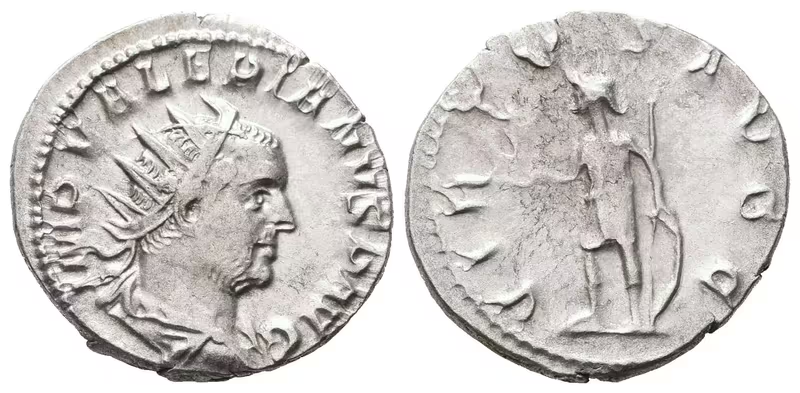
Valerian I., antoninián, Viminacium, RIC 40
Valerian I. (253 - 260) mincovna Viminacium, stojící Virtus s Viktorií v pravé ruce, druhou rukou opřen o štít, VIRTVS AVGG, RIC 40
Skladem 1 ks - Code: BE088-0284
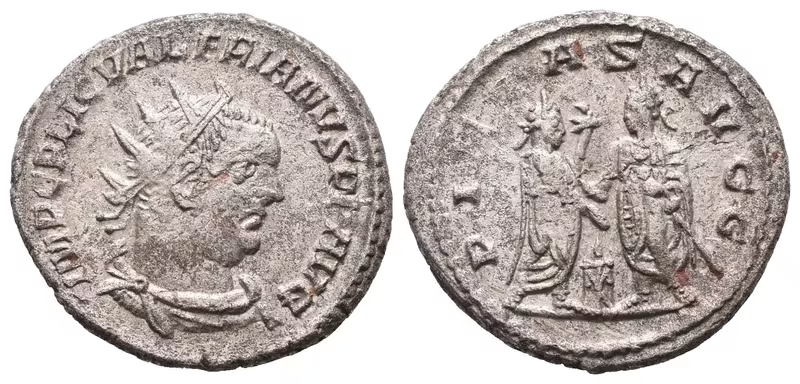
Valerian I., antoninián, Samosata, RIC 284
Valerian I. (253 - 260) mincovna Samosata, raženo 255 - 256, Valerian a Gallienus společně obětují u oltáře, RIC 284
Skladem 1 ks - Code: BE088-0277
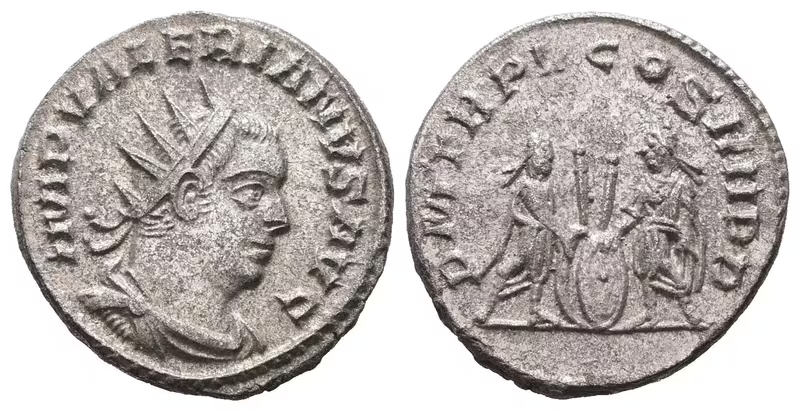
Valerian I., antoninián, Řím, RIC 277
Valerian I. (253 - 260) mincovna Řím, raženo 257, Valerian a Gallienus stojící naproti sobě opřeni o štíty, kopí na pozadí, RIC 277
Skladem 1 ks - Code: BE088-0262
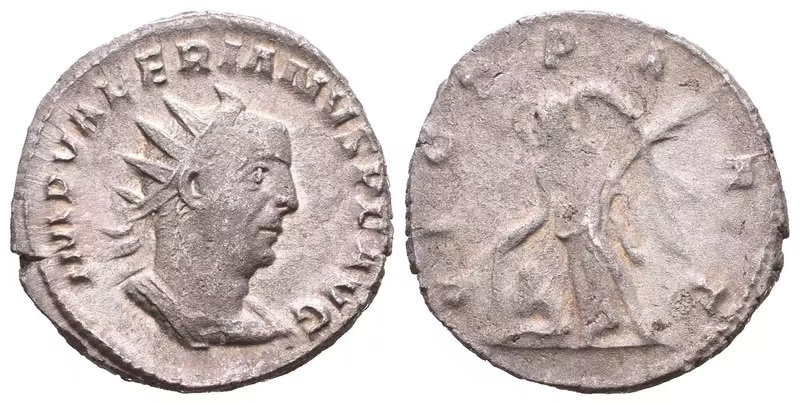
Valerian I., antoninián, Viminacium, RIC 262
Valerian I. (253 - 260) mincovna Viminacium, raženo 257 - 258, stojící Viktorie držící štít nad truchlícím zajatcem, RIC 262
Skladem 1 ks