William I of Orange
William I of Orange (1533–1584), known as the Silent, was a Dutch statesman and leader of the revolt against Spanish rule, which set in motion the emergence of an independent Netherlands. As stadtholder and later "father of the fatherland", he combined politics, diplomacy and military resistance during the religious and power conflicts of the 16th century.
William I of Orange was born in 1533 in the German town of Dillenburg into the House of Nassau. He acquired the title "Prince of Orange" through inheritance, which from his youth made him a significant figure of the European high nobility. He grew up in part at the Habsburg court and entered the service of Emperor Charles V, in whose empire the Dutch provinces had extraordinary economic importance. William gradually became one of the most influential men in the Netherlands: he held high offices, owned extensive estates, and was able to deal both with the aristocracy and with the towns, whose wealth rested on trade and crafts.
The turning point came with the reign of Philip II of Spain, who, after Charles V, inherited the Netherlands as part of the Habsburg empire. Philip pursued stronger centralisation, harsher action against the Reformation and firmer control of administration and taxes. This provoked resistance both from Protestant groups and from part of the Catholic nobility and towns, who defended their traditional liberties. William did not initially belong to the radicals: he sought compromise and the preservation of provincial autonomy, yet he ran increasingly into the fact that Madrid had priorities different from those of the local elites. When tension turned into open conflict, William became one of the central figures of the resistance.
A key moment was the escalation of events in the second half of the 1560s, when the situation in the provinces came to a head and Spanish administration resorted to repression. William came into direct conflict with Spanish policy, gradually lost the chances of compromise, and moved to the position of leader of the rebel party. The revolt was not a simple "national struggle" in the modern sense: it was a mixture of religious disputes, defence of estate rights, urban autonomy and rejection of centralised power. William's strength lay in his ability to hold this complex whole together, at least enough for the resistance to survive repeated defeats and internal disputes.
History
In the development of the Dutch revolt it gradually became clear that decisive importance lay in the ability to gain the support of towns and ports, to secure financing and to maintain allies abroad. William negotiated and sought support outside the Netherlands, since against the Spanish military force it was difficult to hold out without international support. Internally, the revolt was transformed into a struggle over political organisation: the provinces were concerned with how to arrange government, how to levy taxes and how to reconcile religious conditions. The result was the gradual formation of a northern bloc of provinces, which in the end became the basis of the future independent state.
William's political importance peaked in the 1570s and at the beginning of the 1580s. He was able to weather the period when part of the provinces turned away from the revolt and at the same time created the framework in which the northern provinces continued their resistance. His position, however, was so fundamental that he became a target. In 1584 he was assassinated in the town of Delft, and the Dutch revolt thereby lost a key figure. Even so, the process did not stop: the Netherlands gradually moved towards the establishment of a republic and a long-term clash with Spain that was to drag on for decades. William I of Orange therefore entered history as the "father of the fatherland" – not because he had created a finished state, but because he gave the revolt a political axis and the ability to survive.
William I was above all a political organiser. His reputation as "the Silent" refers to caution and the ability to weigh words at a time when an incautious remark could mean the loss of allies or of life. In practice he had to balance the interests of provinces, nobility, towns and various religious groups, while at the same time conducting negotiations with foreign powers. His legacy therefore lies not only in military episodes but in the fact that he created a style of politics based on coalitions, patience and the gradual building of legitimacy.
Politics, symbolism and numismatic connections
In numismatics the period of the Dutch revolt is reflected mainly in the coin as an instrument of state authority. During the years of conflict, strikes appear that emphasise provincial liberties, urban identity and the new political reality. The coin served not only to pay armies and for trade, but also as "small-scale propaganda": an emblem, a motto or a coat of arms on a circulating coin quickly spread the message of who held power and what values they defended. With Dutch strikes of the 16th–17th century it is therefore important to watch how the titulature, provincial arms and motifs associated with resistance against Spanish rule changed. William's personal iconography does not impose itself on coins as universally as in some kings, yet his era represents a time when the monetary image in the Netherlands was changing markedly together with the emerging statehood.
In our auction and shop
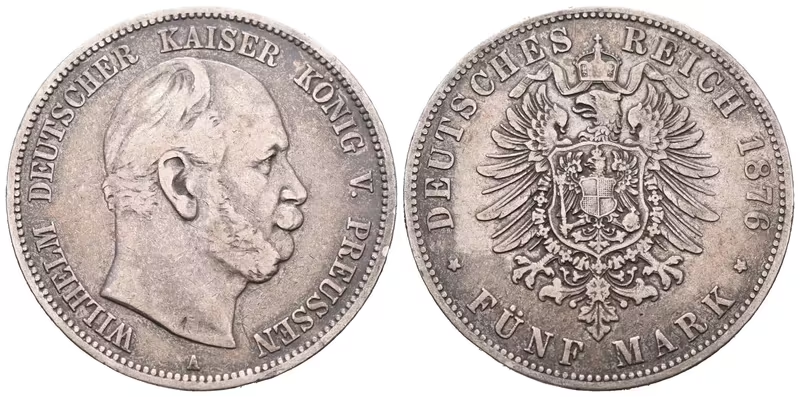
- Code: NBPRU-BX1876A.2
Prusko, 5 Marka 1876 A
Prusko, Vilém I., 1861 - 1888 5 Marka 1876 A, Berlín, KM.503, J.97, oběhový stav
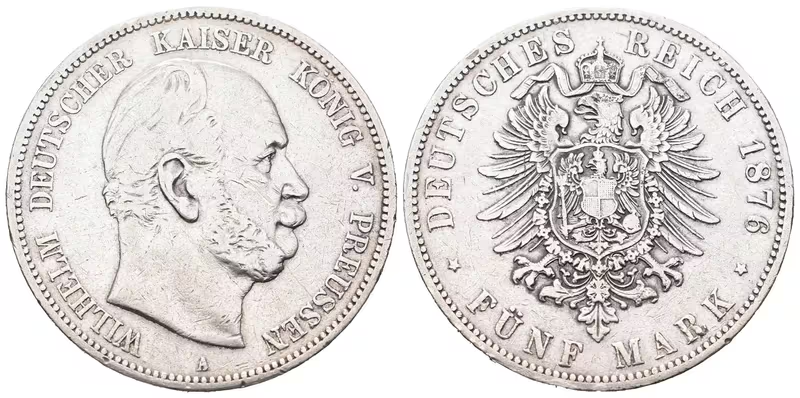
- Code: NBPRU-BX1876A.3
Prusko, 5 Marka 1876 A
Prusko, Vilém I., 1861 - 1888 5 Marka 1876 A, Berlín, KM.503, J.97, oběhový stav
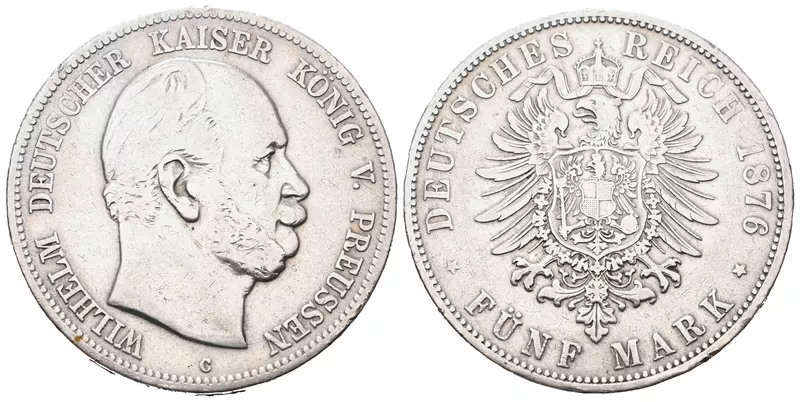
- Code: NBPRU-BX1876C
Prusko, 5 Marka 1876 C
Prusko, Vilém I., 1861 - 1888 5 Marka 1876 C, Frankfurt am Main, KM.503, J.97, oběhový stav
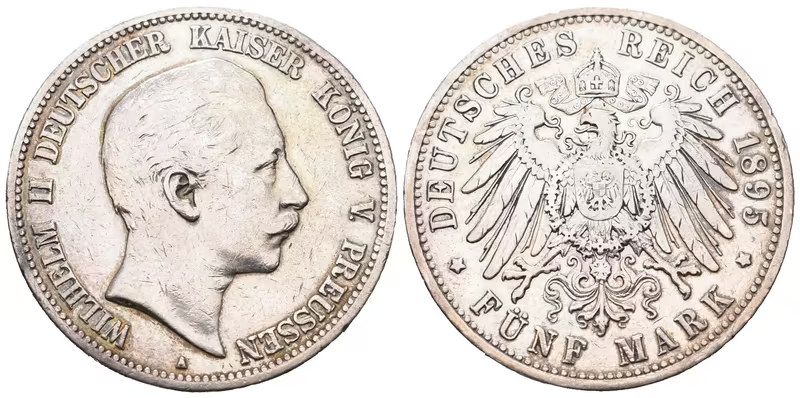
- Code: NBPRU-BX1895A.1
Prusko, 5 Marka 1895 A
Prusko, Vilém I., 1861 - 1888 5 Marka 1895 A, Berlín, KM.523, J.129, patina, rysky