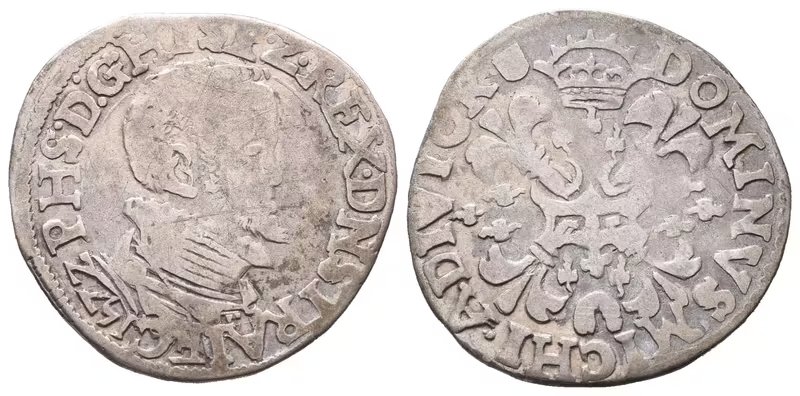
Philip II of Spain
Philip II of Spain (1527-1598) was a Spanish king of the House of Habsburg, ruler of the largest empire of his day, during whose reign American gold and silver flowed into Europe in unprecedented quantities. His eight-real coins, thalers, and gold escudos became the international currency of the early modern period and laid the foundations of the first gl…
Philip II ascended the Spanish throne in 1556 after the abdication of his father Charles V, inheriting an empire over which the sun never set. His dominions included Spain, the Netherlands, a considerable part of Italy, the American colonies, and from 1580 also Portugal with its overseas territories. This vast empire required a unified and reliable monetary system, which Philip II systematically built up.
From a numismatic point of view, Philip's reign represents the golden age of Spanish coinage. The massive inflow of precious metals from American mines, especially the silver mines of Potosi (today's Bolivia) and Zacatecas (Mexico), enabled unprecedented coin production. Annual silver output reached up to 300 tonnes, representing more than 80% of world production. This wealth paradoxically led, however, to the price revolution in Europe and long-term inflation.
Philip II carried out an important monetary reform in 1566, when he standardised minting across his dominions. He introduced a system based on the real as the basic unit of account. The most important coin became the peso de ocho reales (eight-real), also known as the Spanish dollar, which weighed approximately 27.5 grams of pure silver. This coin became the first truly world currency, accepted from China to the American colonies.
Various denominations were struck at Spanish and American mints: gold escudos and their multiples (2, 4, and 8 escudos), silver reals (1/2, 1, 2, 4, and 8 reales), and small copper maravedis. The principal mints were Seville, Madrid, Toledo, and Segovia in Spain; Mexico City and Lima in America; Milan in Italy; and Antwerp in the Netherlands.
History
Philip's coins bore a characteristic iconography: on the obverse the Spanish coat of arms with the Habsburg device, often accompanied by the motto "PHILIPPVS II DEI GRATIA" (Philip II by the Grace of God); on the reverse a cross or the Pillars of Hercules with the motto "PLVS VLTRA" (Further beyond). This motif of the pillars with a ribbon became the model for the dollar symbol ($).
Philip's monetary policy was closely tied to his religious and political objectives. Enormous expenditures on the Counter-Reformation, wars against the Ottoman Empire, suppression of the Dutch Revolt, and the ill-fated expedition of the Invincible Armada against England (1588) exhausted even the vast income from the colonies. Philip had to declare state bankruptcy three times (1557, 1575, 1596), which shook the European financial system.
The coins of Philip II represent the transition from hand-struck to machine-struck coins. At the Segovia mint a rolling press (ingenio) imported from Germany was installed in 1585, enabling more precise and higher-quality minting. Coins struck by this technology are distinguished by their perfectly round shape and uniform thickness, in contrast to the irregular hand-struck pieces.
The American mints produced the characteristic "cob coins" (macuquinas), irregularly shaped coins struck by hand from roughly cut flans. These coins, although technically imperfect, had guaranteed weight and fineness, which ensured their acceptance in international trade. Their rustic appearance makes them today highly sought after among collectors.
Coin characteristics and minting technology
Control marks on Philip's coins allow precise identification of the mint and period of striking. Each mint had its own mark: an M with a circle for Madrid, an aqueduct for Segovia, a castle for Burgos. Mintmasters added their initials, which allows dating to within a few years. These marks are key to numismatic classification and the valuation of coins.
The quality of strikings varied considerably by mint. European mints produced artistically refined pieces with detailed portraits and coats of arms, whereas colonial mints focused on quantity over quality. Paradoxically, it is often these imperfect colonial strikings that are today more valuable than the technically more perfect European coins.
In our auction and shop
- Code: SNIZSPA-E1572
Španělské Nizozemí, 1/10 Philipsdaalder 1572
Španělské Nizozemí - Holland, Filip II. Španělský, 1556 - 1598 1/10 Ecu (Philipsdaalder) 1572, minc. Utrecht, Van.273-308 var., patina, rysky_R!
Skladem 1 ks