The Vítkovci
The Vítkovci were a powerful Czech noble family of the Middle Ages, who became one of the main pillars of the politics of the Přemyslids and later of the Luxembourg era. Several branches gradually broke off from the family, of which the best known are the Rosenbergs, the Lords of Hradec, and the Lords of Stráž.
The Vítkovci enter the history of the Czech lands in the 12th century as a family that was able to combine royal favour, property expansion and the ability to occupy key provincial offices. By tradition, the founder of the family is considered to be Vítek (Vít) of Prčice, from whom the individual branches are derived, although the details of the early genealogy remain debated in scholarly literature. What is certain, however, is that the family quickly secured a firm position especially in southern Bohemia, where it created a continuous network of castles, towns and economic infrastructure.
The rise of the Vítkovci was linked also to the transformation of the Czech state. In the 12th and 13th centuries the importance of the nobility as an administrative and military support of the sovereign was growing. Whoever could hold strategic points, control communications and administer profitable estates gained political influence. The Vítkovci asserted themselves not only as property-holders but also as actors in provincial politics, able to negotiate, conclude marriage alliances and build their power on long-term continuity.
In the 13th century distinct branches broke off from the family on the basis of principal seats and heraldic emblems. The best known are the Rosenbergs, who became one of the wealthiest and most influential families of the Czech kingdom. Alongside them, the Lords of Hradec asserted themselves, whose position was important especially in the area of Jindřichův Hradec, and other branches that held smaller but strategically important estates. A common feature of the Vítkovec branches was the ability to build a system of strongholds in the landscape: castles, market towns, monastic foundations and later also representative residences.
History
The Vítkovci were also significant in the political crises of the Czech Middle Ages. In times of succession disputes and the transformation of dynasties their support became a valuable commodity: great houses often decided what form provincial politics would take, who would gain offices and how profits and privileges would be distributed. In the Luxembourg era the Vítkovec families maintained themselves among the elite, and their network in southern Bohemia provided a stable power base in the long term. At the same time it should be noted that the "Vítkovci" did not form a single unified political party – individual branches could have different interests and their positions in various conflicts could differ.
In the late Middle Ages and the early modern period the importance of the very designation "Vítkovci" was gradually overshadowed by the names of the specific branches. The greatest role in the memory and history of the Czech nobility was taken on by the Rosenbergs, who managed to transform regional dominance into long-term cultural and economic power. Even so, the term Vítkovci is important as a "family trunk" from which a substantial part of the South Bohemian aristocracy grew, and which significantly co-shaped the medieval form of the Czech state.
The Vítkovci are also known heraldically. The individual branches used different emblems that became very recognisable: with the Rosenbergs, for example, the rose; with the Lords of Hradec a golden rose on a blue field; while other branches distinguished themselves by their own colours and figures. Heraldry here is not just an ornament – it is a key to identifying family branches in sources, on seals and on architectural monuments. In southern Bohemia the Vítkovec trace is still legible today in the network of castles, towns and monasteries associated with the family.
Coats of arms, seats and numismatic connections
From a numismatic point of view, the link to the Vítkovci is most often indirect. In the Czech lands the right to mint was long bound chiefly to the sovereign, so the Vítkovec families are not typically associated with extensive "own" coin production. Even so, in the material culture of their time there appear objects connected to numismatics: seals and seal matrices, the medallic art of decorations and commemorative pieces of later centuries, or finds of coins from Vítkovec seats that document trade contacts and the economic background of the estates. The Vítkovci thus represent above all the political-economic framework in which Czech coinage operated: they were great holders of power and property who influenced the history of the country and, with it, the environment in which coins were used.
In our auction and shop
- Code: ZD-2019CKRU
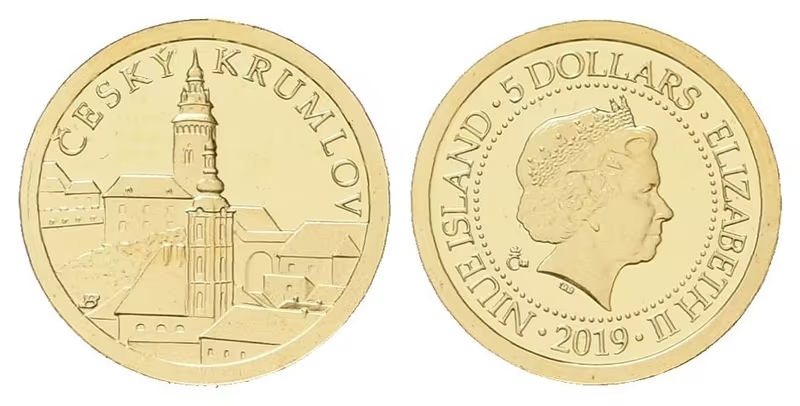
Zlatá mince Český Krumlov - dobová pohlednice
Niue 5 Dollars 2019 (Petra Brodská) - Zlatá mince Český Krumlov - Hrad a zámek v dobové pohlednici Au 0,9999, 11 mm (0,5 g), náklad 1000 ks, PROOF V minulosti si Český Krumlov za své sídlo zvolila celá řada velkých šlechtických rodů – Vítkovci, pánové z…