Vladimir I
Vladimir I was Grand Prince of Kyiv reigning in the years 980 to 1015, who adopted Christianity and made Kievan Rus' a Christian state. His decision to baptise the Rus' in 988 according to the Byzantine rite determined the civilisational direction of the East Slavs for the following millennium.
Vladimir was born around 958 as the son of the Kyivan prince Sviatoslav I and his slave Malusha, housekeeper of Princess Olga. After Sviatoslav's death in 972, civil war broke out between his sons. Vladimir ruled in Novgorod, his brother Yaropolk in Kyiv and Oleg in the land of the Drevlians. Vladimir fled in 975 to Scandinavia, from where he returned with a Varangian army. In 978 he captured Polotsk and in 980 Kyiv, where he had Yaropolk murdered.
The first years of Vladimir's reign were marked by paganism and expansion. He built in Kyiv a pantheon of Slavic gods headed by Perun. He led successful campaigns against the Poles, Volhynians and Bulgars. He had five wives and reportedly 800 concubines. A turning point came in 987, when the Byzantine emperor Basil II asked Vladimir for military help against rebels. Vladimir made his help conditional on marriage to the emperor's sister Anna Porphyrogenita and on an equal alliance.
History
In 988 Vladimir captured the Byzantine town of Chersonesos in the Crimea and forced the emperor to fulfil his promise. He accepted baptism and took Anna as his wife. After returning to Kyiv he ordered the baptism of the population. Perun's statue was thrown into the Dnieper, and the inhabitants of Kyiv were mass-baptised in the river. Vladimir began the Christianisation of Rus', built churches and founded schools. The Tithe Church in Kyiv, the first stone church in Rus', was built according to the Byzantine model.
Vladimir reorganised the administration of the empire by dividing it among his twelve sons. He built a defensive system of fortresses against the nomadic Pechenegs. His court in Kyiv became a centre of culture and learning. He supported trade with Byzantium, Western Europe and the Orient. He died on 15 July 1015 at Berestovo near Kyiv. After his death a fratricidal war broke out among the sons, from which Yaroslav the Wise emerged victorious. Vladimir was canonised as a saint and equal-to-the-apostles for the Christianisation of Rus'.
The minting of Vladimir I
Vladimir I as the first Russian sovereign launched the minting of his own coins according to the Byzantine model. The zlatniki weighed around 4.2 grams and bore on the obverse the image of Christ or the prince with a cross, on the reverse the family trident of the Rurikids with the inscription 'Vladimir on the throne'. The srebreniki had similar iconography with a weight of about 3 grams. These first Russian coins were struck in limited quantities, principally for prestige and ceremonial purposes.
The coins were struck at Kyiv probably by Byzantine mintmasters. The inscriptions were in Cyrillic, which documents the beginnings of Slavic literacy in Rus'. Vladimir's coins imitated Byzantine solidi and miliaresia, but with their own Russian symbolism. After Vladimir's death the minting continued under his sons, especially Yaroslav the Wise. These early Russian coins are extremely rare; only a few dozen specimens are known. They document the beginnings of Russian statehood and the adoption of Christianity.
In our auction and shop
- Code: ZC512
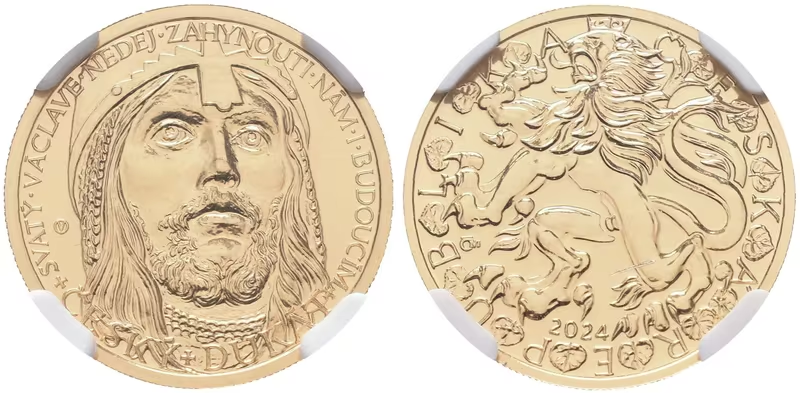
Dukát 2024 - Svatý Václav
Česká republika (1993 - ) Mimořádná zlatá mince Dukát 2024 - Zlatá obchodní mince s motivem svatého Václava (Svatováclavský dukát), autor Vladimír Oppl, Aurea C512, certifikát Au 0,986, 19,75 mm (3,49 g), limitovaný náklad 35 000 ks (běžná kvalita) V…
Skladem 4 ks - Code: RAOPP-2009PRE.1
Oppl Vladimír - Přemysl Otakar I. bez certifikátu
Oppl Vladimír (1953 - ) AR Medaile b.l. (2009) - Přemysl Otakar I., český král z rodu Přemyslovců Ag 0,999, 40 mm (29g), kapsle, bez certifikátu, PROOF Pamětní stříbrné medaile z čistého stříbra (999/1000) z kolekce Největší osobnosti českého národa.…
- Code: RAOPP-2009PRE
Oppl Vladimír - Přemysl Otakar I.+ certifikát
Oppl Vladimír (1953 - ) AR Medaile b.l. (2009) - Přemysl Otakar I., český král z rodu Přemyslovců Ag 0,999, 40 mm (29g), kapsle, certifikát, PROOF Pamětní stříbrné medaile z čistého stříbra (999/1000) z kolekce Největší osobnosti českého národa. Krásný…
- Code: ZC512-NGC
Dukát 2024 - Svatý Václav, MS 70
Česká republika (1993 - ) Mimořádná zlatá mince Dukát 2024 - Zlatá obchodní mince s motivem svatého Václava (Svatováclavský dukát), autor Vladimír Oppl, Aurea C512, certifikát Au 0,986, 19,75 mm (3,49 g), limitovaný náklad 35 000 ks (běžná kvalita), etue…