Yaroslav the Wise
Yaroslav the Wise was the Grand Prince of Kyiv who ruled from 1019 to 1054, under whose rule Kyivan Rus' reached its greatest territorial extent and cultural flourishing. His reign represents the golden age of the Old Russian state, when Kyiv rivalled Constantinople for the title of the greatest city of Eastern Europe.
Yaroslav was born around 978 as the son of Vladimir I and the Polotsk princess Rogneda. His father appointed him prince in Rostov and later in Novgorod. After Vladimir's death in 1015 a war of succession broke out among the brothers. Yaroslav's brother Sviatopolk the Accursed had the brothers Boris, Gleb and Sviatoslav murdered. Yaroslav, with the support of the Novgorodians and Varangian mercenaries, defeated Sviatopolk at the Battle of Lyubech in 1016, but had still to fight his brother Mstislav of Tmutarakan.
After Mstislav's death in 1036 Yaroslav united the whole of Rus' under his rule. He successfully defended the land against the nomads, decisively defeating the Pechenegs at Kyiv in 1036. He led less successful expeditions against Byzantium in 1043 and against Poland. His main work was the internal consolidation of the state and cultural development. He rebuilt Kyiv after the model of Constantinople with a Golden Gate and the Cathedral of Saint Sophia. He founded the first Russian library and a school of translators.
History
Yaroslav created a network of dynastic marriages, which linked Rus' with the whole of Europe. His daughters were married to kings of France, Norway and Hungary; his sons took princesses from Byzantium, Poland and Germany. He himself was married to the Swedish princess Ingegerd. He issued Russkaya Pravda, the first written law code regulating criminal law, inheritance and commercial relations. He appointed the Metropolitan of Kyiv without Byzantine consent, thereby strengthening the independence of the Russian Church.
Yaroslav died on 20 February 1054 in Kyiv and was buried in the Cathedral of Saint Sophia. His will dividing Rus' among his sons according to seniority led to the later disintegration of the state. Nevertheless his rule represented the peak of the power of Kyivan Rus'. Under Yaroslav, Rus' had over 400 towns, extensive trade and diplomatic relations from Scandinavia to Byzantium. His contribution to Russian culture and statehood earned him the epithet "the Wise", assigned only in the 19th century by historians.
Coinage and currency system of Yaroslav the Wise
Yaroslav continued in the striking of srebreniks after the model of his father Vladimir. His coins bore on the obverse the image of Saint George, the prince's patron, on the reverse the family emblem of the Rurikids with the inscription "Yaroslav's silver". The striking was limited, the coins served above all for representative purposes. Most trade was conducted by means of foreign coins, especially Arab dirhams and Byzantine miliaresia, or by barter.
Yaroslav the Wise's Russkaya Pravda contains the first monetary provisions in Rus'. It set fines in grivnas of silver and in kuna, which were fur money. The system reckoned: 1 grivna = 20 nogata = 25 kuna = 50 rezana. This currency system combined weight silver with a fur currency, which reflected the dual character of the Russian economy. Yaroslav's mint and monetary reforms laid the foundation of medieval Russian money.
In our auction and shop
- Code: RAHOR-1949
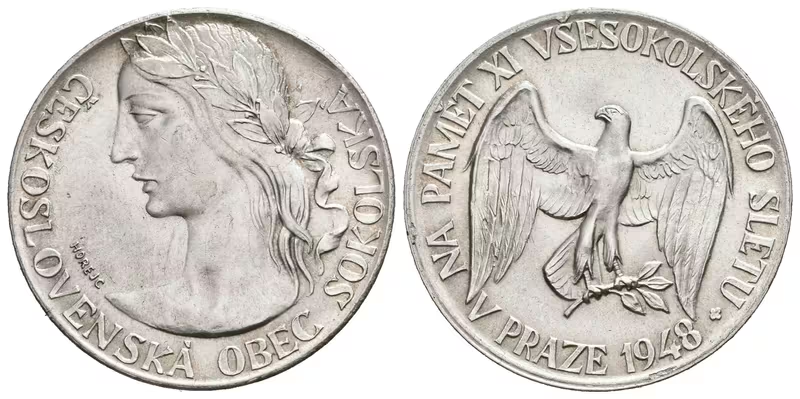
Horejc Jaroslav - XI. všesokolský slet
Kužel Miroslav (1907 - 1985) AR Medaile 1948 - Na paměť XI. všesokolského sletu v Praze. Ag 0,500 (13,88 g), Aurea.M17
Skladem 1 ks - Code: RAKREP-1914
Krepčík Jaroslav - Joža Uprka
Krepčík Jaroslav (1880 - 1959) AE Plaketa 1914 - Joža Uprka - Svým členům Sdružení výtvarných moravských umělců bronz, 65x48 mm, původní kartonový přebal
Skladem 1 ks - Code: RABEJV-2004
Bejvl Jaroslav - Franz Kafka
Bejvl Jaroslav (1941 - 2016) AR Medaile b.l. (2004) - 80. výročí úmrtí Franze Kafky Ag 0,925, 40 mm (20,13 g), dřevěná etue, drobné flíčky, PROOF
Skladem 1 ks - Code: RABRUH-1927-1930
Brůha Jaroslav - Hold sportovců 1929, Hold neznámému vojojínu 1930
Brůha Jaroslav (1889 - 1976) AE Medaile 1927 - Hold sportovců 1929, Hold neznámému vojínu 1930 Bronz, původní ouška, ilustrační foto (cena za 1 ks)
Skladem 2 ks