Vladivoj
Vladivoj was a Czech prince who reigned only briefly in the years 1002-1003 during the crisis after the expulsion of Boleslav III. His origin is uncertain; traditionally a Polish background is considered.
Vladivoj came to the Czech princely throne in autumn 1002 in an exceptionally turbulent situation. The Přemyslid principality was then passing through a period of internal conflicts in which the interests of local magnates, rivalry within the ruling dynasty and the pressure of strong neighbours clashed. The immediate predecessor was Boleslav III, whose rule had ended with expulsion from the country and a temporary power vacuum. It was at this very moment that Vladivoj was summoned as a compromise ruler — a person assumed to be acceptable to part of the Czech elite and at the same time not too dangerous for the surrounding powers.
His origin remains unclear to this day. In sources and historical literature the idea of a Polish background appears, or kinship with the Přemyslids through the female line, but no firm family placement can be documented with the certainty we have for other rulers. Precisely this uncertainty is typical of Vladivoj: we know relatively little of his person, and the short period of rule has left only a limited amount of unambiguous information. Nevertheless, his fate concentrates an important theme of early medieval politics — the legitimisation of power. The prince had to obtain support within the country, but at the same time he needed his position to be respected even by the powers that intervened in Czech affairs.
The most striking political act of Vladivoj's reign was his appearance before the Roman-German king Henry II. At the end of 1002 Vladivoj appeared at Regensburg, where he is said to have pledged loyalty to the king and accepted Bohemia as a fief. This act is important not only as an episode of personal diplomacy but also as a symbolic moment: the relationship of the Czech prince to the empire was thereby formalised in a feudal framework typical of medieval politics. In practice it meant the strengthening of the sovereign's legitimacy 'from outside', but at the same time the acceptance of obligations that could influence the further development of the Czech state.
History
Vladivoj's rule, however, lasted only a few months. At the beginning of 1003 he died suddenly, so that the Czech lands again found themselves in open struggle for power. Into the situation entered the Polish prince Bolesław I the Brave, who sought to exploit Czech affairs to his advantage. Shortly afterwards further upheavals and changes of ruler followed, until the princely throne stabilised again. Vladivoj thus remains a 'transitional' ruler: his short reign is important rather as part of a broader crisis than as a period of long-term administration and reform.
It is for this very reason that Vladivoj is interesting also for modern historians. He shows how fragile rule could be in the early Middle Ages, when internal disputes, dynastic uncertainty and the ambitions of neighbours combined. At the same time he reminds us that even a short episode can have lasting importance if a step of far-reaching consequences takes place in it — in this case especially the relationship to the empire and the way the prince was politically 'confirmed' in the international space.
In numismatics Vladivoj is known above all thanks to the very rare denarii associated with his short reign. These coins are encountered only occasionally, and some of the known pieces are linked to a find context that significantly helped to identify them and to distinguish them from the mintages of Boleslav III. On Vladivoj's denarii one follows not only inscription and symbolism but also the form of the flan itself: on some pieces a smaller diameter and a striking cross motif is noted, sometimes complemented by a trefoil or 'three-lobed' termination, by which the type can easily be recognised even when the inscription is less legible.
Vladivoj's denarii and the 'Chodovlice' type
In scholarly and collecting practice, for some of these mintages the name 'Chodovlice type' has become established, derived from a significant find at Chodovlice (1928). This is not an official period designation but a modern working term that helps to name a group of coins of similar appearance and probably close chronological placement. With early medieval denarii this is a common procedure: typology often stands on a combination of motif, style of dies, legibility of inscriptions and find connections, since written reports are scarce and coins are sometimes the only direct 'imprint' of the ruler's power.
For Vladivoj's denarii it holds that their rarity is determined not only by the short period of reign but also by how narrow the circle of mintage and distribution could have been. Every surviving piece is therefore a valuable source for knowledge of the period around the year 1000: it shows how the symbolism of the cross was used in Bohemia, what mint production looked like in a period of political uncertainty, and how quickly changes of rule could be reflected in the circulating currency. In numismatic description, precise type identification and careful assessment of the legibility of the inscription are crucial with Vladivoj's mintages, since the similarity with some denarii of Boleslav III can at first sight be considerable.
In our auction and shop
- Code: GFCSPUL
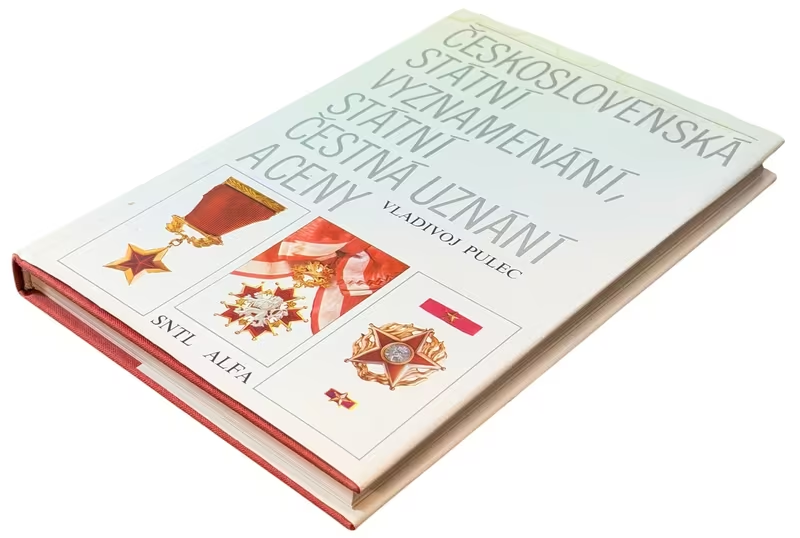
Československá státní vyznamenání, státní čestná uznání a ceny
Pulec, Vladivoj Československá státní vyznamenání, státní čestná uznání a ceny Praha 1984, 184 stran s vyobrazeními, vázané, poškozený papírový přebal jinak pěkná zachovalost Ilustrační fotografie!
Skladem 1 ks