
1/4 gulden
The 1/4 gulden (quarter florin, German Viertelgulden) is a silver coin of the Austrian currency worth a quarter of a gulden, i.e. 25 kreuzer. It was struck under Francis Joseph I from 1857 to 1872 and is one of the most common small silver coins of the Habsburg monarchy in the second half of the 19th century.
History
With the Vienna Monetary Treaty of 1857 the monarchy moved from the Convention currency to the Austrian currency, in which the gulden was divided into 100 kreuzer instead of the previous 60. The new system needed practical fractional denominations, so alongside the gulden, the double gulden and the small kreuzer coins the quarter gulden was created. Striking began in 1857 and ended in 1872; afterwards small silver was replaced by 10 and 20 kreuzer pieces of lower fineness and, from 1892, by the crown currency.
Specifications and types
The quarter gulden weighs 5.345 g, is .520 fine (2.78 g of pure silver) and measures 23 mm. Two main types exist: the Austrian type with the emperor's portrait on the obverse and the double-headed eagle on the reverse, and the Hungarian type with the Hungarian arms, struck for the lands of the Crown of St Stephen. The coins were struck at Vienna (A), Kremnica (B), Karlsburg (E), Milan (M) and Venice (V); the Italian mints worked only until the loss of Lombardy and Venetia. Collectors distinguish the coins by date and mintmark and, for the Hungarian type, by the legend variant.
In our auction and shop
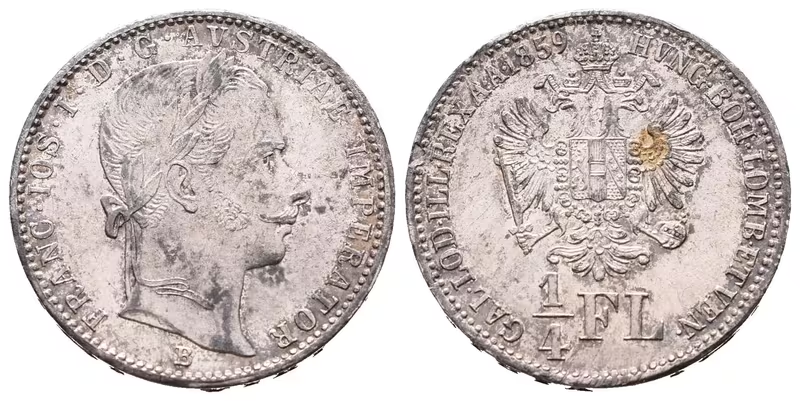
- Code: MA070-1859B.1
1/4 Zlatník 1859 B
František Josef I. (1848 - 1916) 1/4 Zlatník 1859 B, Kremnica, Ves. 70, krásná zachovalost, lesk, tmavá patina, drobné rysky
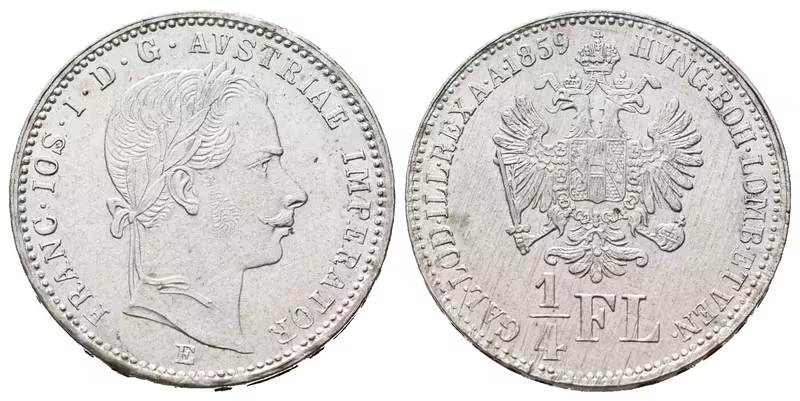
Skladem 1 ks - Code: MA070-1859E
1/4 Zlatník 1859 E
František Josef I. (1848 - 1916) 1/4 Zlatník 1859 E, Karlovský Bělehrad, Ves. 70, krásná zachovalost, patina, zbytky lesku, just.
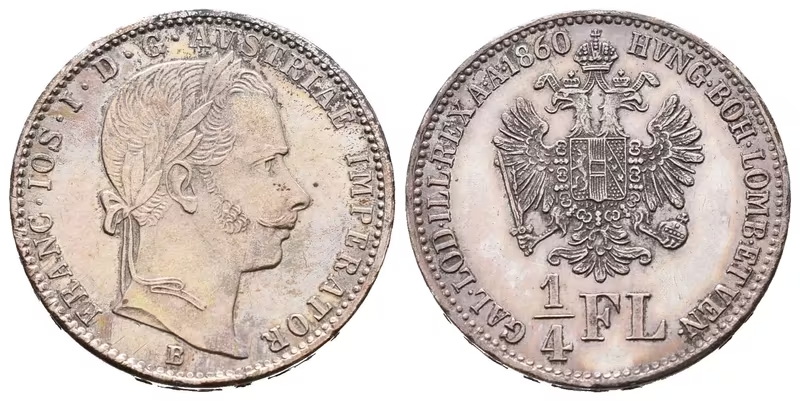
Skladem 1 ks - Code: MA070-1860B
1/4 Zlatník 1860 B
František Josef I. (1848 - 1916) 1/4 Zlatník 1860 B, Kremnica, Ves. 70, velmi pěkná zachovalost, tmavá patina, rysky
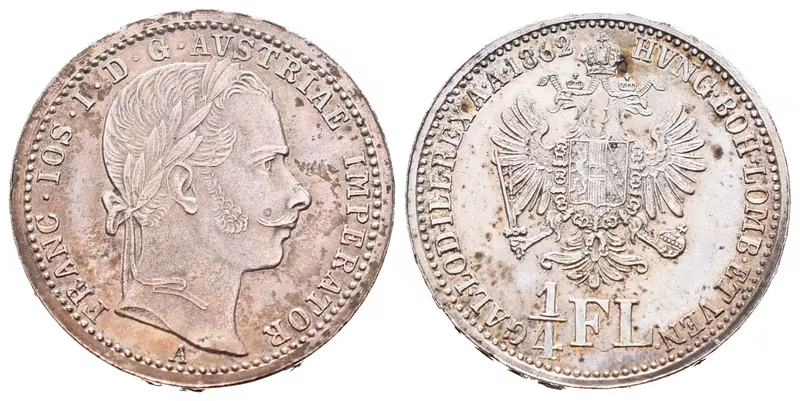
Skladem 1 ks - Code: MA070-1862A
1/4 Zlatník 1862 A
František Josef I. (1848 - 1916) 1/4 Zlatník 1862 A, Ves. 70, velmi pěkná zachovalost, tmavá patina, zbytky lesku, drobné rysky
Skladem 1 ks
Further in the encyclopaedia
More entries in the category typ_mince. Continue browsing or return to the full encyclopaedia.