10 Kreuzer
The 10 kreuzer (ten-kreuzer piece) is a silver coin used in the Czech lands and in the Habsburg Monarchy as a practical 'smaller' means of payment between the lowest values and larger silver denominations. In Bohemia it appeared for the first time in the 16th century under Ferdinand I and was struck again from the middle of the 18th century.
The ten-kreuzer piece asserted itself as a denomination in the Czech lands at a time when the Habsburg administration sought to make monetary circulation clearer and to stabilise it. In Bohemia its introduction is associated with the reign of Ferdinand I and with the period of the so-called gulden currency, when alongside larger values reliable silver coins were also needed in circulation for everyday payments. The ten-kreuzer piece filled an important gap: it was sufficiently 'small' for the ordinary market, but at the same time had a higher value than the smallest strikings, which often wore out quickly and were the most heavily debased in crises.
In Bohemia ten-kreuzer pieces were struck in several important mints. In the 1560s strikings appear from Prague, Kutná Hora and Jáchymov, that is, from the traditional centres of royal coinage where the metal and an experienced background of mintmasters and officials were available. At the turn of the reigns of Ferdinand I and Maximilian II the ten-kreuzer piece became an established part of circulation and in subsequent years it was struck in the Czech mints in repeated series. České Budějovice, which in the early modern period belonged among towns with a significant economic role in southern Bohemia, also joined the circle of local strikings at that time.
For understanding why the striking of the ten-kreuzer piece in Bohemia ceased for a time, the change of the monetary framework is important. In 1573 the gulden currency was again replaced by the thaler currency, which placed greater emphasis on larger silver denominations and their accounting links. In such a situation the ten-kreuzer piece as a transitional coin lost its original meaning in the Czech environment and its striking disappeared for a long time. This did not mean that coins of a similar value ceased to exist, but the Czech tradition of this specific denomination was interrupted and was renewed only much later.
History
The renewal of striking in Bohemia came only under Maria Theresa, when the ten-kreuzer piece reappeared in the Prague mint. The issues of that time fall into several year groups, which was connected with the needs of circulation and with broader reform steps within the Habsburg empire. Later reigns also followed on from the practice: in Prague ten-kreuzer pieces were struck also under Joseph II, further under Francis II and finally still under Ferdinand V, when years from the end of the 1830s are documented for Bohemia. After that the striking of the ten-kreuzer piece in Bohemia was not renewed, which reflects the transformation of the monetary system and the gradual retreat of the older kreuzer denominations in favour of a more modern monetary system.
The ten-kreuzer piece was struck as a silver coin, and its parameters changed slightly over time according to monetary adjustments and the needs of the state treasury. For the Czech strikings of the 16th century a weight in the approximate range of around 3.8 to 4.0 g is given, while with the renewed Prague strikings of the 18th century one encounters a weight of around 3.7 g. In the 19th century, in practice, ten-kreuzer pieces appear with a weight close to 3.8 g, which corresponds to the fact that the denomination sought to maintain a legible place in the system of kreuzer values.
The artistic conception differed according to the period, but maintained a clear royal character. With the oldest Czech strikings from the time of Ferdinand I, royal symbolism is typical: on one side the figure of the ruler with the insignia of power appears, and on the other imperial heraldry, which emphasises the incorporation of the Czech lands into the broader Habsburg and imperial framework. The denomination '10' was distinctly expressed on the coin so that it would be easy to use in ordinary trade and when collecting fees. With later strikings of the 18th and 19th centuries the form naturally changed with the style of the time, but the meaning remained the same: to offer a silver coin of medium small value, which functions well in everyday payments.
Form of the coin and monetary context
In the Czech environment the ten-kreuzer piece is also interesting in that it appears in two distant waves: first in the 16th century in connection with the gulden currency, then after a long pause in the time of Maria Theresa and her successors. This 'double chapter' makes it a denomination on which it is well visible how monetary needs change according to whether emphasis is placed on smaller silver circulation coinage or on larger thaler and later more modern values. At the same time it is a coin that bears a marked trace of specific mints (Prague, Kutná Hora, Jáchymov and others) and thereby also of the economic centres of the Czech lands in various periods.
In our auction and shop
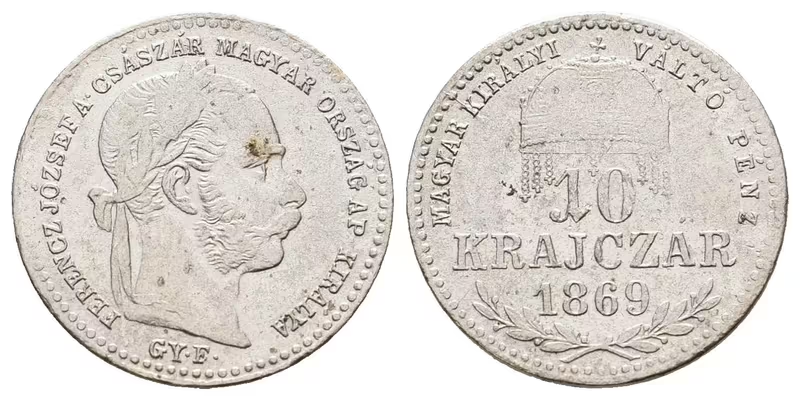
- Code: MA106-1869G
10 Krejcar 1869 GYF
František Josef I. (1848 - 1916) 10 Krejcar 1869 GYF, Ves. 106, oběhová zachovalost
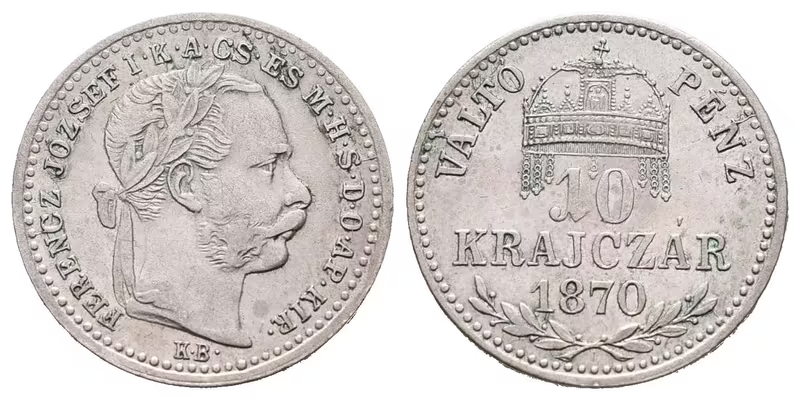
Skladem 1 ks - Code: MA107-1870K.1
10 Krejcar 1870 KB
František Josef I. (1848 - 1916) 10 Krejcar 1870 KB, Ves. 107, velmi pěkná zachovalost, tmavá patina, zbytky lesku, rysky
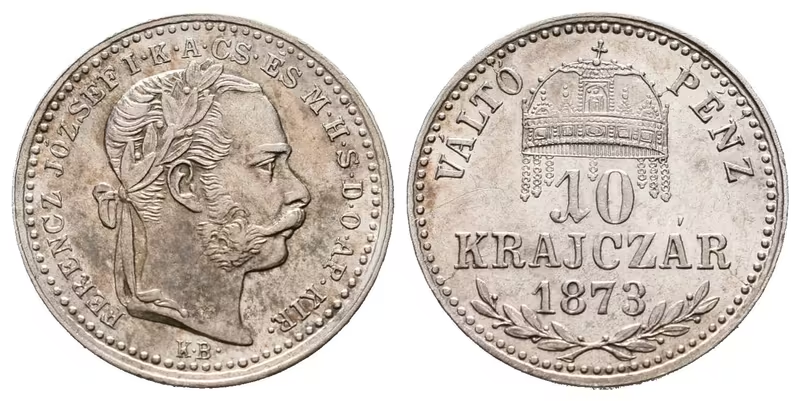
Skladem 1 ks - Code: MA107-1873K
10 Krejcar 1873 KB
František Josef I. (1848 - 1916) 10 Krejcar 1873 KB, Ves. 107, luxusní zachovalost, pěkná patina, lesk, rysky
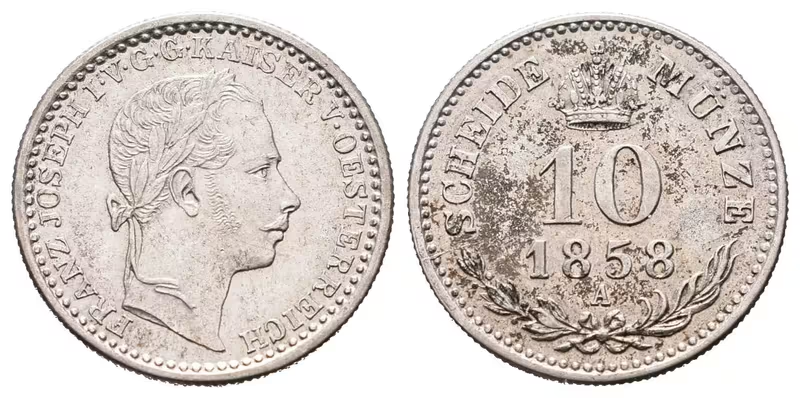
Skladem 1 ks - Code: MA075-1858A
10 Krejcar 1858 A
František Josef I. (1848 - 1916) 10 Krejcar 1858 A - Vídeň, Ves. 75, krásná zachovalost, patina, lesk, nep. rysky
Skladem 1 ks