1000 Koruna
The 1000 koruna (thousand-koruna note) is a high monetary denomination which on our territory long asserted itself above all as a banknote. In history one finds it in several state formations from Austria-Hungary through Czechoslovakia to later issues, always as a means of payment for higher sums.
The 1000 koruna belongs to denominations which play a special role in cash circulation: an ordinary daily purchase is usually not paid with them, but they are practical for settling higher sums, payouts, larger commercial transactions or storing money in cash. It was precisely for this reason that the thousand-koruna note asserted itself on our territory primarily in paper form – a banknote is light, easy to carry and makes it possible to concentrate high value in a small volume.
In the environment of Austria-Hungary the thousand-koruna banknote was issued in 1903 and in the conditions of the time it was an extraordinarily high denomination. It is said that by conversion it represented 304.875 g of silver, which illustrates well the contemporary effort to express the value of large sums in connection with metal currency and its accounting standards. Such a denomination came into circulation in practice rather through the banking and commercial environment than through small everyday payments, and that is also why it is interesting for collectors as a document of the financial culture of the time.
After the founding of Czechoslovakia the 1,000-koruna banknote appeared for the first time in 1919 and subsequently in further issues during the First Republic. The thousand-koruna thus became part of the new state monetary system, which needed to cover both ordinary denominations for broad sections of the population and higher values for trade, offices and banks. High banknotes at the same time also fulfilled a representative function: artistic motifs and the quality of printing were intended to strengthen confidence in the currency and visually to confirm the authority of the state.
History
The development of the 20th century, however, showed that the life of high denominations tends to be sensitive to political upheavals and monetary interventions. The thousand-koruna also appears in the period of the Protectorate of Bohemia and Moravia and likewise in 1945, when monetary circulation again stabilised after the end of the war and the practical side of payments in extraordinary conditions had to be dealt with. It is precisely in such periods that one sees well on banknotes how a currency adapts to reality: sometimes high denominations are maintained because of a shortage of circulating coinage and the need to pay larger sums; at other times they disappear, if the state seeks to simplify circulation or tighten control.
An interesting milestone is the issue prepared for 1951, which however was not put into circulation. The reason was the monetary reform of 1 June 1953: in the new conditions the thousand-koruna would have represented too high a denomination and did not fit into the established structure of circulating coinage. Such 'unrealised' issues are extraordinarily attractive for collectors and historians, because they remind us that banknotes do not arise merely as a finished product in the wallet but pass through a long process of design, approval and political decision.
Another distinct chapter is connected with the year 1985, when a thousand-koruna with motifs of Bedřich Smetana and Vyšehrad was issued (the author of the design was Albín Brunovský). The thousand-koruna thus again joined the distinct banknotes which bear not only a value but also a cultural message: they recall significant personalities and places and at the same time show how the state, through money, tells a story about itself. From the numismatic-notaphilic point of view the thousand-koruna is, thanks to its position as a 'high banknote', often sought after also in preserved conditions, because it typically did not wear down in circulation as quickly as low denominations.
Banknote, use and collector significance
The 1000 koruna behaved in practice differently from small banknotes and coins: it usually circulated among a smaller number of people and was more often used for targeted payments of higher sums. This has two consequences. First, some pieces have survived in very fine preservation, because they were not 'squeezed' for a long time in everyday circulation. Second, greater attention concentrates around thousand-koruna notes when verifying authenticity and condition, because a higher denomination was always more tempting for counterfeiters and for various unprofessional interventions (cleaning, smoothing of folds, repairs of tears).
In collector assessment the greatest role is played by the state of the paper: the number and depth of folds, the cleanness of the surface, sharp corners, any tears and the overall 'freshness' of the print. With banknotes in general it holds that interventions intended to 'beautify' the banknote at first glance may significantly reduce its collector value, even though to a layman the piece appears nicer. Therefore with more valuable banknotes expert assessment and sometimes also certification are often applied, which help to describe unambiguously the condition and any defects.
For thematic collections the thousand-koruna is rewarding because it connects several historical periods: from late Austria-Hungary through the First Republic and the wartime to later issues. The collector may go by years and issues, by artistic motifs or by the 'stories' of banknotes which arose at turning points in history. The thousand-koruna is thus not only a high value on paper, but also a well-legible document of how states, monetary conditions and the aesthetics of Czechoslovak and Czech means of payment changed.
In our auction and shop
- Code: BCSR2CZ036.R88
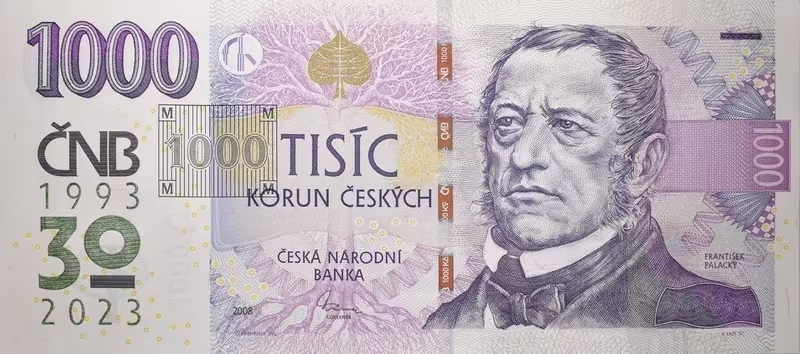
1000 Koruna 2008/2023, série R 88, s pamětním přítiskem 30 let ČNB, 1993-2023
Česká republika, 1993 - 1000 Koruna 2008/2023, série R 88 , s pamětním přítiskem 30 let ČNB 1993-2023 (30 let od měnové odluky) N/UNC
Skladem 1 ks - Code: BC-079CS1-1396
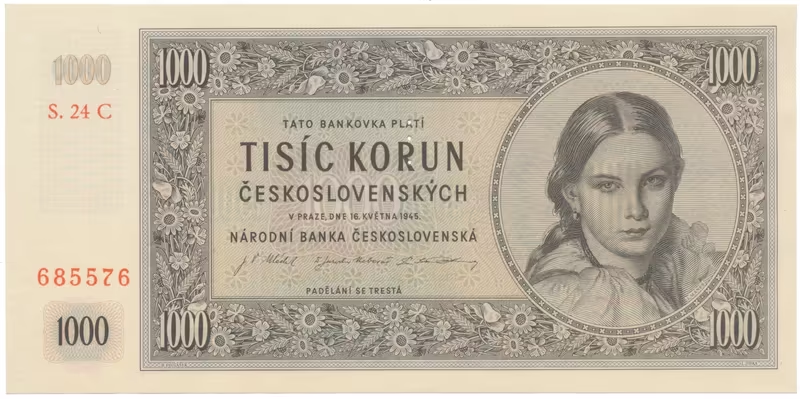
1000 Koruna 1945, II. vydání, série C, perforace 3 m.d., Hej.79aS1
Československo (1945 - 1953) 1000 Koruna 1945, II. vydání, série C, perforace 3 m.d., Hej.79aS1, ilustrační foto N/UNC
Skladem 2 ks - Code: BC-078BS1-1395
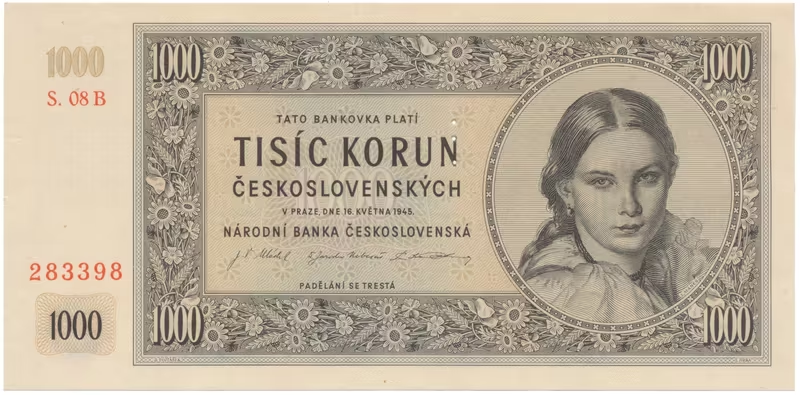
1000 Koruna 1945, I. vydání, série B, perforace 3 m.d., Hej.78bS1
Československo (1945 - 1953) 1000 Koruna 1945, I. vydání, série B, perforace 3 m.d., Hej.78bS1, ilustrační foto N-0/aUNC
Skladem 2 ks - Code: BC-079C-1393
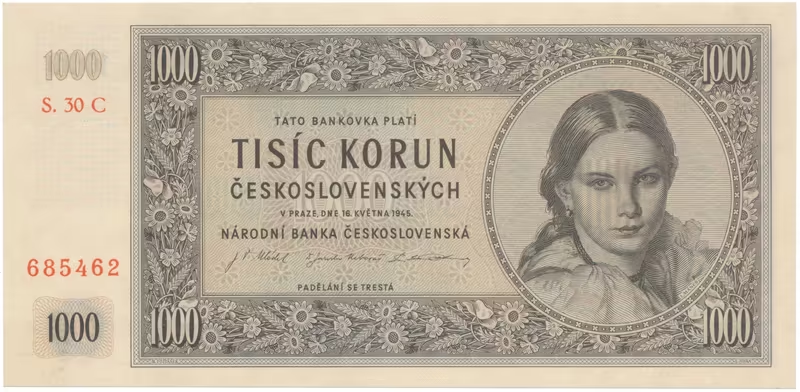
1000 Koruna 1945, II. vydání, série C, Hej.79a
Československo (1945 - 1953) 1000 Koruna 1945, II. vydání, série C, Hej.79c N/UNC
Skladem 1 ks