4 guilder
The 4 guilder is an Austrian gold trade coin introduced in the 19th century as a practical denomination for larger payments and the storage of value. In numismatics it is often referred to also as the "ten-franc", because in its concept it followed the European gold standards of the time.
The 4 guilder came into being at a time when European states were attempting to simplify trade and to facilitate international payments through gold coins with predictable parameters. Austria moved in this logic close to coins of the "franc" type of gold pieces, and the 4 guilder became established also as the "ten-franc" — a popular and collector term emphasising that it was not merely a domestic denomination, but a coin intended also for the wider commercial environment.
According to contemporary regulations the 4 guilder was established by the law of 9 March 1870. Precisely this legislative support is typical of trade coins: by it the state guarantees the parameters and trustworthiness of the issue, so that it can be accepted even outside the narrow framework of a single country. In practice this meant that the coin was to be easily verifiable and "legible gold" was to function as a generally recognised bearer of value.
It is interesting that the mintage of the 4 guilder continued even after the introduction of the koruna currency in 1892. In the numismatic world this is a frequent phenomenon: an older gold denomination does not disappear at once, because there may be demand for it as a reliable trade coin, or as a traditional form of storing value. With the 4 guilder it is moreover reported that with the year 1892 it is being struck at the Vienna mint as a restrike up to the present day, which is essential information for collectors — the date on the coin need not always indicate the actual year of production of a given piece.
History
It is precisely the restrikes that explain why the 4 guilder appears on the market relatively often in fine condition: some pieces were not intended for long circulation, and a number of them were produced with the intention of offering a "classic" type of gold coin in repeated production. For collectors, 4 guilders may therefore have a dual character — either as historical evidence of the gold currency of the 19th century, or as later issues continuing the same type.
The 4 guilder is described as a gold trade coin weighing 3.226 g. In normal practice it was intended for transactions where it made sense to pay in gold, or for longer-term holding. With such coins emphasis was placed on easy checking and trust: gold is indeed resistant to corrosion, but the coin had to be legible, with a clear relief and without interventions that might raise doubts.
For collector assessment the surface and the preservation of the edges are therefore important. Gold is not chemically damaged in circulation, but it is sensitive to mechanical scratches, dents and careless cleaning. With trade coins one moreover often encounters the fact that they were tested or stored in larger numbers, so even small traces of contact with other coins are common.
Parameters, use and collecting context
A practical rule when buying is to distinguish whether the piece is from ordinary historical production or a later restrike. With the 4 guilder this is important precisely because of the long-used year 1892. In a well-managed collection the 4 guilder can then function in a dual way: either as a representative of the Austrian gold currency in the broader European context, or as a typological gold coin collected for its traditional appearance, parameters and popularity on the market.
In our auction and shop
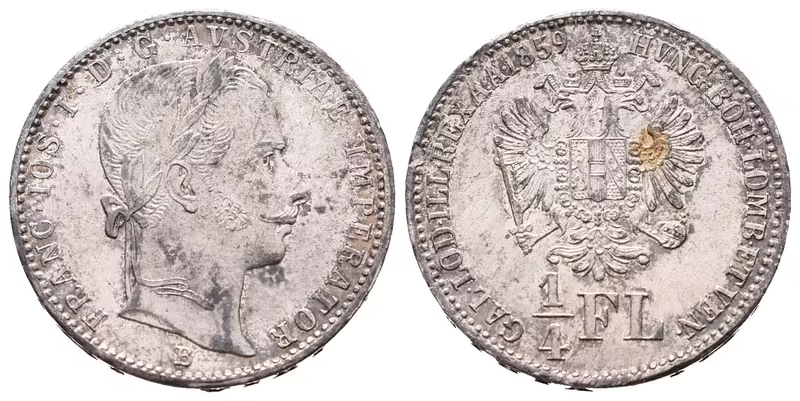
- Code: MA070-1859B.1
1/4 Zlatník 1859 B
František Josef I. (1848 - 1916) 1/4 Zlatník 1859 B, Kremnica, Ves. 70, krásná zachovalost, lesk, tmavá patina, drobné rysky
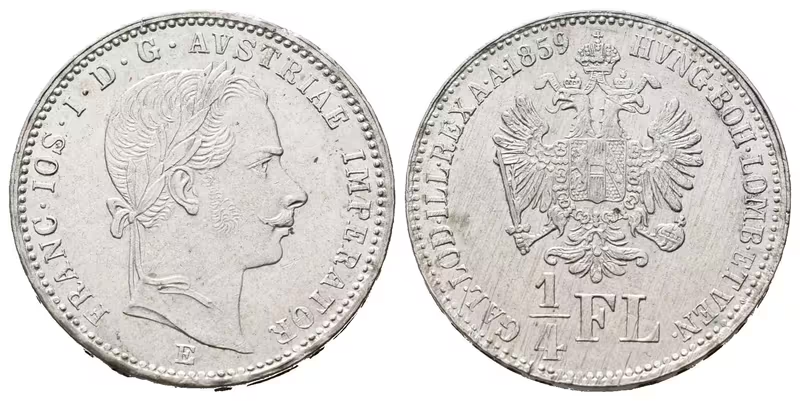
Skladem 1 ks - Code: MA070-1859E
1/4 Zlatník 1859 E
František Josef I. (1848 - 1916) 1/4 Zlatník 1859 E, Karlovský Bělehrad, Ves. 70, krásná zachovalost, patina, zbytky lesku, just.
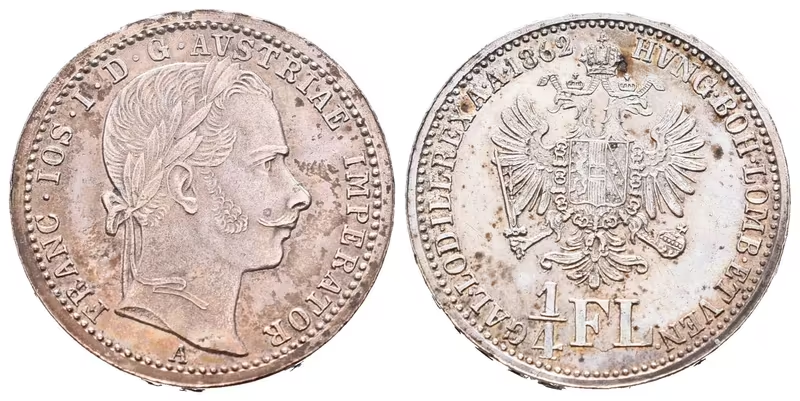
Skladem 1 ks - Code: MA070-1862A
1/4 Zlatník 1862 A
František Josef I. (1848 - 1916) 1/4 Zlatník 1862 A, Ves. 70, velmi pěkná zachovalost, tmavá patina, zbytky lesku, drobné rysky
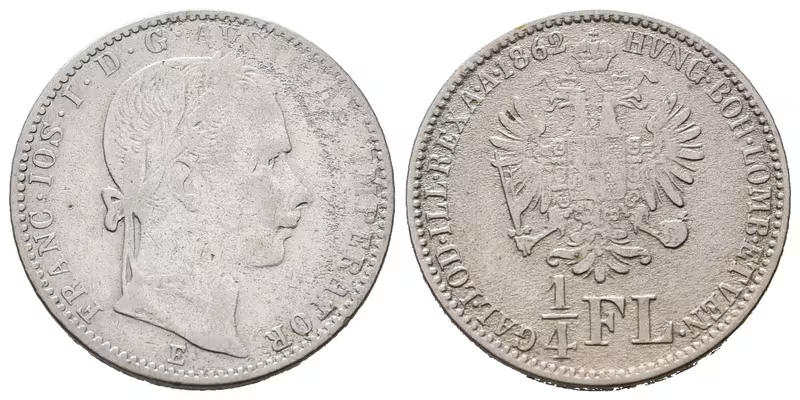
Skladem 1 ks - Code: MA070-1862E
1/4 Zlatník 1862 E
František Josef I. (1848 - 1916) 1/4 Zlatník 1862 E, Karlovský Bělehrad, Ves. 70, oběhová zachovalost_R!
Skladem 1 ks